- Stories at this place
- 1
- Filed as
 History
Story 234
Stones at Kawainui
The Silence and the Basalt: A True Story of Nā Pōhaku o Hauwahine
The wind does not blow softly over Kawainui; it rushes down the steep Koʻolau Pali, sweeping across a thousand acres of emerald-green marsh before it hits the western ridge. If you stand on that ridge on a clear morning, looking out toward Kailua, the town below feels modern, busy, and tethered to the 21st century. But turn around to face the imposing hillside of Puʻu o ʻEhu, and the modern world evaporates.
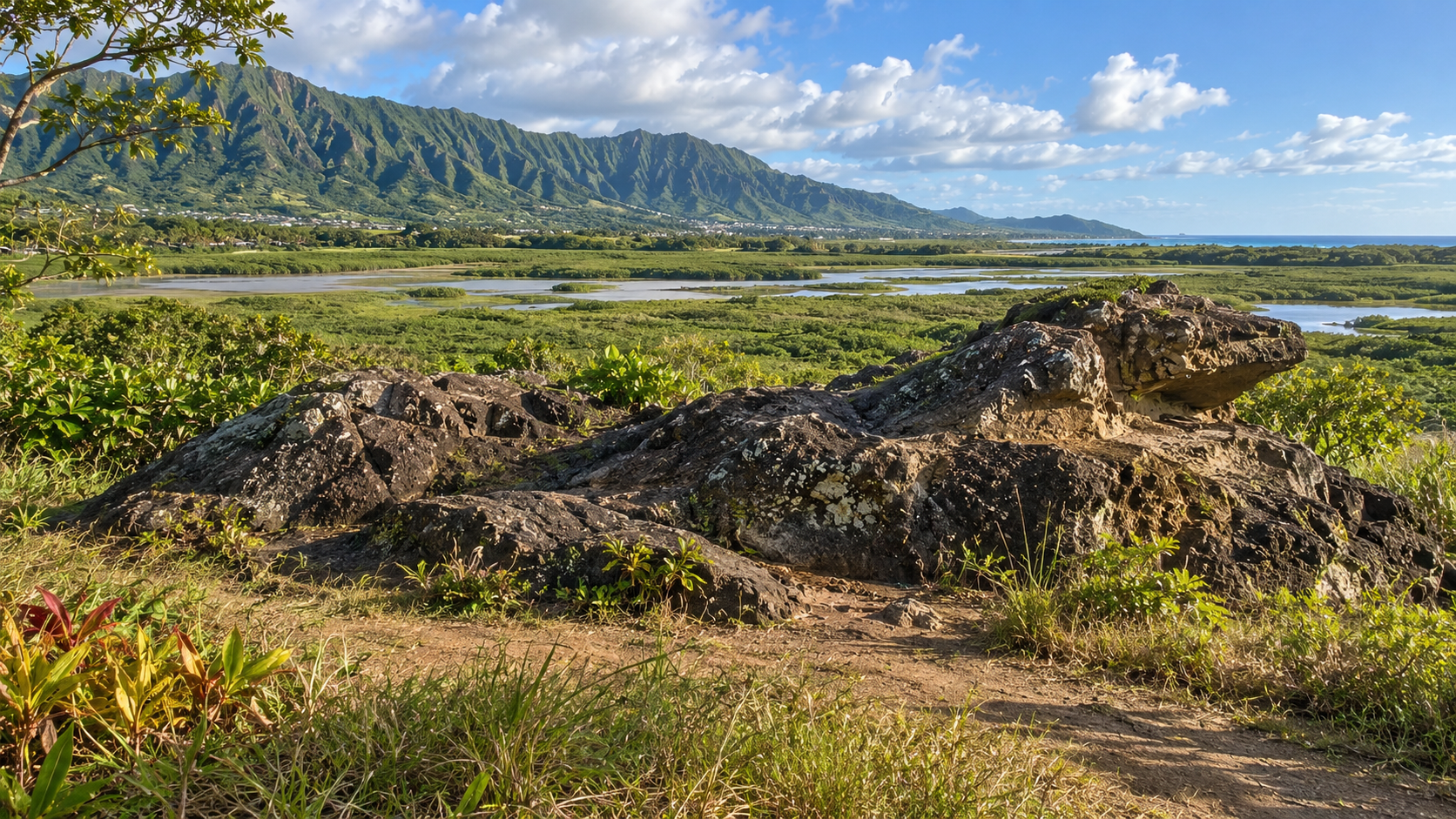
There, perched like silent, watchful sentinels above the wetlands, lie Nā Pōhaku o Hauwahine—the stones of Kawainui.
History and Background: The Heart of Koʻolaupoko
To understand these stones is to understand the lifeblood of ancient Oʻahu. Centuries before European contact, Kawainui was not a marsh, but the largest and most productive traditional freshwater fishpond in the Hawaiian Islands. Formed thousands of years ago when an open marine bay was cut off from the sea by a massive sandbar, it evolved into a vast, nutrient-rich sanctuary.
For pre-contact Hawaiians, Kawainui was a center of political and spiritual power. In the 1700s, Kailua served as the political seat of power for the district of Koʻolaupoko. The surrounding lands fed thousands of people through an intricate, cooperative web of loʻi kalo (taro patches) and aquaculture. The pond was considered male, while its sister pond, Kaʻelepulu, was female.
Yet, the true guardian of this abundant ecosystem was not human. According to Hawaiian moʻolelo (oral history and traditions), Kawainui was protected by Hauwahine, a powerful moʻo—a shape-shifting guardian spirit. Able to take the form of a giant lizard or a human woman, Hauwahine regulated the health and productivity of the waters. When the fish were plentiful and the community respected the land, her presence brought prosperity. When humans grew greedy or careless, the fish would vanish, and the waters would sour.
Overlooking this sacred wetland is a massive basalt outcropping known as Nā Pōhaku o Hauwahine—literally translated as “The Stones of Hauwahine.” Oral history holds that these stones mark a favored resting and dwelling place for the guardian spirit herself, featuring natural rock formations that bear the striking, solemn contours of a lizard’s face.
The True Story: Reclamation from Silence
While the ancient legends stretch back a millennium, the modern history of Nā Pōhaku o Hauwahine is a true story of neglect, ecological degradation, and eventual cultural resurrection.
By the late 19th and early 20th centuries, the arrival of Western land tenure systems fractured the communal stewardship of Kawainui. The ancient taro patches and fishponds were converted into rice paddies, and later, used for cattle ranching. Streams were diverted for plantation agriculture, the native forests on the slopes were cleared, and aggressive invasive species choked out the ecosystem. By the mid-20th century, Kawainui had transformed from a pristine agricultural paradise into an overgrown, forgotten swamp, and the sacred basalt stones on the ridge were surrounded by thickets of alien brush, trash, and neglect.
For a long time, the stones sat in quiet desolation. But history in Hawaiʻi has a way of coming full circle through the persistence of those who remember.
In 1996, the State Department of Land and Natural Resources designated a 12-acre parcel around the outcropping as a public park space, setting the stage for change. Shortly thereafter, a dedicated cultural and environmental organization—ʻAhahui Mālama i ka Lōkahi—took on the heavy, sacred kuleana (responsibility) of restoring Nā Pōhaku o Hauwahine.
What followed was decades of grueling, physical human labor driven by love for the land (aloha ʻāina). Volunteers, cultural practitioners, and community members hauled away mountains of invasive weeds, junk, and albizia trees. Slowly, painstakingly, they cleared the earth around the massive basalt boulders. In place of invasive grasses, they reintroduced over 80 species of endangered native Hawaiian plants, including wiliwili, ʻaʻaliʻi, and native loulu palms, turning the barren hillside back into a thriving dry-mesic forest.
Standing Today
If you visit Nā Pōhaku o Hauwahine today, you are stepping into a living classroom and a spiritual sanctuary.
The stones still sit heavy and unmoving against the skyline, weathered by centuries of salt air and tropical rain. From their perch, you can look out across the vast, sweeping expanse of Kawainui Marsh—now recognized internationally as a Ramsar Wetland of Importance. The frantic hum of Kailua traffic fades into the background, replaced by the sharp call of native waterbirds like the ʻalae ʻula (Hawaiian moorhen) stepping carefully through the reeds.
The true story of the stones at Kawainui is not just about geology or ancient folklore; it is a testament to resilience. It proves that while environments can be disrupted and sacred histories temporarily buried under the weight of “progress,” the deep cultural memory of a place can be revived through community hands—restoring the balance between the people, the land, and the silent guardians watching from the hill.