- Stories at this place
- 1
- Filed as
 Hawaiian Folklore
Story 1245
The Sacred Lore of the Pueo and Mānoa’s Ua Tuahine
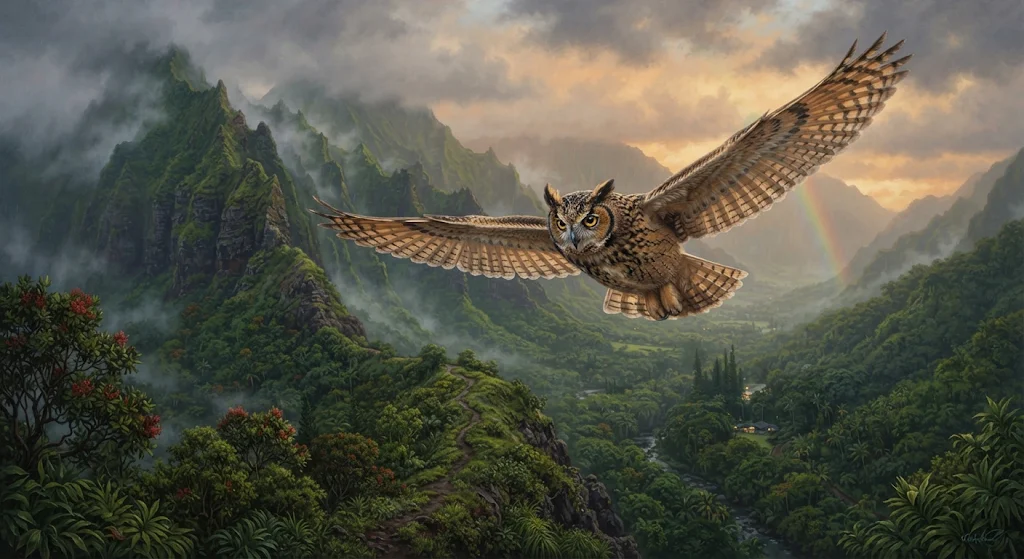
In Hawaiian tradition, the pueo (the endemic Hawaiian short-eared owl) and the Ua Tuahine (the famous mist-rain of Mānoa) are deeply woven into the spiritual geography of Oʻahu—and in traditional moʻolelo (stories and legends), their lore actually intersects directly in Mānoa Valley.
The Pueo as an ʻAumakua
In Native Hawaiian cosmology, an ʻaumakua is a deified family ancestor who takes the physical form (kino lau) of an animal, plant, or natural phenomenon to watch over, guide, and protect living descendants. Among the most revered ʻaumākua across the islands, the pueo holds a distinct place:
-
Daylight Watcher & Guide: Unlike the introduced barn owl, the native pueo (Asio flammeus sandwichensis) is diurnal—hunting in broad daylight and at dusk across ridges, valleys, and open grasslands. Because people frequently saw the pueo gliding silently overhead during the day, seeing one cross your path, hover in place, or fly ahead along a trail was traditionally interpreted as a direct message from an ancestor—either offering reassurance or warning of unseen danger ahead.
-
Protector of Souls & Warriors: Known in ancient chants as ka pueo kani kaua (“the owl that sings of war”), the pueo was believed to guide defeated warriors safely out of treacherous terrain and lead wandering or lost spirits back to the right path. Even the deity Kāne was said to take the form of an owl to shield his people in battle.
-
The Battle of the Owls (Kapoʻi & Puʻu Pueo): One of Oʻahu’s most famous pueo legends centers on a man named Kapoʻi, who found a nest of owl eggs while gathering pili grass near Honolulu and returned them to their mother. In gratitude, the owl became his guardian and instructed him to build a small heiau (temple). When the high chief Kākuhihewa ordered Kapoʻi executed for building an unauthorized temple, Kapoʻi’s guardian flew to Puʻu Pueo (“Owl Hill”) in Mānoa Valley—home of the owl king—and summoned pueo from every island. Thousands of owls darkened the skies over Waikīkī and Kūkaniloko, attacking the warriors until Kapoʻi was freed.
The Legend of Ua Tuahine & Mānoa Valley
In traditional Hawaiian weather lore, rains are not generic weather events—every valley has named rains with distinct personalities, origins, and genealogies. Ua Tuahine (also written Ua Kuahine, meaning “Sister Rain”) is the signature fine, misty rain that drifts down from the Koʻolau cliffs at the back of Mānoa Valley.
According to Mānoa’s foundational moʻolelo, the rain and wind of the valley are living ancestors of the land:
-
The Elemental Parents of Kahalaopuna: The story begins on the high ridge behind Mānoa with ʻAkaʻaka (a projecting mountain spur) and his wife Nālehuaʻakaʻaka (the red ʻōhiʻa lehua blossoms growing on that ridge). Their twin children became the elemental forces of the valley: Kahaukani, the gentle wind of Mānoa, and Kauakuahine (Ua Tuahine), the soft mountain rain.
-
The Rainbow Maiden: Together, the wind and the mist-rain gave birth to Kahalaopuna, a chiefess of extraordinary beauty who was constantly accompanied by a radiant rainbow arching over Mānoa wherever she walked. Today, when sunlight strikes the fine Ua Tuahine mist drifting down the valley, the resulting rainbows are still remembered as a living sign of Kahalaopuna and her parents watching over the valley.
-
Where the Two Legends Meet: In the tragic moʻolelo of Kahalaopuna, her jealous fiancé Kauhi falsely accuses her of infidelity and repeatedly leads her into the mountains to murder and bury her. Each time, Kahalaopuna’s family ʻaumakua—a great pueo from Puʻu Pueo in Mānoa—follows them up the ridge, scratches away the earth and leaves with its talons, and revives her by rubbing its soft feathers against her temples.
Visual Exploration
Watching the pueo in flight and seeing how mist moves across the Koʻolau ridges above Mānoa brings the physical setting of these legends into sharper focus.