- Stories at this place
- 1
- Filed as
 History
Story 978
Dracula’s Castle Fact VS Folklore
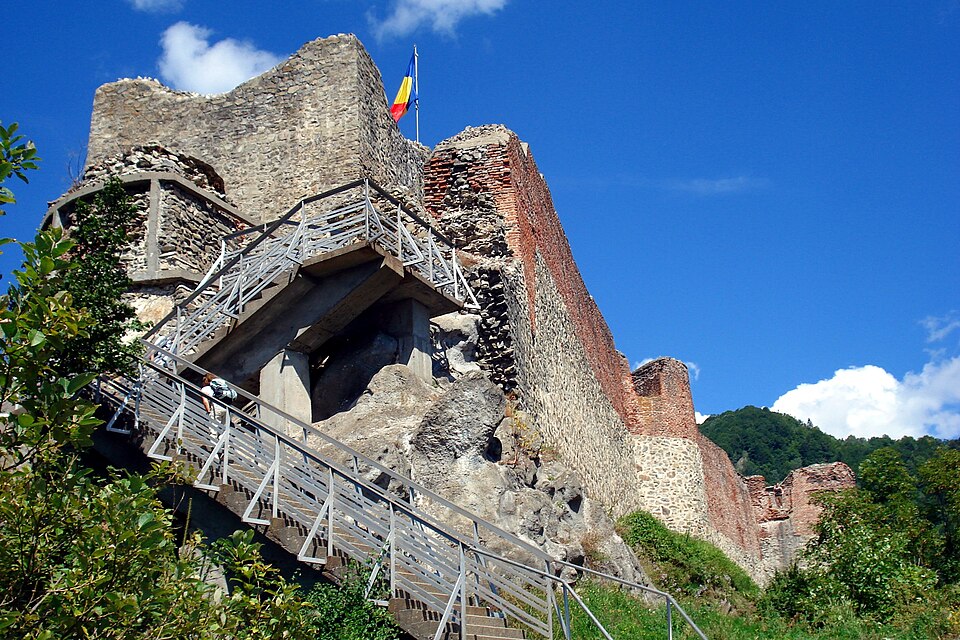
The fog clinging to the Carpathian peaks does not merely obscure the landscape; it guards it. High above the roaring waters of the Argeș River, the stone ramparts of Poenari Castle—the true historical fortress of Vlad the Impaler—stand like jagged teeth against the twilight sky. To reach them, one must ascend 1,480 stone steps carved into the spine of the mountain, a punishing climb that feels less like a trek and more like a deliberate trial imposed by the shadows.
History and Background
The legend of Dracula’s castle is a fascinating tapestry woven from medieval warfare, Gothic literature, and clever marketing. In reality, two very different fortresses dominate the Romanian landscape when the name “Dracula” is invoked:
- Poenari Castle (The True Fortress): Perched in the Wallachian mountains, this citadel was originally built in the early 13th century. In the 15th century, Vlad III Dracula (Vlad the Impaler) recognized its strategic, isolated perch and heavily reinforced it using forced labor. It served as his genuine stronghold and a grim refuge during the Ottoman invasions.
- Bran Castle (The Tourist Icon): Located near Brașov, Bran Castle is widely marketed as “Dracula’s Castle” due to its dramatic Gothic silhouette matching Bram Stoker’s fictional descriptions. However, Vlad the Impaler likely never lived there, and his connection to it is limited to a brief imprisonment or passing campaigns.
In Bram Stoker’s 1897 novel, the fictional count’s castle is described as being built on the edge of a terrific precipice, where the dark waters of a river roar far below—a vivid description that mirrors the harrowing reality of Poenari.
A Story of Stone and Shadow
The wind howled through the arrow slits of the crumbling keep, carrying the scent of damp earth and ancient pine. centuries ago, those same gusts had carried the screams of invading armies and the clank of heavy iron chains.
Vlad stood at the edge of the parapet, his dark cloak snapping in the mountain gale. Below him, the valley vanished into an abyss of absolute black. He had built this fortress not merely for defense, but as a monument to defiance. Every block of granite had been hauled up the sheer cliff face by men who knew that failure meant the stake. He stared into the darkness, listening to the river churn against the rocks a thousand feet below.
Locals in the villages far down in the valley whispered that the mountain itself remembered the blood spilled upon its slopes. They said that when the moon was hidden and the mist rolled thick through the gorge, the stones of the citadel seemed to breathe, whispering warnings to anyone foolish enough to seek out the secrets of the Impaler.
As the centuries turned, the walls crumbled and the roof fell in, yielding the fortress to the elements and the ghosts of history. Yet, even in ruin, the castle retains an undeniable gravity—a brooding sentinel watching over the Carpathian wilderness, daring the modern world to forget the terror that once reigned upon its peak.