- Stories at this place
- 1
- Filed as
 Apparition
Story 1341
The Ghost of the Flamingo
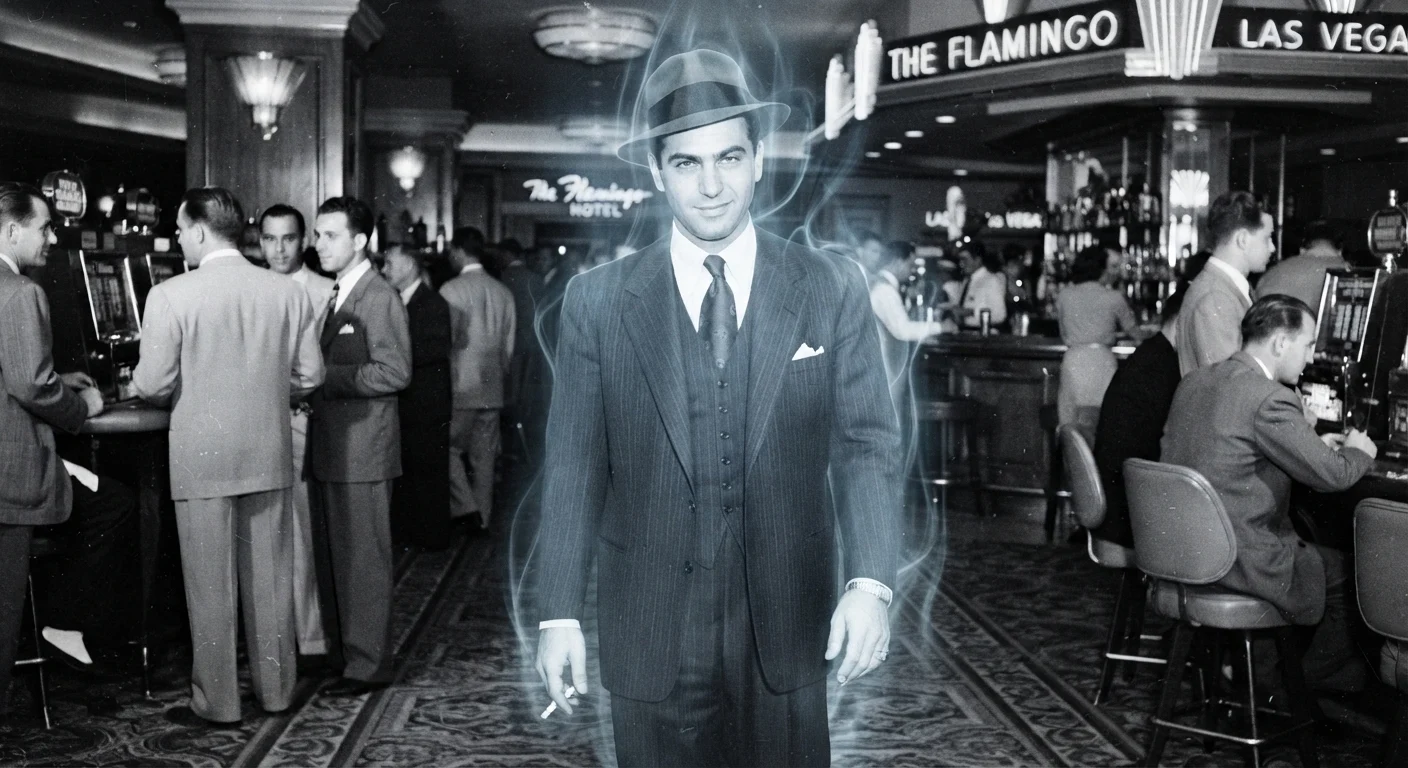
When Benjamin “Bugsy” Siegel opened The Flamingo on December 26, 1946, he wasn’t building a hotel—he was building a fortress. His private third-floor suite had steel-lined walls, bulletproof glass, and a hidden trapdoor leading to a ladder that dropped straight down into the garage. Siegel knew his New York partners wanted their six million dollars back, and he knew what happened to men who came up short. On June 20, 1947, a sniper fired a .30-caliber carbine through the living room window of a Beverly Hills mansion, hitting Siegel in the head and chest. Yet on the Las Vegas Strip, long after the original 1946 building was torn down in 1993, graveyard-shift workers still swear the man who built the place never checked out.
The Flamingo doesn’t sleep, not really, but between three and four in the morning, the noise drains out of the courtyard like water down a sink. The pool speakers cut off. The waterfall slows to a trickle. Out by the wildlife habitat, the only sound is the high, electric buzz of the pink neon signs baking in the desert heat.
Elena had worked overnight housekeeping at the resort for six years, and she had one hard rule: never cut through the garden path behind the wedding chapel after 3:00 a.m.
That Tuesday, a burst pipe on the ground floor forced her to take the outside walkway with her supply cart. The heavy rubber wheels rattled over the stone pavers, echoing off the empty stucco walls. Halfway past the chapel, the front wheel jammed against a crack in the stone.
Elena bent down to yank it free—and stopped.
The air around her ankles had gone dead cold. Not air-conditioning cold, and not the dry chill of a winter desert night, but the damp, heavy cold of an unlit basement. Above her, the pink glow of the neon sign flickered once, twice, and dimmed to a dull bruise.
Click. Click. Click.
Hard leather heels struck the stone path behind her. Slow. Measured. Unhurried.
Elena straightened up slowly, her fingers tightening around the metal handle of her cart. “Security?” she called out. Her voice sounded thin, swallowed instantly by the palms.
No one answered. The footsteps kept coming, closing the distance between them until they stopped no more than six feet behind her back.
She turned around.
A man was standing in the middle of the walkway where the shadow of the old Oregon Building used to fall. He wore a heavy, double-breasted dark suit cut in a style fifty years out of date, a stark white shirt buttoned to the collar, and black wingtips that gleamed under the weak garden lights. His hair was jet-black and slicked straight back, and his pale-blue eyes were locked onto the towering glass wall of the modern hotel above them.
His jaw was clenched so hard a muscle jumped beneath his cheek. Slowly, his gaze dropped from the upper floors down to Elena.
He didn’t blink, and he didn’t make a sound. Up close, the left side of his face was slicked dark in the dim neon light, his collar soaked through as though he had just stepped out of a rainstorm—except the pavers beneath his shoes were bone dry, and the sharp, metallic stench of fresh blood and cordite rolled off him in waves.
Elena tried to step backward, her heel hitting the lower tray of her cart. Her throat locked shut.
The man didn’t speak. Instead, he raised one trembling, dark-stained hand and pointed stiffly toward the blank stucco wall where the old exterior stairs to his private suite had once stood. His eyes bore into hers, wide and frantic, before he motioned sharply downward toward the ground—as if trying to show her a trapdoor and a garage that hadn’t existed for thirty years.
Elena couldn’t breathe. She bolted, abandoning the cart, her sneakers slipping on the slick stone as she sprinted toward the glass casino doors. Behind her, the heavy footsteps didn’t run—they kept that exact same slow, steady pace, right at her heels, the freezing air clinging to the back of her neck until she slammed through the automatic doors into the bright, noisy glare of the slot floor.
When security walked back out to retrieve her cart ten minutes later, the pink neon was burning bright again and the courtyard thermometer read eighty-nine degrees.
Except for the stone pavers where the man had stood—which were covered in a thin, glistening layer of frost, with two wet, dark footprints leading straight into the solid brick wall of the chapel.