- Stories at this place
- 1
- Filed as
 Haunted Places
Story 1356
Ogden Exchange Building
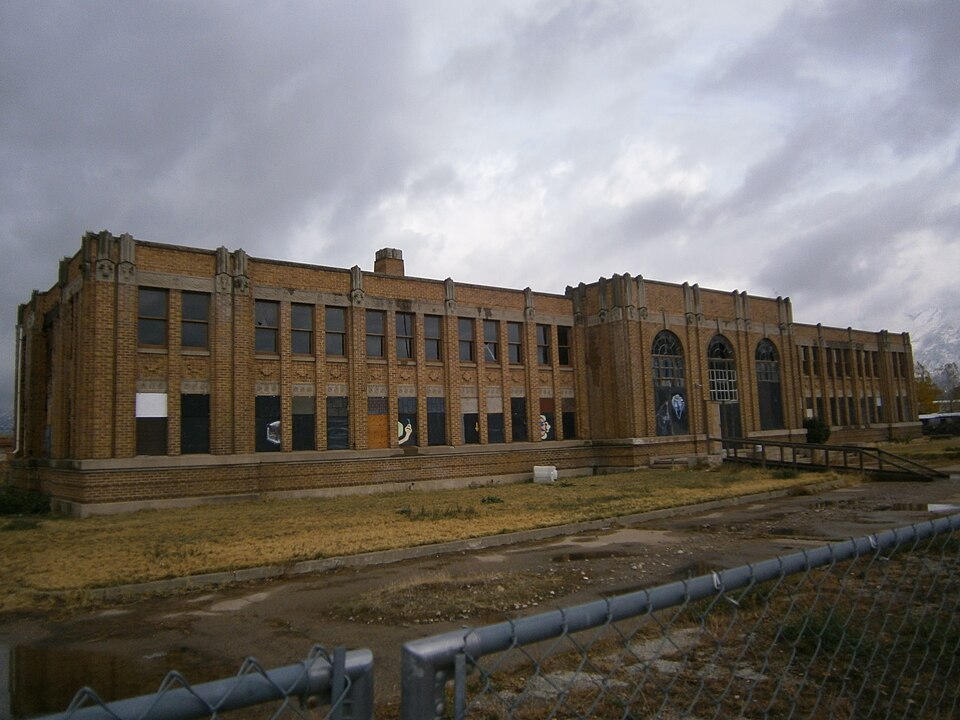
The air around Exchange Road in western Ogden has always smelled faintly of old iron, dried mud, and something deep down that the earth refuses to digest. Standing off 600 Exchange Road is the historic Ogden Union Stockyard Exchange Building.
Marcus was a local historian foolish enough to take a nighttime walkthrough of the fenced-off property in late October. Armed with a high-powered flashlight and a digital voice recorder, he wanted to capture the ambient echoes of the old Art Deco ruin before urban renewal projects swallowed the remaining footprint.
The building loomed against the pale moonlight like a concrete tombstone. Its geometric Aztec-style pilasters and decorative brickwork, once meant to project modern corporate prestige, now looked like jagged teeth biting into the night sky.
“Testing, testing. October sixteenth,” Marcus whispered into his recorder. “Initial sweep of the ground floor lobby. Structural integrity is heavily compromised, but the 1931 detailing is still visible.”
He swept his flashlight beam across the walls. The shadows danced weirdly, twisting against the faded pastel paint. That was when he smelled it—not the crisp autumn air of Weber County, but a thick, sickening wave of wet wool, copper, and warm, unwashed animal musk. It was the suffocating stench of a live, claustrophobic slaughterhouse pen.
Marcus coughed, waving a hand in front of his face. “Must be mold trapped in the ventilation,” he muttered, though his chest tightened with a sudden, irrational panic.
He decided to head down toward the basement—the historic site of the old Exchange Café. The stairwell yawned downward into pitch-blackness, swallowing his flashlight beam as if the dark had physical weight.
Clack. Clack-clack. Clack.
Marcus froze, his boot hovering over the next step. Down in the darkness, echoing from the old concrete basement corridors, came the distinct sound of heavy, split-hoofed stamping. Intermingled with the rhythmic clacking was a low, vibrating murmur—thousands of low, guttural throats rumbling in unison, mixed with the dry, rasping sound of heavy iron gates dragging across a concrete floor.
“Hello?” Marcus called out, his voice cracking against the damp walls. “Who’s there? City property, you shouldn’t be in here.”
The rumbling stopped. Silence fell, absolute and suffocating.
Marcus let out a nervous laugh, raising his flashlight. He stepped off the last stair into the basement cellar. The beam cut through the gloom, sweeping past crumbling brick partitions and empty, rusted structural beams.
Then, his light hit the far wall.
There were no doors down here, only blank foundation concrete and bricked-over service arches. But the concrete was scarred. Gouged deep into the ancient masonry were thousands of jagged, frantic scratch marks—millions of them, crisscrossing in chaotic despair, reaching waist-high, chest-high, and higher still, as if something massive had clawed endlessly at the walls trying to escape a fire that never came.
And the floor was wet.
Marcus lowered his beam. A dark, thick, viscous fluid was slowly pooling around the toes of his boots, leaking out from the cracks in the foundation. It wasn’t water. It was far too heavy, far too dark, gleaming slick and black under the harsh LED light.
He lifted his hand to his nose. His fingers came away sticky, slick with iron.
Thud.
A heavy impact slammed against the brick wall directly behind him, so close it rattled his teeth. Marcus spun around, dropping his flashlight. The beam rolled across the floor, pointing upward, casting long, monstrous, elongated shadows against the ceiling.
In the erratic light, the shadows didn’t match his own. They were towering, multi-horned, hulking silhouettes with broad, heavy shoulders and wide, sweeping racks of bone, crowding into the narrow basement corridor. They shifted and breathed with a terrifying, rhythmic heave.
Marcus opened his mouth to scream, but the air was suddenly sucked from his lungs, replaced entirely by the suffocating weight of a thousand suffocating beasts pressing inward from the dark.
Out in the quiet Ogden night, the wind howled through the skeletal remains of the stockyards. Inside the Exchange Building, a lone digital recorder lay half-submerged in the dark, pooling floor, picking up the clear, distinct sound of a heavy steel gate unlatching—followed by the heavy, echoing stamp of a thousand hooves marching up toward the grand lobby.