- Stories at this place
- 1
- Filed as
 Roads
Story 1351
Horror on Hwy 95
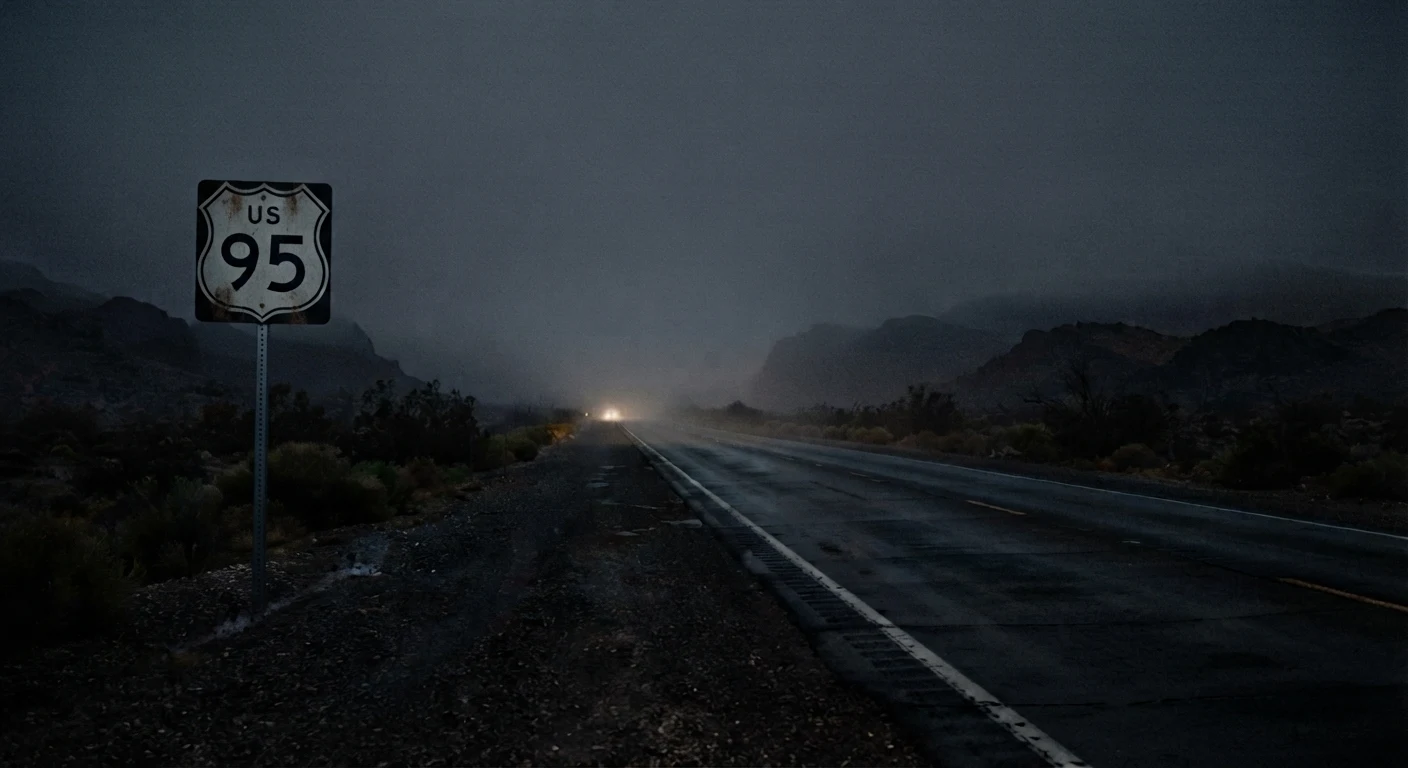
There’s a specific kind of quiet out in the Nevada desert in the middle of the night. It’s not a peaceful quiet. It’s a heavy, suffocating silence that makes you feel like you’re the last person left on earth.
If you’ve ever driven the stretch between Carson City and Las Vegas, you know exactly what I’m talking about. Once you leave Carson City behind and head south onto US Route 95, it’s hundreds of miles of mostly nothing. No streetlights. Long stretches with zero cell service. Just a dark ribbon of asphalt cutting through high-elevation sagebrush.
This happened to me about four years ago, on the Sunday night after Thanksgiving. I was twenty-six at the time, driving my mom’s Honda Pilot south to Vegas from Carson City. My little sister, Mia, who was twelve, was asleep in the passenger seat. We had spent the holiday with our dad, and I had a work shift the next afternoon, so we pulled out of Carson City right around 9:45 PM to push through the night.
At first, everything was fine. It was actually a really cozy drive. Outside, the temperature had dropped into the twenties, so I had the heater blasting, cruise control set to 75, and a podcast playing low. Mia was curled up under a fleece blanket, totally knocked out. We were in our own safe, warm little bubble moving through the dark.
Around 1:15 AM, just a few miles north of Tonopah, my gas light dinged.
I wasn’t panicked, because I knew Tonopah was right at the halfway mark—about three and a half hours into the drive—and out in Esmeralda and Nye counties, you don’t push your luck with an empty tank. At 1:25 AM, the bright canopy lights of a 24-hour travel stop appeared like a beacon against the black desert sky.
I pulled up to one of the outer pumps, away from the semi-trucks idling on the diesel side. The place was quiet at that hour. Inside, through the glass, I could see a night-shift clerk behind the counter stocking cigarette cartons.
I parked, turned off the engine, and stepped out into the biting, freezing air.
As I swiped my card at the pump, Mia woke up, rubbed her eyes, and said she needed to use the restroom. I told her to be quick and wait for me by the register. She wrapped her blanket around her shoulders and jogged toward the entrance.
While the gas was pumping, I walked over to the squeegee bucket to clear a layer of road salt and desert grime off the windshield. That’s when I noticed him.
Standing near the side of the building, half-shadowed by the ice chest and propane cage, was a man.
He was maybe in his forties, wearing a heavy, stained canvas work jacket with the collar turned up against the cold. The only reason I caught sight of him was because the cherry of his cigarette flared in the dark. He wasn’t walking toward a semi-truck. He wasn’t looking at his phone. He was just staring directly across the lot at my SUV.
It gave me a weird, prickling sensation on the back of my neck. Still, it’s easy to rationalize things when you’re tired. Tonopah is a trucking hub. People take smoke breaks at all hours. I told myself I was just being paranoid.
The pump clicked off. I hung the nozzle back up, screwed the gas cap on, and went inside to grab a couple of energy drinks and meet Mia. When we walked back out to the Pilot at 1:40 AM, I glanced over toward the ice chest.
The man was gone.
Just an empty patch of concrete and a crushed cigarette butt still faintly smoking in the cold air. I felt a wave of relief. Mia climbed into the front seat, I got in, hit the power lock button out of habit, and pulled back onto US-95 heading south.
For the next forty-five minutes, continuing south past the old mining town of Goldfield, we fell right back into our routine. Mia went back to sleep. I cracked my window just a fraction of an inch to keep from getting drowsy, opened my energy drink, and turned my podcast back up. Tonopah was already more than fifty miles behind us.
By 2:25 AM, though, I started noticing little things.
First, it was a smell—a faint, stale trace of cheap tobacco and damp wool. I sniffed my own sleeve, thinking maybe the smoke from the guy outside had clung to my jacket when I stood near the building. I brushed it off.
Ten minutes later, around 2:35 AM, I reached up to adjust the rearview mirror. It was angled slightly downward, pointed more toward the back bench than the rear glass. I didn’t remember bumping it, though I figured I might have knocked it off-center while reaching across the dash earlier.
I tilted it back up and kept driving.
Mile after mile of empty two-lane desert stretched south toward Beatty, roughly an hour and a half past Tonopah. The silence inside the cabin stretched on, rhythmic and hypnotic.
At 2:55 AM, Mia shifted in her seat and turned around to look into the back of the SUV. We had the third row folded down flat to fit our suitcases and Thanksgiving leftovers, all covered with a heavy quilted moving blanket.
“Did you leave the back window cracked?” she asked, her voice groggy.
“No,” I said, keeping my eyes on the road ahead. “Just mine, a tiny bit. Why?”
“There’s a draft coming from the trunk,” she murmured. “It’s freezing back here.”
I frowned. The dash vents were still blowing hot air. “Just pull your fleece up.”
She didn’t turn back around. She stayed kneeling on the passenger seat, peering over the second row into the dark cargo area. I glanced over at her. Even in the dim green glow of the dashboard, I could see all the color drain out of her face. She went completely rigid.
“Mia?” I asked.
She slowly turned her head back toward me, tears pooling in her eyes. She leaned across the center console, bringing her mouth right up to my ear so she barely had to make a sound.
Her voice was a shaky whisper.
“There’s someone breathing under the moving blanket.”
The bottom fell out of my stomach. The air in my lungs turned to ice.
Every tiny, off-kilter detail from the last hour and fifteen minutes slammed together all at once. Leaving the doors unlocked while I walked inside the store at 1:30 AM. The rear liftgate latch not being fully clicked shut—which was why cold air was seeping into the back. The man disappearing from the ice chest. The smell of stale smoke in the cabin. The bumped rearview mirror.
While I was inside paying for energy drinks, he hadn’t walked away. He had slipped behind the SUV, quietly pulled the liftgate open, climbed into the cargo area, and pulled the moving blanket over himself—leaving the hatch just slightly unlatched so it wouldn’t make a loud clunk when closing. He had been lying motionless in the dark, inches behind us, for nearly eighty miles.
I kept my eyes locked on the white lines of the highway ahead. I forced myself not to slam on the brakes. If I stopped in the middle of nowhere with no cell reception, we wouldn’t survive.
“Okay,” I whispered back, fighting to keep the sheer panic out of my voice. “Keep your seatbelt buckled tight. Don’t take it off, no matter what.”
I heard her fingers trembling against the buckle as she checked it.
Slowly, against every instinct screaming at me not to look, I flicked my eyes up to the rearview mirror.
The faint ambient light from the dashboard reached just far enough into the back of the cabin.
Behind the second row of seats, the quilted moving blanket was rising.
A weathered hand reached out, gripping the top of the headrest directly behind Mia. Then, a dark silhouette slowly sat up in the cargo space.
It was the man from the gas station.
He didn’t say a word. He just knelt there in the dark behind us, staring straight at the back of my head—and in his right hand, catching the faint green glow of the instrument cluster, was the dull metallic glint of a blade.
For a split second, neither of us breathed. He hadn’t realized Mia had seen him, and he was waiting for the right moment to lunge over the middle row.
I didn’t give him the chance.
Ahead, a reflective yellow curve sign flashed in my high beams as US-95 began winding down through the canyon just north of Beatty. In the distance, the faint, warm glow of town lights finally broke the pitch-black horizon.
“Hold onto the dash,” I hissed.
Without touching the brakes, I floored the gas pedal, pushing the Pilot past ninety, and then jerked the wheel hard to the left, throwing the heavy SUV into a violent swerve across the empty southbound lane before snapping it back to the right.
The sudden lateral force threw him off balance. Without a seatbelt, his body slammed hard against the driver’s-side rear window, the knife clattering onto the plastic wheel well as he cursed and scrambled to catch himself on the second-row seats.
Before he could recover, I crested the last hill into Beatty just after 3:05 AM. The giant, neon-lit sign of Eddie World—the massive 24-hour travel center at the north end of town—lit up the night like a stadium, with a dozen cars and semi-trucks parked under its bright canopy.
I aimed straight for the front doors, laying on the horn with my left hand while my right hand gripped the wheel. The blaring horn echoed off the canyon walls, turning heads across the parking lot.
I skidded to a halt right under the brightest lights in front of the main entrance, slammed the gearshift into park, and hit the unlock button.
“Run! Inside, now!” I screamed.
Mia threw her door open and bolted toward the glass doors, screaming for help, with me right behind her. Out of the corner of my eye, I saw the rear liftgate fly open on the driver’s side—he wasn’t coming after us; he was sprinting blindly out toward the dark desert scrub behind the station.
Within seconds, two truckers and the night manager rushed out to surround us while someone dialed 911. Nye County deputies arrived fifteen minutes later, and when they searched the back of my mom’s SUV, they found a hunting knife wedged between the folded third-row seats and a pack of cheap cigarettes in the cargo tray.
They caught him hiding in a drainage culvert less than a mile south of town just before sunrise at 6:30 AM.
Needless to say, Mia and I never made it to Las Vegas that morning—and to this day, no matter how quick the stop is, I never walk away from my car without hitting the lock button twice.