- Stories at this place
- 1
- Filed as
 Haunted Places
Story 1333
The Cursed Pyramid
You don’t realize how unnatural a 39-degree wall feels until you’re standing inside one at three in the morning.
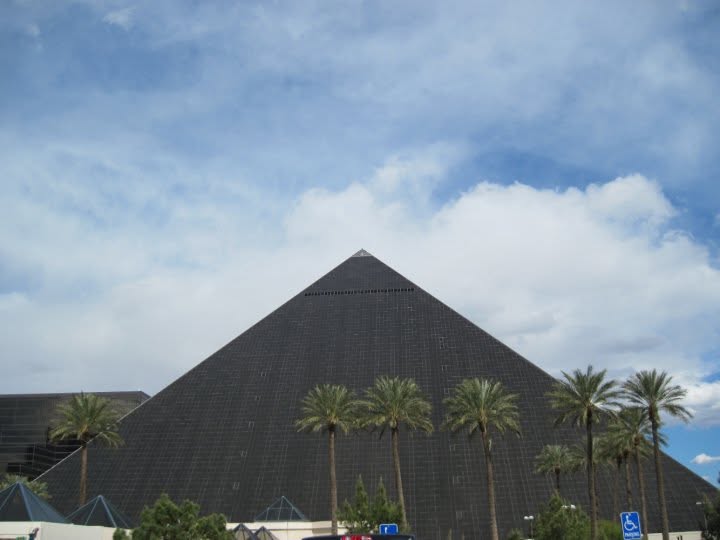
From the outside, rising thirty stories out of the Mojave heat at the southern edge of the Las Vegas Strip, the Luxor looks like an obsidian monolith dropped onto a neon stage. They threw it together in a frantic eighteen-month sprint—$375 million of black glass and steel rushed to completion in October 1993—and blasted a blinding beam of light straight into the desert sky. I checked in thinking it would be kitschy, just another themed resort where tourists lose twenty dollars at blackjack before catching a buffet. By the second night, I understood why locals call it the Cursed Pyramid.
The wrongness starts with the architecture itself. The builders didn’t just copy the silhouette of Giza; they imported its funerary geometry without any of the ancient rites meant to seal the dead inside. In Egyptian cosmology, a true pyramid is a benben—a petrified ray of the sun built as a resurrection machine to launch a pharaoh’s soul upward toward the immortal stars. Its four sloped faces are designed to funnel spirit and energy to a single apex, while the subterranean chambers lock the physical remains in absolute darkness. The Luxor mimics that sacred funnel, right down to the hollow, cavernous void at its core—the largest enclosed atrium on earth—and the towering Sky Beam shooting out of the capstone like an open beacon. They built a tomb engineered to channel the dead, wired it with slot machines, and invited thousands of strangers to sleep inside the burial chamber.
Even the statues guarding the entrance feel less like decorations and more like wardens. Past the massive Great Sphinx and the obelisk inscribed with protective hieroglyphs, the interior drops into a dim, cavernous expanse where sound travels strangely. To reach my room, I had to ride the inclinators—elevators that don’t rise straight up, but grind diagonally along the slanted spine of the pyramid. Every floor opens onto narrow interior balconies hanging over that dizzying, pitch-black abyss. The air up there feels thick, heavy with static, as if the black glass walls are leaning inward to crush whatever is trapped beneath them.
Late on my second night, after the casino floor had finally quieted to the low hum of ventilation shafts and distant slot chimes, I went downstairs for water. That was when I saw him. A man in a dusty yellow hard hat, faded flannel, and scuffed work boots stood near the base of one of the massive support columns, staring straight up into the rafters. The whispers around the Strip say workers died during the breakneck 1992–1993 build, and that management buried the fatalities to keep the grand opening on schedule, sealing their restless spirits into the concrete. I took a step toward him, opening my mouth to ask if the corridor was closed for maintenance, and he simply stepped behind the pillar and ceased to exist.
My heart hammering against my ribs, I backed away toward the lower levels where the old Nile River Tour used to run. When the hotel first opened, guests could board small barges that drifted through artificially cooled, pitch-dark tunnels beneath the casino floor, gliding past replicas of ancient temples. Within a few years, management permanently shut it down. Officially, it was low ridership and a remodel. Ask anyone who worked the graveyard shift in the mid-nineties, though, and they’ll tell you guests kept emerging from those refrigerated waterways screaming that ice-cold hands had grabbed their ankles from beneath the black water, or that shadowy figures had leaned over the boats whispering in voices no one could understand. Standing beside the sealed-off corridor where the river once flowed, I could still smell stagnant water and damp stone seeping through the drywall.
The pyramid doesn’t just hold onto its builders; it seems to collect every tragedy that crosses its threshold. Over the decades, the sheer vertigo of those open interior balconies has claimed too many lives to count, turning the atrium into a magnet for despair. Shadows cling to the structure like soot—from the lingering ghost of Tupac Shakur, who stayed inside the pyramid just before he was gunned down off the Strip in 1996, to the terror of the 2007 parking garage pipe-bomb attack that killed a worker, and the 2012 Legionnaires’ outbreak that poisoned the building’s water system. Even the permanent Titanic: The Artifact Exhibition buried in the lower levels feels like a deliberate provocation: hundreds of personal belongings, water-stained luggage, and a jagged, fifteen-ton slab of the sunken liner’s hull locked inside a monument to death. Walking past the replica Grand Staircase near closing time, I caught the unmistakable sting of cold salt water in the dry desert air and saw the hem of an Edwardian dress vanish around a corner where no one had been standing.
By the time I rode the inclinator back to the twelfth floor, every shadow along the slanted wall looked like a silhouette waiting to step forward. I hadn’t realized until earlier that evening what the twelfth floor meant to local ghost hunters. That is her territory—the Blonde Woman of the 12th Floor, the pale apparition guests wake up to find standing motionless at the foot of their beds, her freezing fingers already pressing down against their windpipes. I locked the deadbolt, wedged a chair under the handle, and kept every lamp in the room burning.
Somewhere above me, up on the thirtieth floor near the apex, lies Room 30018, infamous in Strip folklore for erupting into violent, metallic pounding inside the walls every morning at 8:30 sharp—as though whatever is trapped inside the capstone is slamming against the steel to drive the living out. Down on twelve, the room was dead silent, save for the faint creak of glass and steel contracting against the desert cold. Every time I closed my eyes, I felt the pressure of thirty stories of slanted black glass pressing down over my chest, and the sensation of eyes watching me from the dark corner near the window.
When pale gray morning finally bled through the tinted glass, I didn’t wait for checkout. I grabbed my bag, took the inclinator down for the last time, and walked out into the Mojave sun without looking back. Only when I was driving north up the Strip, glancing in my rearview mirror at that black geometric peak piercing the haze, did the final truth settle into my bones: the ancient Egyptians sealed their pyramids for a reason. In Las Vegas, they left the door wide open—and the beam on to guide the dead straight home.