- Stories at this place
- 1
- Filed as
 Apparition
Story 993
The Weeping Willow in Bran Park
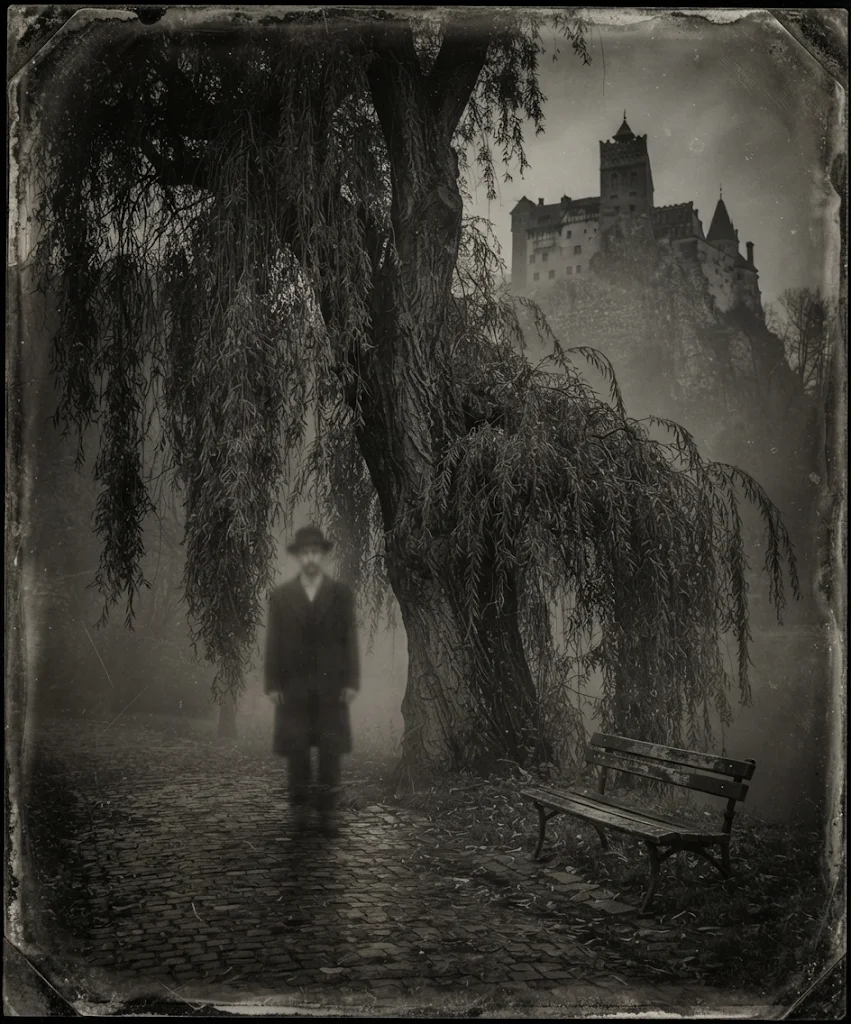
The village of Bran rests in the shadow of its legendary fortress, but just beyond the stone walls and tourist paths lies Bran Park—a quiet, terraced landscape that slopes down toward the rushing waters of the Turcu River. Today, it is a place where visitors rest their feet and admire the castle looming above the tree line. Yet, local elders remember a time when the park was simply known as the Dumbrava Plângătoare (The Weeping Grove), anchored by an ancient, twisted willow tree whose branches sweep so low they kiss the grass.
In the folklore of the Carpathian foothills, trees planted near water—especially weeping willows—were viewed as boundaries between the living world and the realm of memory. And in Bran, the great willow of the park is said to carry the tears of a tragedy born from the turbulent border wars of the 17th century.
History, Background, and Folklore
To understand the roots of the legend, one must look at Bran’s geopolitical reality during the 1600s. As a vital customs fortress between Transylvania and Wallachia, Bran was frequently caught in the crossfire of shifting loyalties, Ottoman incursions, and internal conflicts among Transylvanian princes. The local peasantry and minor nobility who farmed the valleys lived under constant threat of raids, forced requisitions, and sudden violence.
In Romanian and broader Carpathian folklore, water and trees possess deep spiritual agency. Willows, with their drooping fronds and affinity for riverbanks, were often associated with grief, mourning, and unexpressed sorrow. Traditional beliefs held that powerful human emotions—particularly the grief of a broken heart or a wrongful death—could soak into the earth and be absorbed by the roots of long-lived trees, causing them to weep dew or sap long after the mourners had turned to dust.
The Legend of the Weeping Willow
In the summer of 1658, Transylvania was bleeding from political instability and border skirmishes. A young Wallachian nobleman named Radu had fallen deeply in love with Ilinca, the daughter of a Saxon merchant who lived in the shadow of Bran Castle. Their love crossed the invisible, fiercely guarded boundary of culture, language, and politics that divided the mountain pass.
Knowing that their union would be forbidden by their families and the garrison commanders, Radu and Ilinca met in secret beneath a young willow sapling planted by the riverbank in what is now Bran Park. The sound of the rushing water masked their whispered vows, and the cascading branches shielded them from the patrolling mercenaries on the castle battlements.
One evening, as the autumn mists began to swallow the valley, Radu failed to meet her. Word had reached the village that a company of border guards had ambushed a group of travelers near the gorge. Desperate for news, Ilinca waited for hours under the darkening sky as the willow leaves whipped violently in the cold mountain wind.
Her fears were confirmed at dawn when soldiers carried Radu’s body back toward the fortress gates. He had been killed in a skirmish, wrongfully branded as a spy.
Overwhelmed by grief, Ilinca spent her days sitting beneath the willow tree where they had vowed their lives to one another. Local villagers whispered that she wept endlessly, her tears watering the roots of the tree. According to the legend, one stormy night, Ilinca vanished into the mist along the riverbank. She was never seen again, but by morning, the willow sapling had grown strangely old, its branches bending toward the earth as if forever searching for the ground where her tears had fallen.
The Spirit of the Grove
Today, locals and park caretakers still speak quietly of the ancient willow in Bran Park. Even on calm, dry summer days when no rain has fallen, the leaves of the tree are said to be perpetually damp, dripping heavy droplets that sound like rhythmic tapping against the soil.
Visitors walking through the park after dusk often report a strange microclimate around the tree:
- The Chill in the Air: A sudden, localized drop in temperature, even when the rest of the park is warm.
- The Rustling Sigh: A soft whispering sound through the drooping branches, reminiscent of a low voice carried over running water.
- The Endless Dew: Moisture pooling on the tips of the leaves long after morning dew has evaporated elsewhere.
The Weeping Willow stands as a living monument to Bran’s older, quieter history—a reminder that beneath the grand stone towers and tales of fortress battles lie the deep, personal sorrows of those who lived and loved in the shadow of the pass.