- Stories at this place
- 1
- Filed as
 Apparition
Story 1165
The Whispering Arch
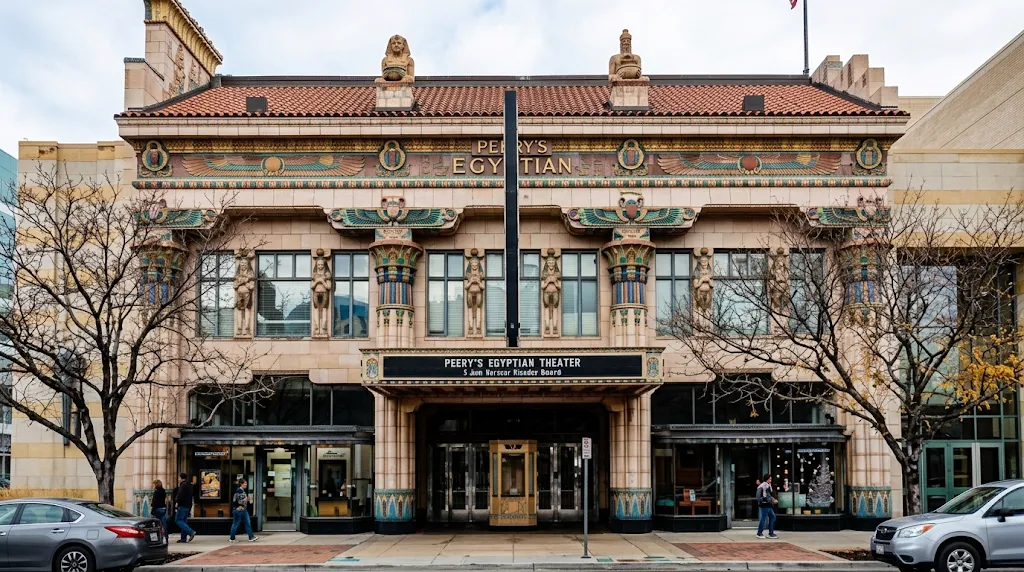
When the midnight cleanup shift starts at Peery’s Egyptian Theater in Ogden, the grand decor takes on a different life. Beneath the ornate terracotta scarabs and atmospheric ceiling painted with fading stars, night custodian Marcus knew every creak of the 1924 palace.
He had heard the rumors about the “Stagehand in the Flies” and the faint sound of the Wurlitzer organ idling when the console was locked away. But Marcus never paid much mind to ghost stories until the night he worked late restoring the curtain rigging.
As the street noise died down, the temperature inside the auditorium plummeted. A low breeze swept down from the grand balcony, carrying the scent of antique perfume and dry desert sand. High up in the fly loft, ropes began to sway gently back and forth without a draftsman in sight.
Then came the sound — a rhythmic, whispering echo rebounding off the Egyptian hieroglyphs framing the proscenium arch. It wasn’t English. It sounded like an ancient chant, softly repeated, matching the quiet hum of an organ chord held in mid-air.
Marcus looked toward the organ lift. Sitting at the keys was a shadow with distinct, sharp contours, dressed in 1920s usher attire. The shadow turned its head slowly toward him, its face featureless except for two faint, glowing points of light.
Instead of feeling dread, Marcus felt a strange, cold calm. The usher raised a single finger to where its lips should be, gesturing for silence, before dissolving back into the darkness of the orchestra pit.
From that night on, Marcus left a single spotlight burning on stage before locking up — a nod to the silent caretakers who never left their posts.
When the midnight cleanup shift starts at Peery’s Egyptian Theater in Ogden, the grand decor takes on a different life. Beneath the ornate terracotta scarabs and atmospheric ceiling painted with fading stars, night custodian Marcus wasn’t the only one keeping watch over the 1924 historic palace.
Joining him that evening were Vance, the pragmatic stage manager who scoffed at local theater lore, and Dr. Teresa Hollis, an archivist investigating the theater’s original 1920s blueprints.
“There are no ghosts in the fly loft, Teresa,” Vance muttered, coiling a heavy stage cable over his shoulder. “Just drafty brick and nearly a century of settled dust.”
Teresa didn’t look up from her drafting table set up in the orchestra pit. “The original architectural logs from 1923 mention three workers who vanished during the vault construction under the stage floor, Vance. Their names were never recorded in the city ledger.”
As midnight struck on Washington Boulevard outside, the temperature inside the auditorium dropped instantly. A sharp breeze swept down from the grand balcony, carrying the scent of antique lavender perfume and dry desert sand.
High above, the heavy rigging ropes began to swing in synchronization.
“Tell me that’s just a draft, Vance,” Marcus murmured, stepping closer to the stage apron.
Vance froze, his hand tightening around the steel cable. Up in the lighting booth, the antique spotlight turned itself on, casting a harsh beam across the proscenium arch.
Sitting at the Mighty Wurlitzer organ console was a figure dressed in a crisp 1920s usher uniform. Next to the console stood a woman in a beaded flapper dress, her face veiled in shadow. Standing high above them on the cat-walk was a third silhouette—a construction foreman holding a vintage brass lantern.
Teresa gasped, quickly reaching for her notebook as the organ keys began to depress silently on their own, filling the dark theater with a low, vibrating bass chord that shook the floorboards.
The shadowy usher turned slowly toward the trio, raised a gloved hand, and pressed a single finger to his lips.
Vance slowly let out a breath he hadn’t realized he was holding. “Okay. Maybe it’s not just dust.”
The deep, silent bass note of the Wurlitzer resonated through the floorboards, vibrating through the soles of Marcus’s boots. The atmospheric ceiling—painted to resemble an open Egyptian night sky—seemed to darken, the artificial stars dimming until only the dim emergency sconces along the side walls remained lit.
“Don’t move,” Teresa whispered, her pen hovering over her sketchbook. She observed the woman in the beaded dress. “Look at her neck—that’s a 1920s scarab pendant. It matches the relief carving on the proscenium arch.”
Vance took a slow step backward toward the exit doors, his eyes fixed on the silhouette with the brass lantern high on the catwalk. “I’ve worked this house for twenty-two years. I’ve heard the creaks, the thermal expansion in the heating pipes, the wind off the Wasatch Range hitting the roof vents. This isn’t thermal expansion.”
The figure at the organ didn’t strike the keys again. Instead, the console itself began to slowly lower into the orchestra pit on its hydraulic lift, accompanied by the mechanical groan of gears that hadn’t been oiled since the Carter administration.
As the organ sank below stage level, the sound of rhythmic murmuring grew louder. It was coming from beneath the stage—from the forgotten utility sub-basement known among stagehands as the Catacombs.
“The 1923 blueprints showed a sealed chamber behind the organ chamber,” Teresa said, her voice trembling with excitement rather than fear. “The original builder, Joseph Peery, altered the plans two weeks before opening night. He walled off an entire alcove.”
Marcus shone his flashlight toward the descending lift shaft. The beam cut through decades of dust, revealing a gap in the masonry wall behind the organ mechanism—a dark passage that shouldn’t have been there.
The brass lantern held by the catwalk figure flickered once, then twice, casting long, swinging shadows across the Egyptian Pharaoh statues flanking the stage.
“We need to go down there,” Teresa said.
Vance looked from the dark passage up to the catwalk figure, who slowly nodded. “If we go down there, we keep the ghost light on stage burning. Nobody locks those front doors until we come back up.”
Descending the iron ladder into the pit beneath the organ lift, Marcus, Vance, and Teresa stepped into air so cold their breath bloomed in pale clouds. The flashlight beams swept across the crumbling mortar of the 1923 foundation.
Behind the hydraulic housing lay the breached brick wall Teresa had identified. Beyond it was a narrow room untouched by time, lit only by a faint, ghostly illumination emanating from the stone itself.
On a heavy wooden table in the center of the alcove sat a brass-bound ledger and a copper time capsule, its seal unbroken.
Teresa approached carefully, opening the leather-bound ledger. As she turned the yellowed pages, the ghostly figures of the usher, the flapper, and the foreman materialised softly around the table, watching silently.
“It wasn’t a tragedy or a disaster,” Teresa read aloud, her eyes scanning the handwritten entries dated September 1924. “It was a secret preservation.”
During King Tut’s tomb fever in the 1920s, the theater’s original craftspeople—foreman Arthur Miller, lead usher Clara Vance (an ancestor of Vance’s, as a sudden gasp from Vance confirmed), and organist Harold Sterling—discovered a collection of authentic Egyptian artifacts unearthed during the foundation excavation. Rather than allowing private collectors to auction them off or misplace them, the theater crew built a hidden sanctuary beneath the stage to protect them.
When opening night arrived in July 1924, they sealed the alcove with a silent vow: to remain guardians of the theater and its hidden collection as long as the curtain continued to rise.
“They weren’t haunting the theater to frighten people,” Marcus realized, looking up at the ghostly trio. “They were keeping watch over what they protected.”
Clara’s spectral form smiled gently at Vance, giving a quiet nod before fading into the warm glow of the stage lights above. The heavy air lifted, replaced by the familiar scent of old oak and polished brass.
By morning, the city historical commission arrived at Peery’s Egyptian Theater. With Teresa’s documentation and Vance’s guidance, the artifacts in the hidden alcove were cataloged and safely preserved in a museum display right in the theater’s grand lobby—finally shared with the community as the original builders had intended.
Vance never scoffed at theater lore again. Before every performance, he personally checked the rigging and made sure the ghost light on stage was positioned just right.
And every night, after the last patron left Washington Boulevard and the grand doors were locked, Marcus would look up at the proscenium arch before turning off the main lights. High above in the balcony, two faint, warm points of light would flicker in gentle approval—a silent promise that the guardians of 1924 were still keeping watch.