- Stories at this place
- 3
- Filed as
 Haunted Forests
Story 1103
The Lost Child of Hoia-Baciu
On the western edge of Cluj-Napoca, where the rolling hills of Transylvania begin to darken into dense woodland, the locals have always known better than to walk beneath the canopy of Hoia-Baciu after dusk.
Long before researchers arrived with Geiger counters and cameras, the forest earned its name from a ghost story. Centuries ago, a local shepherd—a baciu—drove his flock of two hundred sheep into the trees to escape an approaching storm. Neither the man nor a single animal was ever seen again. The villagers searched for weeks, calling out into the fog, until they realized the forest had simply swallowed them whole. Over the generations, the stories multiplied. Travelers spoke of sudden, inexplicable nausea, of compass needles spinning wildly, and of trees that refused to grow straight, twisting instead into gnarled, clockwise spirals as if wrung out by an invisible hand.
By the mid-twentieth century, the old folklore had collided with modern mystery. In the 1950s, a Romanian biologist named Alexandru Sift began documenting strange, shimmering light anomalies and shadowy figures darting between the trunks. Then, in August of 1968, a military technician named Emil Barnea captured a photograph of a metallic, disc-shaped object hovering silently above the treetops—an image that cemented the forest’s reputation as the Bermuda Triangle of Transylvania.
Just two years after Barnea’s photograph sent ripples of unease through the region, the woods claimed a far more haunting legend: a five-year-old girl whose name has long since been forgotten by history.
She vanished on a crisp afternoon in October 1970. She had been playing near the edge of her family’s orchard, wearing a hand-stitched red wool vest over a white linen dress, her dark hair braided tight by her mother that morning. A stray breeze carried her favorite painted wooden hoop rolling down the grassy slope and across the invisible boundary where the meadow ended and Hoia-Baciu began.
The little girl ran after it, laughing, her small boots crunching through the dry leaves.
At first, the forest felt ordinary—just the smell of damp moss and oak bark. But as she followed the hoop deeper into the shade, the sound of the village behind her vanished all at once, cut off as cleanly as a closing door. The birds stopped singing. Even the wind died. Around her, the trunks bent at impossible angles, their branches interlocking overhead like the ribs of a great, sleeping beast.
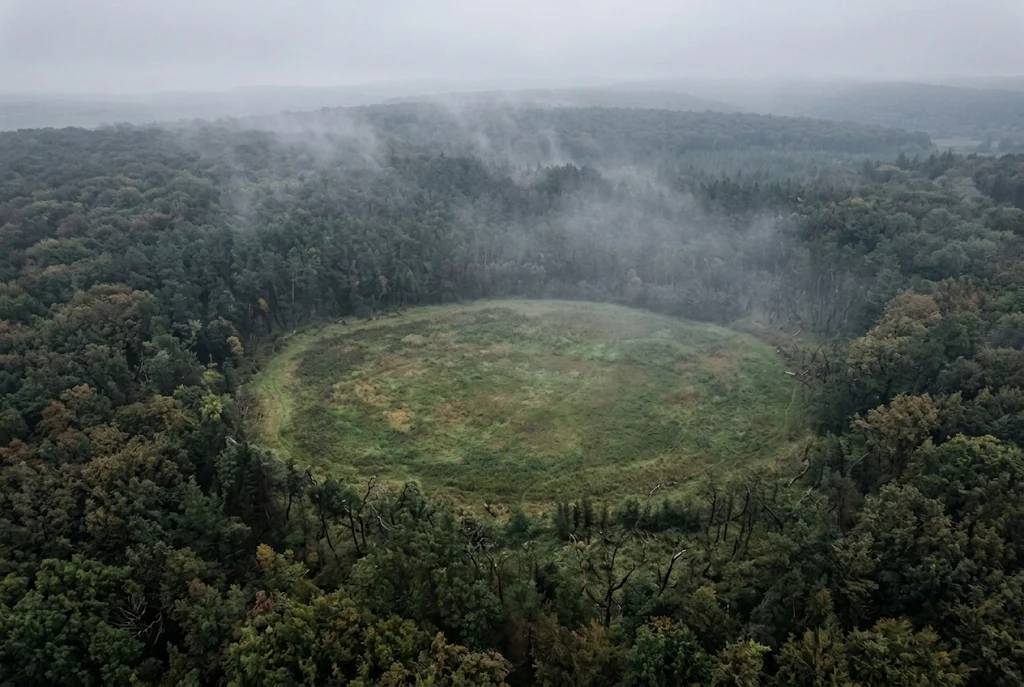
She stumbled into Poiana Rotundă—the Round Clearing.
Even today, no scientist has fully explained the clearing. It is a nearly perfect oval of barren grass in the heart of the dense forest where no tree has ever taken root, despite soil tests showing nothing unusual in the earth. To the child, it was just a quiet, sunlit patch of ground. Her wooden hoop lay flat in the center of the grass.
As she stepped into the circle to pick it up, the air grew thick and tasted faintly of copper. The sunlight didn’t fade, yet the shadows around the clearing stretched long and sharp, bending inward toward her. She felt a strange, weightless tug in her chest, like the moment right before you fall asleep. She blinked once against a sudden, blinding flash of silver light filtering through the canopy—or perhaps it was just the sun catching the mist.
When she opened her eyes, the hoop was in her hand. The air was cool again. Feeling a sudden chill, she turned around and walked straight back toward the orchard, calling for her mother.
In the village, it was 1975. Five years had passed.
When the girl first disappeared in the autumn of 1970, the entire community had mobilized. Men with lanterns and dogs had combed every ravine and thicket of Hoia-Baciu for days, even braving the dread of the Round Clearing. The dogs had whimpered and refused to cross into the barren circle, their hackles raised at nothing. As weeks turned into winters, the search parties gave way to quiet grief. The elders shook their heads and murmured the story of the lost shepherd. The forest, they said, had taken another.
The girl’s mother had aged a decade in those five years. Her hair had streaked with premature silver, and she kept the red wool thread she had used to mend her daughter’s vest tucked inside her Bible.
Then, on an ordinary afternoon in October 1975, five years to the day after the disappearance, the mother was hanging laundry in the yard when she heard the creak of the wooden gate.
She turned, expecting a neighbor. Instead, she dropped the basket.
Standing on the dirt path was her daughter. She was holding her painted wooden hoop. She was wearing the exact same white linen dress and red wool vest from 1970, not a thread frayed, not a single smudge of mud out of place. Her braids were still neat and tight. She hadn’t grown an inch.
Her mother ran to her, falling to her knees, sobbing so hard she could barely breathe as she pulled the child against her chest. The little girl, confused and frightened by the weeping woman with grey-streaked hair, pushed back slightly and looked up into her mother’s face.
“Mama,” the child asked softly, “why are you crying? I only went to get my hoop.”
She had no memory of the lost years. She didn’t know about the five winters that had buried the forest in snow, or the search parties that had shouted into the dark. To her, she had stepped into the quiet circle of trees, blinked against the bright afternoon light, and walked right back home.
To this day, no one in Cluj-Napoca can say where the five-year-old girl went between 1970 and 1975, or what waits inside the stillness of Poiana Rotundă. Visitors still walk the trails of Hoia-Baciu, snapping photos of the twisted oaks and testing their compasses in the dead zone—always careful to check their watches, and always making sure they leave the trees before the light begins to fade.