- Stories at this place
- 1
- Filed as
 Vampire
Story 1055
The Ghost of the Watermill
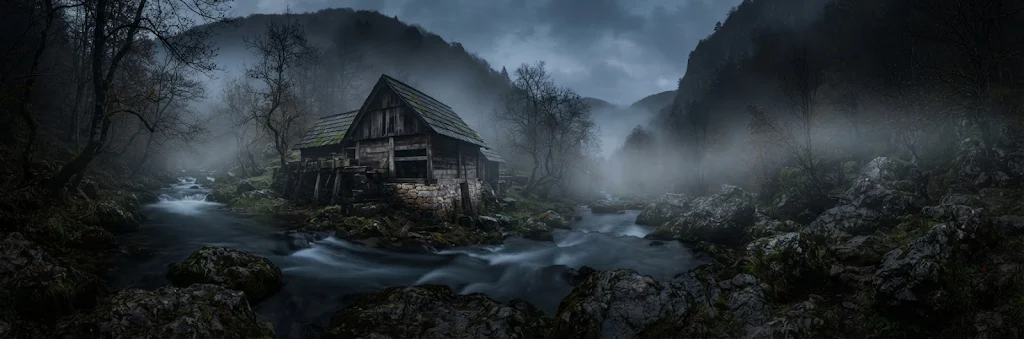
The heavy timber of the old watermill on the Rogačica river groaned under the weight of the mountain night. Outside, deep in the ravine of Zarožje, the dark forests of western Serbia pressed close, breathing a cold mist that smelled of damp earth and rotting leaves.
Inside, the air was thick with the dust of ground wheat and an old, coppery stench that never quite washed away.
Strahinja pulled his heavy wool coat tighter around his shoulders. He was young, stubborn, and desperately in love. To win the hand of Radojka—whose father, Živan, stubbornly rejected him—Strahinja had agreed to do what no other man in the village dared: spend the night working alone in the cursed watermill.
The mill belonged, in local whisperings, to Sava Savanović.
Background and History: The Legend of Sava Savanović
Long before Bram Stoker penned Dracula, and decades before Austrian vampire hysteria swept the Balkans with cases like Peter Plogojowitz, Serbian folklore was rich with terrifying entities that walked the night. Sava Savanović is celebrated as Serbia’s most infamous literary and folk vampire.
According to legend, Sava was a wealthy peasant or miller who lived in the 18th or early 19th century in the remote village of Zarožje (near Bajina Bašta). In life, he was notorious for his harshness and greed; in death, he became something infinitely worse. Upon dying, Sava transformed into a vampire and took up permanent residence in an isolated watermill on the Rogačica river.
The rules of Sava’s hunting were simple and merciless: any miller foolish enough to bring his grain to the mill after dark would be found dead at dawn, his throat torn open and drained of blood. The mill fell into fearful disuse, becoming a monument to local dread.
The myth crossed from oral folklore into immortality in 1880, when the renowned Serbian realist writer Milovan Glišić published his classic horror novella, Posle devedeset godina (After Ninety Years). Glišić captured the authentic superstition of the Serbian peasantry, immortalizing Sava Savanović. The tale was later adapted into Leptirica (1973), a legendary Yugoslav folk horror film that terrified generations with its portrayal of Sava as a creature associated with nocturnal terror and the monstrous leptirica (she-butterfly).
The Story: The Mill of Zarožje
Midnight had come and gone. The massive wooden water wheel creaked outside, splashing icy river water against the stone foundations. Strahinja sat on an upturned sack of flour, staring at the heavy oak door.
Suddenly, the grinding stones stopped turning.
The ambient noise of rushing water seemed to muffle, swallowed by an absolute, suffocating silence. From the rafters above, a low, wet rustling sound echoed down.
Strahinja raised his flintlock pistol, his heart hammering against his ribs.
A shadow detached itself from the ceiling beams—tall, emaciated, and unnaturally flexible. It dropped to the wooden floor with a sickening, boneless thud. As it stepped into the meager sliver of moonlight piercing the window, Strahinja gasped.
It was a man, but warped by unlife. His hair was long, matted, and coarse like an animal’s coat; his skin stretched tightly over a skeletal frame, pale and gray like parchment left in a tomb. But it was his face that paralyzed Strahinja with primal terror: a mouth split wide from ear to ear, dripping with dark, viscous blood, and eyes that burned with centuries of malice.
“You are bold, young Strahinja,” a voice rasped, sounding like dry leaves dragged across grave markers. “Just like the others. They all thought the mill was empty.”
Sava Savanović glided forward, moving not with walking steps, but like a sliding ghost. Strahinja tried to raise his gun, but an unseen weight crashed against his chest. The vampire moved with blinding speed, a blur of grey fur and freezing wind.
Panic took over. As Sava lunged, Strahinja swung a heavy wooden beam, striking the creature square across the shoulders. The vampire hissed—a sharp, bird-like shriek that echoed off the stone walls—and vanished into the deep shadows of the flour bins.
Shaking violently, bruised and gasping for air, Strahinja managed to scramble out a high window just as dawn began to bleed pale pink over the peaks of the Povlen mountains.
The Dawn and the Hunt
When the villagers of Zarožje arrived at the mill shortly after sunrise, they expected to collect another body. Instead, they found Strahinja alive, shivering in the mud outside, babbling about the monster in the dark.
The village elders exchanged grim, knowing glances. There was only one solution. If Sava Savanović was active again, they had to find his resting place before the next sunset.
Led by an old wise-woman who understood the ancient ways, the villagers brought forth a completely black stallion—a horse born with no white hairs, believed to possess the sight to peer beyond the veil of the living. They led the stallion through the deep ravines and thickets of Zarožje, letting it pick its path.
Near a forgotten hollow beneath a canopy of ancient oaks, the stallion stopped. It reared back, snorting in terror, its eyes wide as it refused to move forward. The earth here was sunken, marked by a nameless stone slab covered in moss.
“Here,” the elders whispered.
With frantic determination, the men drove their iron shovels into the soil. Down they dug, through layers of clay and stone, until their blades struck wood. They heaved the heavy lid off the oak coffin.
Inside lay Sava Savanović, preserved as if he had died only yesterday. His skin was taut, his lips stained a fresh, dark crimson, and his eyes—wide open—gared up at the morning sky. A low, unnatural hum filled the air around the grave, and a large, monstrously patterned butterfly fluttered frantically out of the coffin, darting away into the dark forest canopy.
Before the creature could fly far, the village elder stepped forward with a sharpened hawthorn stake. With a swift, practiced motion, he drove it through the center of the vampire’s chest.
A piercing, inhuman wail tore from the corpse, shaking the trees around them, before the body rapidly dissolved into a pool of foul, black dust.
Epilogue
With the vampire of Zarožje finally put to rest, the shadow that had hung over the valley for generations lifted. Old Živan, humbled by the bravery of the young man who faced the nightmare of the Rogačica river, finally gave his blessing.
Strahinja and Radojka were wed in a celebration that lasted for days, the villagers dancing late into the evening, casting nervous glances toward the distant woods only once in a while.
The old watermill still stands today—restored as a monument of stone and timber where tourists walk through the quiet ravine. Yet, locals will still tell you with a half-smile and a serious eye: never walk down by the Rogačica river after dark, because even the dead sometimes find their way back home.