- Stories at this place
- 1
- Filed as
 Apparition
Story 575
Shakchunni and the Petni
Deep within the fertile, mist-shrouded river deltas of Bengal, where twilight bleeds into the inky blackness of bamboo groves and ancient banyan trees, the boundary between the living and the dead has always been dangerously thin. It is in this twilight realm that the Shakchunni and the Petni dwell—two distinct yet deeply intertwined spirits born from the tragic, unfulfilled desires of women who met untimely ends.
To understand their haunting, one must first look back centuries into the social fabric of rural Bengal.
The Origin and Background
In traditional Bengali folklore, a woman’s soul was believed to be tethered tightly to her earthly desires, familial duties, and unresolved passions. When a woman died suddenly—whether through disease, betrayal, childbirth, or violence—before she could fulfill her worldly roles, her spirit would sometimes refuse to cross over into the peace of the afterlife. Instead, trapped between worlds, these souls morphed into female spirits known collectively as bhutnis.
Among them, the Shakchunni and the Petni occupy specific, terrifying niches shaped by their mortal lives and manner of death.
The Petni: The Outcast Spirit
The Petni was historically a mortal woman who died an unnatural, miserable death while unmarried, impoverished, or deeply unhappy. Sometimes, a woman who harbored a fierce, unfulfilled greed for food, wealth, or sensual pleasures would pass away without ever tasting the luxuries she craved.
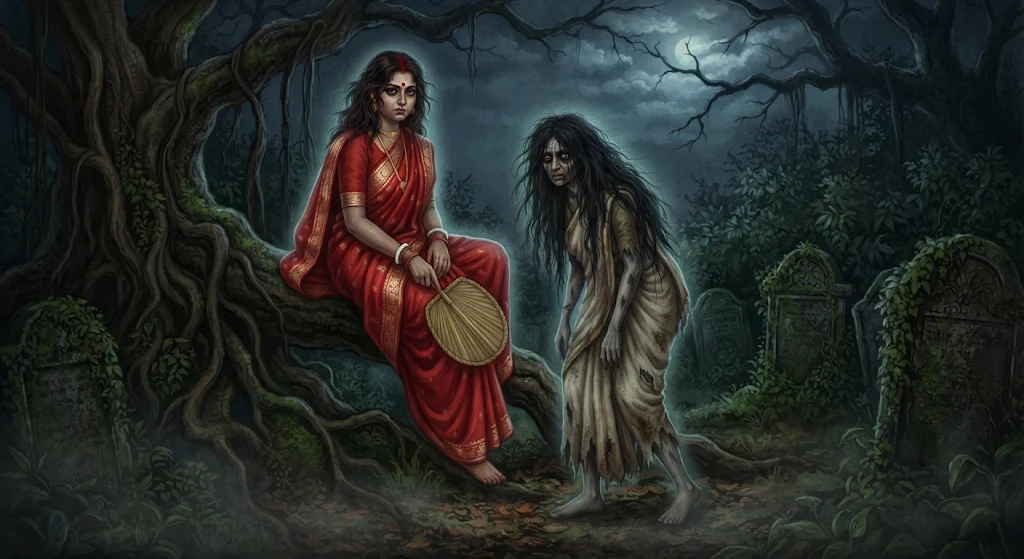
In death, the Petni remains an eternal outcast. She haunts isolated cremation grounds, neglected orchards, and dark riverbanks. Her appearance is grotesque and terrifying: unkempt, tangled hair, sunken eyes that burn with a hollow hunger, and tattered, muddy white saris.
Yet, the Petni possesses a cruel and dangerous shapeshifting ability. To lure unsuspecting travelers—particularly lone men walking home late at night—she can project the illusion of breathtaking beauty, masking her rotting decay beneath a veil of gorgeous youth. But telltale signs always betray her: her feet are famously turned backward, facing the opposite direction of her body, and she casts no shadow.
The Shakchunni: The Domestic Phantom
While the Petni roams the wild edges of society, the Shakchunni is far more insidious, for she yearns for the very thing she lost: domestic life.
The word Shakchunni is believed to be a corruption of the Sanskrit Shankhachurni, referring to women who died while still married—indicated by the traditional conch-shell bangles (shakha) worn by Hindu brides. These spirits were mortal women who enjoyed the comforts of marriage and household life, but died prematurely, often leaving behind a bitter jealousy of the living women who took their places.
A Shakchunni does not haunt dark forests; she haunts houses, lingering in dark attics, abandoned rooms, and ancient trees near homesteads. She watches families from the shadows, consumed by a fierce envy.
Unlike the wild Petni, the Shakchunni is clever, articulate, and deeply manipulative. She prefers to target newly married housewives. By whispering dark thoughts into a young bride’s ear, inducing sudden illnesses, or even temporarily possessing her body, the Shakchunni attempts to step back into her old life. She wants the husband, the home, the food, and the social standing she was cruelly robbed of.
The Tale of the Village Boundary
In a quiet village near the banks of the Hooghly River, the two spirits were said to cross paths every night beneath a towering, centuries-old banyan tree that marked the boundary between the wild marshlands and the village houses.
On one particularly moonless night, a greedy village merchant named Madhab was stumbling home late, weighed down by a heavy pouch of coins he had earned at the market. Intoxicated and foolish, he took a shortcut straight through the banyan grove.
Sensing a living soul, a hungry Petni materialized from the mist. She transformed herself into a weeping, destitute maiden sitting by the roots of the tree, crying out for help and a morsel of food.
Madhab, blinded by his arrogance and lust, stepped closer to offer assistance. But as he drew near, the air turned freezing cold. The sweet scent of night-blooming jasmine suddenly curdled into the stench of wet earth and rotting vegetation. Madhab looked down and froze in absolute terror: the woman’s feet were pointing backward.
Before the Petni could strike, a sharp, mocking laughter echoed from the branches above.
Dropping down silently from the canopy came a Shakchunni. Her hair was slick with oil, and she wore ancient, clinking conch-shell bangles that rattled like dry bones. The Shakchunni glared at the Petni with furious possessiveness.
“This soul belongs to the village,” the Shakchunni hissed, her voice sounding like dry leaves scraping across stone. “And his home belongs to me.”
A bitter supernatural turf war erupted between the two entities right before the merchant’s eyes. The Petni shrieked, lunging with clawed hands to drag Madhab into the marshes, while the Shakchunni cast a suffocating spell, wrapping invisible, choking threads of domestic memory around his chest to drag him toward a nearby abandoned house.
Paralyzed by fear, Madhab fell to his knees, praying frantically to any god that would listen. As the first faint streaks of dawn began to bleed through the eastern sky, the golden light of morning pierced the canopy.
Powerless against the purity of the rising sun, both spirits shrieked in unison—their forms dissolving into wisps of grey smoke that faded into the receding mist.
Madhab crawled back to his village as the sun fully rose, alive, but forever changed. From that night on, the villagers bolted their doors tightly before twilight, knowing all too well that in the quiet corners of Bengal, the Shakchunni and the Petni were always watching, waiting in the dark for the living to wander too close to the past.