- Stories at this place
- 1
- Filed as
 History
Story 520
Ogden City “Doughboy” History
Incident Summary
High above the bustling sidewalks of 24th Street in the 1920s, a young soldier stood watch in quiet bronze. He did not stare down the barrel of a gun; instead, he held his helmet in his hand, his posture carrying the heavy, solemn relief of a man who had survived the trenches of Europe
High above the bustling sidewalks of 24th Street in the 1920s, a young soldier stood watch in quiet bronze. He did not stare down the barrel of a gun; instead, he held his helmet in his hand, his posture carrying the heavy, solemn relief of a man who had survived the trenches of Europe. Sculpted by Gilbert P. Risvold and commissioned by Herman Baker American Legion Post 9, the Ogden City Doughboy was born out of grief and gratitude—a permanent tribute to the young men of Weber County who had marched off to World War I and never came home.
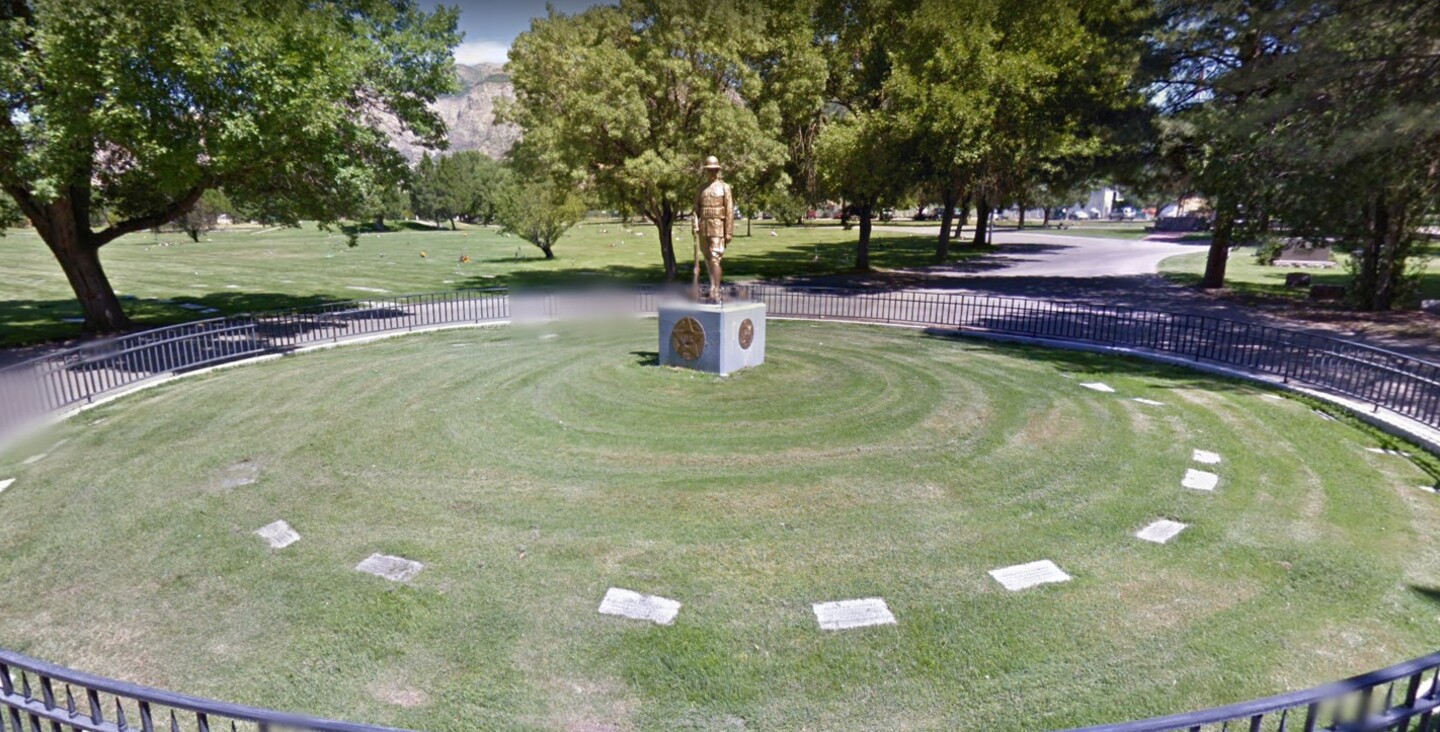
From his perch on the balcony of the old American Legion hall, the Doughboy watched Ogden grow. He listened to the clatter of railcars at Union Station and the footsteps of returning veterans gathering below him. Then came another war—even larger, even more consuming—and when the dust of World War II finally settled, the city decided the soldier belonged closer to his brothers. Donated to Ogden City, he was lifted from 24th Street and carried up to the Ogden City Cemetery on Monroe Boulevard. There, surrounded by trees and individual copper markers for every local soldier lost in the Great War, he settled into a quieter vigil.
Decades passed, and as the generation that remembered the Argonne Forest and Flanders Fields faded away, the vigil grew lonely. Winter snowblowers and summer lawnmowers mangled the copper markers at his feet. Worse still, the Doughboy himself began to take fire on home soil. Vandals scarred his bronze with graffiti, spray paint, and even bullet holes. His rifle was bent out of shape, and someone pried the helmet right out of his hand. In a cruel mockery of his service, a spray-painted construction hard hat was eventually jammed onto his head. For years, the soldier stood wounded and forgotten beneath the Wasatch Mountains.
Then, on a quiet walk through the cemetery, a local man named Bob Geier stopped with his wife to look closely at the battered monument. He didn’t look away. Instead, he came to a simple conclusion: the soldier needed help.
What followed was a decade-long rescue mission led by the Weber County Heritage Foundation, American Legion Post 9, the Daughters of the American Revolution, and dozens of local partners. Money was raised through autumn home tours, grants, and quiet acts of devotion—including an anonymous older woman who donated twice in memory of her father, a World War I veteran, just to make sure the soldier was made whole again. First, on November 11, 2011, the mangled copper plaques were replaced with sturdy round granite markers and fresh trees. Then came the Doughboy’s turn. He was lifted from his crumbling perch, his wounds repaired, his rifle straightened, and his original helmet returned to his hand.
When he returned to the cemetery in November 2018—just in time for Veterans Day and the 100th anniversary of the Armistice—he stood atop a new granite-faced base, protected by a concrete dais and inscribed with the haunting lines of John McCrae’s “In Flanders Fields”. As the Ogden Concert Band played melodies from a century past, the Doughboy once again stood tall, no longer a relic of neglect, but a promise kept.
History and Background
The term “doughboy” was a popular nickname for members of the U.S. Army and Marine Corps during World War I, particularly the soldiers of the American Expeditionary Forces. While many American towns erected mass-produced WWI monuments in the 1920s, Ogden’s statue is a distinct work by noted sculptor Gilbert P. Risvold, originally installed on the balcony of the remodeled American Legion Post 9 building on 24th Street before its post-WWII relocation to the Ogden City Cemetery at 1875 Monroe Boulevard.
Following the two-phase restoration spearheaded by the Weber County Heritage Foundation and supported by organizations including the Pritzker Military Museum Foundation and the Utah Department of Veterans and Military Affairs, the monument was officially rededicated on November 10, 2018. As part of the National World War I Centennial, the Ogden City Doughboy was recognized as one of the official 100 “WWI Centennial Memorials” across the United States.
Beyond its solemn history, the monument has also earned a spooky reputation in local folklore. For generations, the Doughboy has been famous for a late-night rite of passage: locals drive slowly around the statue after dark—often circling it three times—to see if the bronze soldier will shift his stance or follow them with his eyes through the cemetery.