- Stories at this place
- 1
- Filed as
 Cemetery
Story 1306
The Ledger of Block 14

The Chinese cemetery altar and funerary burner in Block 14 of Lone Fir Cemetery, Portland, Oregon, ca. early 1900s. Demolished and paved over by Multnomah County in the 1950s. Image Courtesy of the Oregon Historical Society Research Library.
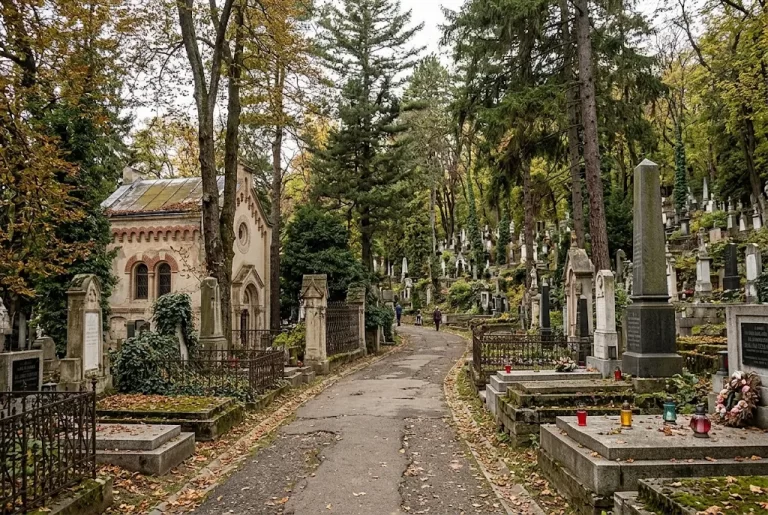
The November rain in Portland didn’t fall so much as hang in the branches of the old trees inside Lone Fir Cemetery, turning the gravel paths slick and dark. Clara, an archivist tracing nineteenth-century property transfers in southeast Portland, had stayed past dusk near the southwest edge of the grounds, where the air felt heavier and smelled faintly of wet earth and cold iron.
What is now a sprawling, thirty-acre historic graveyard began in 1846 with the burial of Emmor Stephens on his son James B. Stephens’s donation land claim. In 1854, shipbuilder Colburn Barrell bought the farm and—after his partner Crawford Dobbins died in a steamship explosion—set aside ten acres as a burial ground called Mount Crawford, later renamed Lone Fir for a solitary tree standing on the site. Over the decades, tens of thousands of people were buried here, from early city founders and Oregon governors to patients from Dr. James C. Hawthorne’s asylum and nearly three thousand Chinese immigrants in Block 14, whose remains were meant to be returned home or were later disturbed when mid-century county construction paved over and built across part of the block.
Clara crouched by the edge of the old southwest section with a flashlight, checking a faded plat map against the uneven turf. Beneath the damp grass, the ground felt subtly hollow in places where old curbs had once been pulled up and forgotten. When her flashlight beam swept low across the wet soil, it caught the glint of something small and metallic half-buried near a root—a tiny brass tag stamped with a number that wasn’t on her map.
Behind her, a branch snapped sharply, though there was no wind moving through the boughs above. Clara spun around, shining the light across the rows of tilted headstones and shadowed paths, but no one else was there—only the pale mist rising from the ground and the quiet, persistent tapping of rain on forgotten stone.
Her thumb froze on the rubber switch of her flashlight. In the beam’s narrow cone, the brass tag lay half-embedded in the mud like a coin dropped from a torn pocket, its stamped numerals—1,408—edged with verdigris. In the late nineteenth century, benevolent associations had used small metal markers like this to identify the wooden coffins of Chinese immigrants awaiting disinterment and shipment back to Guangdong, a promise that was supposed to be kept within seven years. When the county had cleared the southwest corner decades later, they claimed every remaining grave had been accounted for.
She knelt and pried the tag loose with the edge of her clipboard. The metal was unexpectedly cold, not the ambient chill of November rain, but the sharp, biting cold of deep cellar stone.
A faint scraping sound drifted from the dark stretch of asphalt where the old Multnomah County maintenance building had once stood. Clara aimed her light across the cleared ground. The mist had thickened, pooling low around the trunks of the towering Douglas firs and bigleaf maples like standing water. Just beyond the boundary of the remaining headstones, something shifted—not the quick dart of a stray cat or raccoon, but the slow, deliberate movement of a figure standing motionless beside a weathered cedar.
“Hello?” Clara called out, her voice swallowed almost instantly by the wet air. “The gates lock at dusk.”
The figure didn’t answer. As she raised the beam, the light caught the hem of a dark, heavy coat and pale, bare ankles standing ankle-deep in the sodden grass. Before the beam could reach a face, the flashlight flickered twice and dropped to a dim, amber glow.
Clara tapped the casing against her palm, and in that split second of near-darkness, she heard footsteps—not on the gravel path, but beneath the turf, dull and muffled, as if someone were walking along a wooden boardwalk buried six feet down. The sound moved steadily toward her, stopping directly under her boots.
She looked down. Around the brass tag clutched in her fist, dark water was seeping upward through the grass, pooling around the soles of her shoes with the faint, unmistakable scent of incense ash and cedarwood. When she looked back up toward the cedar tree, the figure was gone, but three more pale shapes stood at the edge of the paved lot, each holding a small, unlit paper lantern that swayed gently in the windless dark.
Clara backed away toward SE 20th Avenue, the brass tag burning like ice against her palm, and didn’t look back until her hand hit the cold iron bars of the gate.
By midnight, the fluorescent lights of the county records room felt thin against the rain drumming on the high windows. Clara set the brass tag on a sheet of blotting paper beside an 1898 shipping ledger rescued from an old Chinatown association basement. The metal had left a damp ring on the paper that smelled faintly of stagnant river water and woodsmoke.
She ran a gloved finger down the brittle, ink-faded columns until she reached the entry for 1,408.
Beside the number, written in neat vertical brush strokes and cramped English clerk’s script, was a name—Chen Wei, railroad laborer, died October 1894—followed by a notation in red ink: Remains held for spring passage. Fee paid in full. Beneath it, in a different hand dated thirty-five years later, a single line had been scrawled across the margin: Marker removed during grading. Box unlocated.
A cold draft slid across the back of Clara’s neck, though the archive vents had shut off at ten. On the blotting paper, the brass tag rattled once against the glass paperweight holding the ledger open.
Clara looked up. The reflection in the dark windowpane behind her desk didn’t match the empty aisle of steel shelving. Standing just behind her chair, dripping rainwater onto the linoleum floor, was a man in a soaked wool coat with bare, mud-streaked ankles. His head was bowed, wet hair obscuring his face, and one hand rested lightly on the back of her chair—right beside the open ledger.
Slowly, a pale, water-wrinkled finger reached down onto the page, tapping the red-ink note twice before sliding upward to point at the blank line beneath it.
Clara’s breath caught in her throat. When she looked down at the paper, wet gray ash was smudged across the margin where his finger had touched, spelling out four neat numbers in the dust: 20th & Morrison—the exact corner of the paved county lot where she had stood at dusk.
She swept the brass tag into an evidence envelope, locked the ledger in the vault, and walked out into the rain without turning off the lights.
The next morning at dawn, before the grounds crew arrived, Clara returned to the southwest corner of Lone Fir Cemetery. She knelt beside the uprooted cedar root where the soil had settled overnight, pressed the envelope containing tag 1,408 deep into the soft earth, and covered it over with wet leaves and moss. As she stood up, the mist between the fir trees thinned in the pale gray light, and the hollow, muffled sound beneath the grass finally went quiet.