- Stories at this place
- 3
- Filed as
 Cemetery
Story 1106
The Story of Hajongard Cemetery
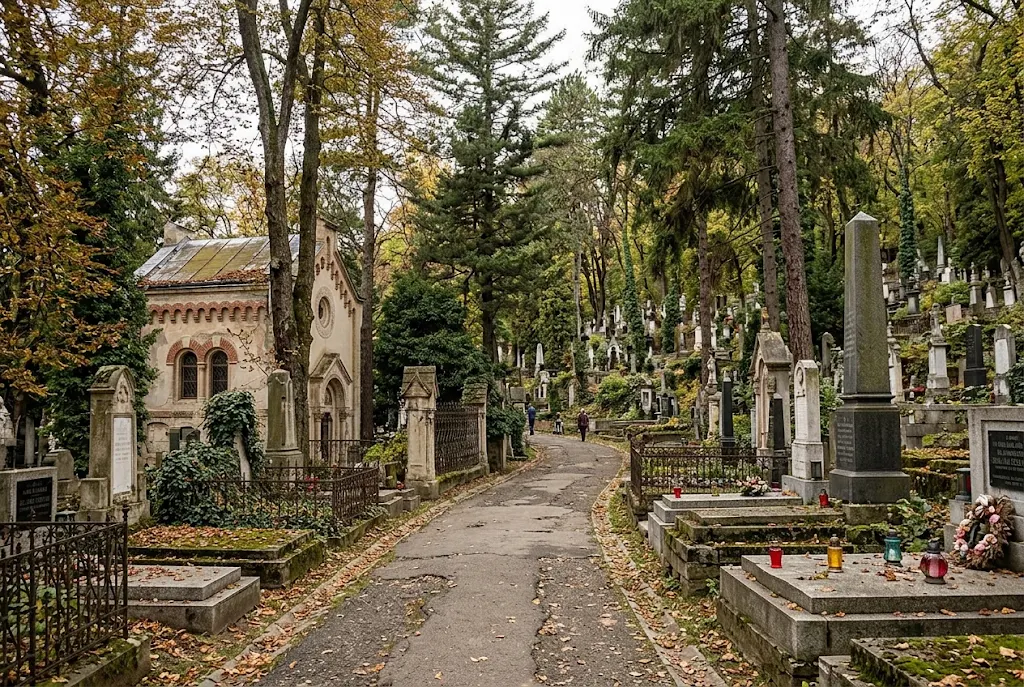
Every autumn, when the mist rolls off the Feleac hills and settles over Cluj-Napoca, the city’s oldest residents seem to wake beneath the iron gates of Strada Avram Iancu. Beyond those gates, climbing the southern slope above the medieval town, lies Hajongard—officially the Central Cemetery, though few who know its winding, leaf-strewn paths call it by so plain a name.
Long before the first stone was laid here, the hillside was a place of rustling brush and darting wildlife. The German-speaking Saxons who lived behind the town walls called it Hasengarten—the Hare Garden—though some linguists insist it was Haselgarten, a Garden of Hazel Trees. Over the centuries, the name softened on Hungarian and Romanian tongues into Házsongárd and Hajongard.
The garden became a cemetery out of desperation. In 1585, the plague tore through the city, and the old graveyard huddled around St. Michael’s Church in the central square ran out of room. The town council looked south, beyond the defensive walls, and consecrated the hillside of hares and hazels as a new resting place. Wooden crosses rotted and vanished, but stone endured; tucked away in the older quarters, a weathered headstone from 1599 still holds its ground, the oldest surviving witness to four centuries of grief and remembrance.
Walk up the main alley today, beneath the canopy of ancient chestnuts and lindens, and you are no longer just in a graveyard. You are walking through 14 hectares of Transylvania’s collective memory—an open-air museum where Hungarian aristocrats, Romanian scientists, Saxon burghers, and quiet dissidents share the same soil.
Near the older terraces, the elaborate baroque and neoclassical crypts of noble families—the Bethlens, the Bánffys, the Mikós—rise like miniature palaces out of the ivy. Not far from them rests János Apáczai Csere, the fiery young humanist scholar who brought the radical ideas of Descartes to Transylvania in the 17th century, only to burn out and die in Cluj at the age of thirty-four. A few turns away lies a man who lived nearly three times as long: Sámuel Brassai, the “last polymath of Transylvania,” who spent ninety-seven years mastering mathematics, linguistics, philosophy, and music before finally laying down his pen in 1897.
Follow the paths deeper into the twentieth century, and the stones begin to speak of a world constantly redrawing its own borders. Here lies Miklós Bánffy, the statesman and writer who chronicled the twilight of the Austro-Hungarian aristocracy in his Transylvanian Trilogy, watching his world dissolve in the fires of two World Wars. Just a short walk away rests Emil Racoviță, the Romanian biologist who once sailed into the frozen dark of Antarctica before returning to Cluj to found the world’s first institute of biospeleology. Beside them in spirit are the voices that shaped modern Romania: the prolific writer and Greek Catholic priest Ion Agârbiceanu, the physician Iuliu Hațieganu, and Doina Cornea, the quiet French professor who risked everything to speak out against the communist dictatorship.
Even an Englishman found his final home on this Transylvanian hill—John Paget, an agriculturist and traveler who fell so deeply in love with the region in the 19th century that he never left.
On most days, Hajongard is hushed, broken only by the crunch of gravel and the caw of rooks perched on the angels’ stone wings. Yet once a year, on the first evening of November, the hillside transforms. Families climb the slopes carrying baskets of chrysanthemums and armfuls of glass lanterns. As dusk falls, thousands of tiny flames flicker to life across the 14 hectares, turning the dark hillside into a fallen constellation.
Transylvania Now
In that warm, swaying light, the old divisions of empire, language, and century fade away. The Hare Garden becomes what it has always been: a quiet pact between the living and the dead, keeping the story of Cluj alive one candle at a time.