- Stories at this place
- 1
- Filed as
 Vampire
Story 1046
The Case of Arnold Paole (Arnaut Pavle)
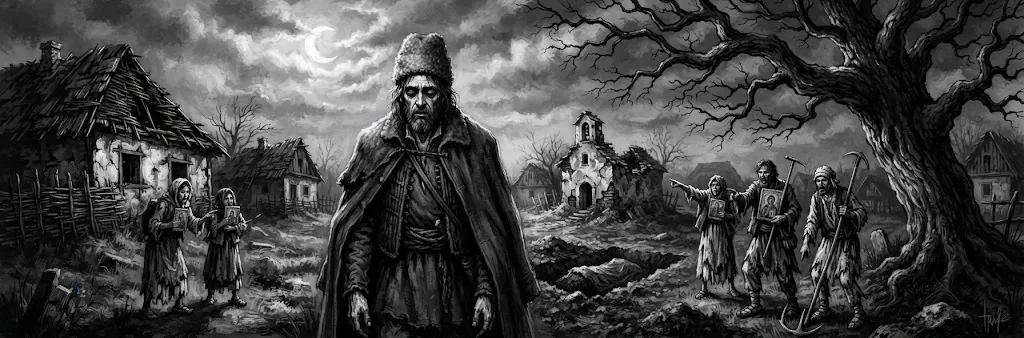
The wind howling through the Morava Valley in the winter of 1731 carried more than just the bitter chill of the Balkans; it carried a terror that would soon captivate—and terrify—all of Europe. Long before Bram Stoker penned Dracula or Lord Byron wrote The Vampyre, the small, remote Serbian frontier village of Medveđa (then spelled Meduegna) became the epicenter of one of the most thoroughly documented and legally investigated vampire panics in history.
At the dark heart of this historical phenomenon was a simple militiaman named Arnold Paole.
History and Background: The Soldier Who Returned
Arnold Paole was a Serbian haiduk—a frontier militiaman and mercenary who served the Austrian Empire during its turbulent conflicts against the Ottoman Empire. After his military service concluded, Paole returned home to Medveđa, a quiet agricultural settlement nestled near Belgrade. He settled down to work his farm, married a local woman, and tried to reintegrate into civilian life.
However, Paole carried a heavy secret, one that he frequently whispered to his wife with a deep sense of dread. While stationed with the army in Turkish Serbia and parts of Greece, Paole claimed he had been tormented by a vampire. To cure himself and shake the dark entity’s relentless harassment, Paole had taken desperate, folkloric measures: he ate dirt from the vampire’s grave and smeared himself with the creature’s blood.
Believing he was safe, Paole resumed his life. But fate intervened cruelly around 1725 or 1727. While working on his farm, Paole suffered a catastrophic fall from a high hay wagon and died from his injuries. He was buried quietly in the village cemetery, and the village moved on.
Why He Was Considered a Vampire
Death, it seemed, was not the end of Arnold Paole.
Roughly twenty to thirty days after his burial, whispers began to ripple through the close-knit community. Several villagers came forward claiming that Paole had returned from the grave. They reported being haunted, choked, and physically assaulted in the dead of night. Within a short span, four of these complaining villagers died suddenly.
Panic gripped Medveđa. According to local Serbian folklore, a person who had been tormented by a vampire or who died an unnatural death could become an undead vampir (revenant), rising from the earth to drain the life force of the living.
Fearing for their lives, the villagers and the local headman decided to take matters into their own hands. Forty days after Paole’s burial, they exhumed his corpse. What they allegedly found inside the coffin cemented his status as a monster in the local imagination:
- The Body Was Undecayed: Despite weeks in the earth, his body showed no signs of standard decomposition.
- Fresh Blood: His skin was ruddy, and fresh, fluid blood was discovered pooled in his eyes, nose, mouth, and ears.
- Grown Appendages: The villagers claimed his hair, beard, and nails had continued to grow, with the old nails sloughing off to reveal fresh ones underneath.
- The Shroud: His burial shirt and the inner lining of the coffin were soaked in fresh blood.
Convinced they were looking at a true vampire, the villagers executed customary preventative measures: they drove a sharp wooden stake straight through his heart. According to historical lore, Paole let out an audible, agonizing groan and bled copiously as the stake went in. To ensure he could never rise again, they decapitated him, burned his body to ashes, and cast them into the nearby Morava River. They then performed the same ritual on the four people who had died after claiming his visitation.
The Aftermath and Historical Legacy
The story did not end at the riverbank. Five years later, in the winter of 1731, a secondary wave of sudden deaths struck Medveđa. Seventeen people died within a matter of weeks—ranging from children to the elderly—after brief, three-day illnesses. Villagers whispered that Paole’s curse had mutated; he had reportedly fed on local cattle before his death, and the villagers who consumed the meat had contracted the “vampiric” contagion.
The panic became so severe that the Austrian administration—fearing both contagion and civil unrest—sent an official medical commission led by Regimental Field Surgeon Johannes Flückinger to investigate. Flückinger and his team conducted formal autopsies on dozens of exhumed bodies, documenting their findings in a clinical, chilling report titled Visum et Repertum (“Seen and Discovered”).
When Flückinger’s official report was published, it became an overnight sensation across Western Europe. It transformed local Balkan folklore into a continent-wide obsession, sparking philosophical debates, theological treatises, and inspiring the entire Gothic literary horror genre. Arnold Paole went down in history not just as a frightened soldier of the Serbian frontier, but as the archetypal vampire whose post-mortem trials terrified an entire empire.