- Stories at this place
- 1
- Filed as
 Apparition
Story 471
The Legend of the Nishi
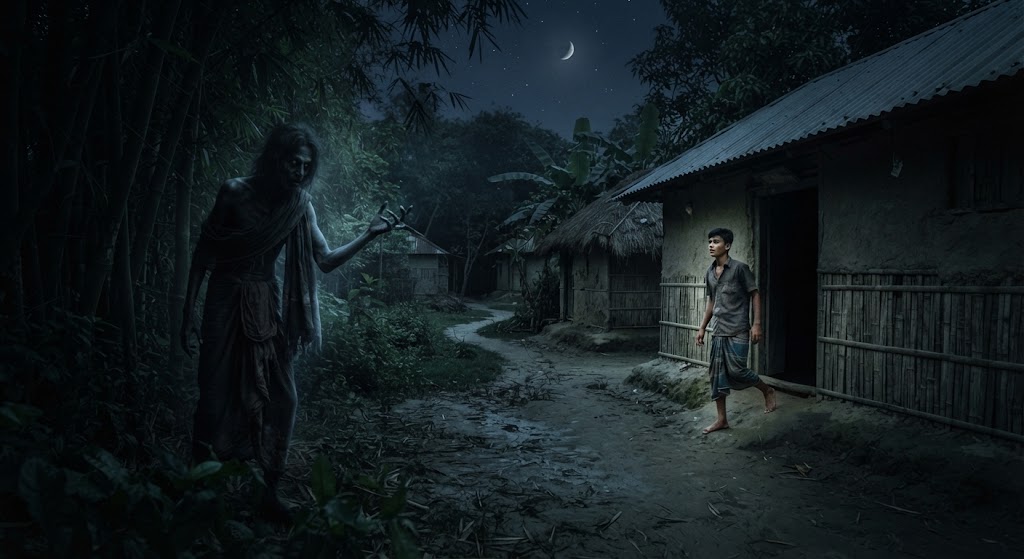
Background and Folklore: The Legend of the Nishi
In the rural riverine villages of Bengal—spanning both West Bengal (India) and Bangladesh—the night does not merely belong to darkness; it belongs to the Nishi (নিশি) or Nishir Daak (The Call of the Night).
Unlike aggressive spirits or malevolent entities of violent vengeance, the Nishi does not wield fangs, claws, or visible terror. Instead, it preys on human psychology and the most foundational of bonds: trust and love. The Nishi is a nocturnal phantom that mimics the exact voice of a family member, a spouse, or a childhood friend. It whispers or calls out a person’s name from the shadows of the courtyard, a dense bamboo grove, or the edge of a murky pond.
According to regional lore, if a person answers the voice or steps out into the dark to follow it, they are drawn into a trance-like state. By morning, their lifeless body is typically found floating face-down in a shallow ditch, pond, or paddy field—having walked there willingly, lured by a sound they could not resist.
To combat this, generations of rural Bengali families passed down a strict, unyielding survival rule: Never answer a voice calling your name in the dead of night on the first try. A living human being—whether a mother, sibling, or neighbor—will naturally call out a second or third time if they get no response. The Nishi, bound by mystical rules, calls only once or twice, and never repeats the call if met with silence.
The True Story: Retold from the oral history of Dakshin Gobindapur
Note: ( Names of the account were changed)
This account is drawn from the oral history of Dakshin Gobindapur, a remote village nestled on the eastern fringes of the Sundarbans mangrove delta—a labyrinth of tidal waterways, dense forests, and shifting mudflats where the boundary between land and water constantly blurs.
The event took place during a ferocious July monsoon. The skies had opened up days prior, turning dirt paths into slick mud and swelling the village ponds until their dark waters lapped dangerously close to household doorsteps.
Anirban, a 28-year-old schoolteacher who had recently returned to the village after completing his education in Kolkata (formerly known as Calcutta), prided himself on being a rationalist. He frequently scoffed at the village elders’ warnings about ghosts, spirits, and the Nishi, dismissing them as primitive superstitions born from isolation and a lack of electricity. His grandmother, Nibedita, who had raised him after he lost his parents in a childhood flood, would sigh and shake her head, repeating her nightly mantra: “Anirban, if you hear your name when the lamp goes out, count to thirty. Wait for a second voice. If it doesn’t come back, close your ears.”
On the night of July 14, the power grid had been down for nearly seventy-two hours. The relentless pounding of rain on the corrugated tin roof created a deafening, hypnotic rhythm. By 1:00 AM, Anirban sat alone at his wooden desk, finishing lesson plans by the flickering, amber glow of a single kerosene lamp.
Suddenly, cutting cleanly through the heavy roar of the monsoon rain, a voice drifted up from the wet courtyard outside.
“Anirban… beta (son)… come open the door.”
It was Nibedita’s voice. It wasn’t loud, but it carried an unmistakable, gentle urgency—the exact tone she used whenever she woke up feeling unwell or needed help fetching medicine in the middle of the night.
Anirban froze. Instantly, his pen stopped moving. Without thinking, a surge of filial anxiety overrode his rational mind; Grandmother has fallen in the dark, he thought.
He stood up so quickly his wooden chair scraped loudly against the floorboards. He took two steps toward the heavy wooden front door, his hand reaching out to unlatch the iron bolt.
A sudden, chilling draft blew through the cracks of the window, fluttering the flame of the kerosene lamp. In that split second, a visceral echo of his grandmother’s voice rang in his memory: “Wait for the second call.”
Anirban halted. His hand hovered inches from the latch. He forced himself to stand completely still, his heart hammering against his ribs like a trapped bird. Outside, the rain poured, and the frogs croaked in a frantic chorus.
He waited.
One second. Ten seconds. Thirty seconds.
The courtyard remained dead silent, save for the patter of raindrops. No second call came. No shuffling of elderly feet. No plea for help.
Anirban’s breath hitched. Trembling, he walked backward away from the door, crept quietly down the dimly lit hallway, and pushed open the door to his grandmother’s bedroom.
Nibedita was fast asleep in her wooden cot, wrapped tightly in a cotton quilt, breathing deeply and evenly. She hadn’t left her bed all night.
The next morning, the rain cleared into a heavy, humid stillness. When Anirban stepped outside into the courtyard to check the perimeter, he noticed fresh, heavy barefoot tracks leading from the soft mud right up to his doorstep—and then turning abruptly away, winding past the tulsi plant and straight toward the edge of the swollen, churning village pond behind the house.
He followed the tracks with a cold dread pooling in his stomach. At the edge of the dark, stagnant water, the footprints stopped abruptly at the mudline.
Anirban never spoke of his skepticism again. To this day, in the deep, waterlogged corners of the Sundarbans, the villagers know that when the night grows pitch black and a familiar voice calls your name from the shadows, survival depends entirely on the discipline of silence.