- Stories at this place
- 3
- Filed as
 Roads
Story 889
The Black Truck of Clinton Road
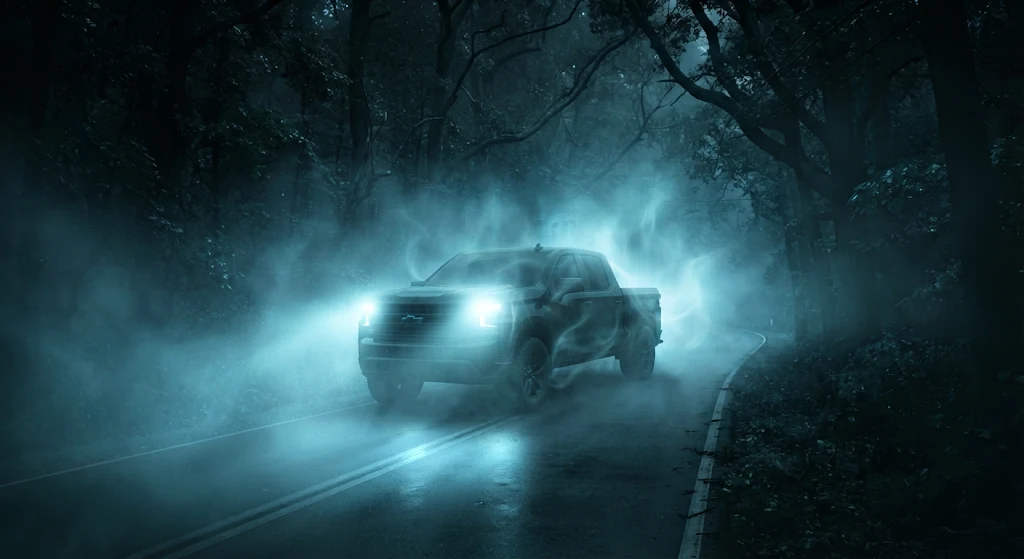
If you grow up in West Milford, New Jersey, Clinton Road isn’t a haunted legend; it’s just the dark, bumpy ten-mile shortcut between Route 23 and Upper Greenwood Lake. You learn to drive it before you’re old enough for a license. You know where the frost heaves crack the asphalt, where the deer step out of the hemlocks, and how hard you can push a turn before your tires lose grip.
That is why I used to laugh at the out-of-towners. Every October, kids from Bergen County or New York City would crawl down the road at twenty miles an hour, their hazard lights blinking, stopping by the reservoir bridge to throw quarters into the water for the ghost boy, or hiking into the woods looking for the ruins of Cross Castle—a stone mansion built in 1905 by Richard Cross that burned down decades ago, leaving behind only a concrete foundation and spray-painted rumors of Satanic rituals.
And, of course, they always asked about the Phantom Truck.
In local barrooms and old issues of Weird NJ, the legend usually goes like this: a massive, rusted pickup—sometimes described as a Camaro, sometimes a blacked-out Ford or Dodge from the 1970s—appears out of nowhere behind you, rides your bumper with blinding headlights, tries to run you off the road, and vanishes before impact. Locals have a simpler explanation for it. Clinton Road has no streetlights, no guardrails in most spots, and long stretches with zero turnoffs. When a tourist creeps along at half the speed limit, an impatient local in a lifted truck comes up behind them fast, flashes their high beams to get them to move over, and turns onto one of the unmarked logging trails once they pass. Mystery solved.
I believed that explanation completely until a Tuesday night in late November.
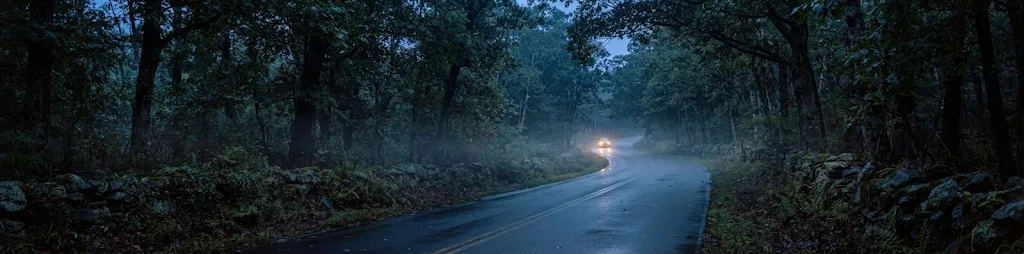
It was 12:40 AM. I was driving north toward Upper Greenwood Lake after a late shift in Butler, running on stale coffee and muscle memory. The air was cold enough to rim the puddles with ice, and a thin, silver mist was lifting off the black water of Clinton Reservoir to my left. I hadn’t seen another set of headlights since turning off Route 23.
Just past the reservoir dam, where the road narrows and the oak trees close overhead like a tunnel, my rearview mirror flickered.
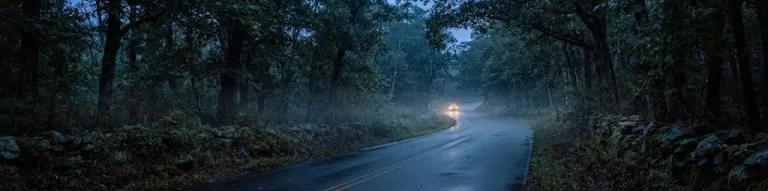
At first, I thought it was a reflection off a wet road sign. Then the glow steadied. Two round, dull-amber headlights sat about fifty yards behind me, low and wide.
I glanced at my speedometer. Fifty-two miles per hour. Anyone who knows Clinton Road knows fifty-two is moving right along in the dark. Whoever was behind me had closed the gap without me ever seeing them round the previous bend.
Great, I thought. Another guy trying to prove he owns the road.
I eased off the gas to forty-five, waiting for him to pass on the short straightaway near the old ironworks. He didn’t pass. Instead, he matched my speed to the exact mile per hour. The distance between our bumpers didn’t shrink or grow by an inch.
I tapped my brakes twice—just enough to flash the red lights—and sped back up to fifty-five.
The headlights behind me didn’t dip or surge. They simply stayed locked at the exact same distance, like the truck was tethered to my rear axle by an invisible steel bar.
That was when the first cold knot tightened in my stomach. When a heavy pickup accelerates from forty-five to fifty-five on a quiet mountain road, the front end lifts slightly, and the headlights tilt up. These lights didn’t tilt. They moved over the uneven asphalt smoothly, almost gliding, without bouncing over the frost heaves that rattled my own suspension.
I rolled down my driver’s-side window an inch, letting the freezing air rush in. Beneath the hum of my tires and the hiss of the wind, I listened for the low rumble of a V8 engine or the whine of knobby mud tires on cold pavement.
There was nothing. Just the sound of my own car and the rushing wind.
Ahead of me lay Dead Man’s Curve—a sharp, blind ninety-degree turn that has claimed more than a few reckless drivers over the years. Normally, you brake hard before the yellow chevron signs, drop to twenty-five, and hug the inside line.
I kept my foot on the gas until the last possible second, then hit the brakes and threw my steering wheel into the turn. My tires chirped against the cold asphalt as the body of my car rolled hard to the left. In the mirror, the black silhouette of the truck followed me through the apex without slowing down at all. Through the dim glow of my own taillights, I caught a brief, clear look at it: a boxy, matte-black pickup from the late seventies, its chrome grille pitted and dark, its windshield completely opaque—not tinted, just empty black, as if there were no cab interior behind the glass.
I cleared the turn, straightened the wheel, and slammed my brakes, pulling half onto the gravel shoulder. I threw the car into park, unbuckled my seatbelt, and shoved the door open, ready to yell at whoever was playing games on a freezing Tuesday night.
The red glow of my brake lights lit up the empty road behind me.
There were no headlights. No taillights disappearing around the bend. No gravel crunching on a side trail, and no engine idling in the woods. The mist hung undisturbed over the center line, and the silence of the state forest pressed in around me so thickly I could hear the ticking of my own cooling exhaust pipe.
I stood beside my open door for nearly a full minute, scanning the tree line where I knew—from thirty years of living here—that thick boulders and steep embankments made it impossible for any vehicle to pull off the road.
Eventually, I got back into the car, locked the doors, and drove the remaining three miles home at thirty miles an hour, checking my mirrors every few seconds.
I still drive Clinton Road every week. I still tell people that most of the ghost stories are nonsense dreamed up by bored teenagers and amplified by travel bloggers. Whenever someone asks me about the Phantom Truck, I give them the standard West Milford answer about impatient locals and unmarked logging trails.
I just never drive past the reservoir after midnight anymore.
The Folklore and Origins Behind the Story
The legend of the Phantom Truck is one of the most enduring pieces of modern folklore associated with Clinton Road in West Milford, Passaic County, New Jersey. While the story above takes creative liberties for narrative effect, it draws directly from the real history, geography, and oral traditions that made the road famous:
- Why Clinton Road Became a Magnet for Legends: Stretching roughly 10 miles through the dense forests of Newark Watershed land, Clinton Road is legitimately isolated, dark, and dangerous. It features sharp, unlit turns—most famously “Dead Man’s Curve”—and runs past real historical ruins, including the remains of Cross Castle (built in 1905 and destroyed by fire and vandalism in the late 20th century) and an 18th-century stone furnace from the Revolutionary War era. In the 1970s and 1980s, the road’s remoteness unfortunately also made it a dumping ground for organized crime, including a 1983 murder linked to infamous contract killer Richard Kuklinski, which cemented the road’s dark reputation in local memory.
- The Evolution of the Phantom Vehicle: Reports of phantom vehicles on Clinton Road began circulating heavily among North Jersey teenagers in the late 1970s and 1980s. In early versions of the tale, the vehicle was often described as a ghostly 1970s Chevrolet Camaro or a dark pickup truck that appeared out of nowhere, aggressively tailgated drivers to force them off the road, and vanished near Dead Man’s Curve. In some tellings, the truck is said to be driven by the ghost of a driver who died in a crash on that exact bend.
- The Role of Weird NJ: The legend gained statewide and national fame in the 1990s when Mark Sceurman and Mark Moran, founders of the magazine and book series Weird NJ, began publishing reader-submitted encounters from Clinton Road. As dozens of drivers wrote in describing nearly identical experiences—being chased by blinding headlights that suddenly winked out—the Phantom Truck became a staple of New Jersey urban legend, alongside the “Ghost Boy” of the reservoir bridge and tales of cult activity in the surrounding woods.
- The Real-World Explanation: Folklorists and longtime West Milford residents often point out how geography fuels the legend. Because Clinton Road lacks streetlights and passing zones, unfamiliar drivers tend to drive overly cautiously, frustrating local residents who know the road well and drive it quickly. A local driver coming up fast behind a nervous visitor—and then turning off onto one of the many dark, unmarked watershed access roads—easily creates the illusion of a menacing vehicle appearing and vanishing into thin air.