- Stories at this place
- 4
- Filed as
 History
Story 586
McCune Mansion
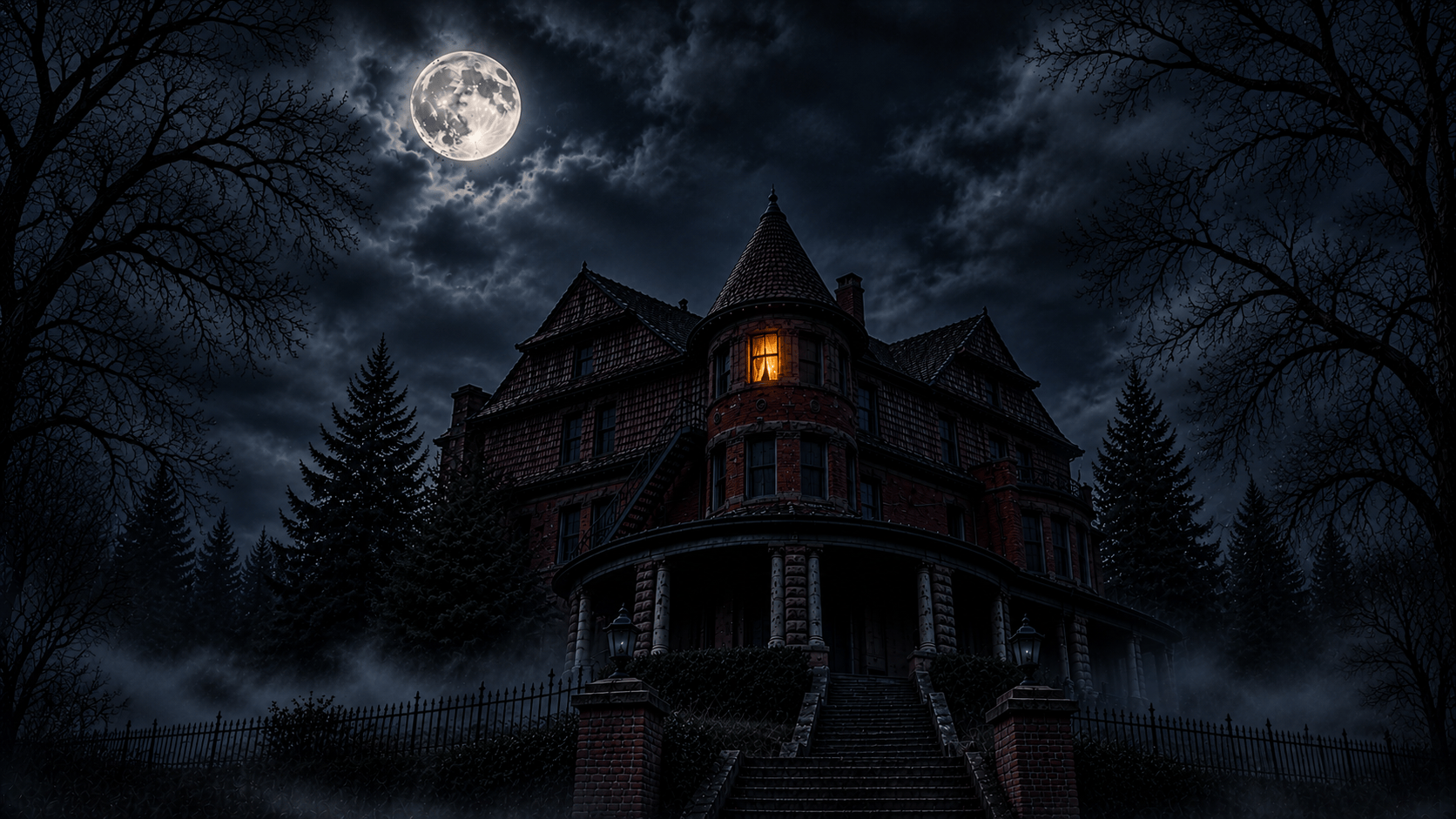
High above Salt Lake City, perched on the slope of Capitol Hill, the McCune Mansion stands as a glittering monument to Utah’s Gilded Age—a place where opulent history and quiet mystery intertwine.
History & Background
Built between 1898 and 1900, the mansion was commissioned by Alfred W. McCune, a self-made railroad and mining tycoon who amassed immense wealth in Utah, Montana, and South America. Wanting a residence that reflected his status and worldly travels, McCune spared no expense.
- Architectural Marvel: Designed by architect Carl M. Neuhausen, the 21-room mansion blends Shingle style and Revivalist architecture with subtle East Asian details.
- Exotic Materials: Materials were imported from around the globe—custom roof tiles from the Netherlands, Nubian marble, English oak, and mahogany.
- Modern Innovations: When completed, it boasted modern marvels of the era: an early intercom system, radiant heating, and a third-floor ballroom with a spring-loaded dancing floor.
In 1920, after years of lavish entertaining, McCune and his wife Elizabeth gifted the estate to The Church of Jesus Christ of Latter-day Saints. Over the decades, it served as a music school, an art center, and a venue for historic gatherings. In the late 1990s, the mansion returned to private ownership and underwent a meticulous, multi-million-dollar restoration to preserve its original glory.
The Echoes of 200 North Main
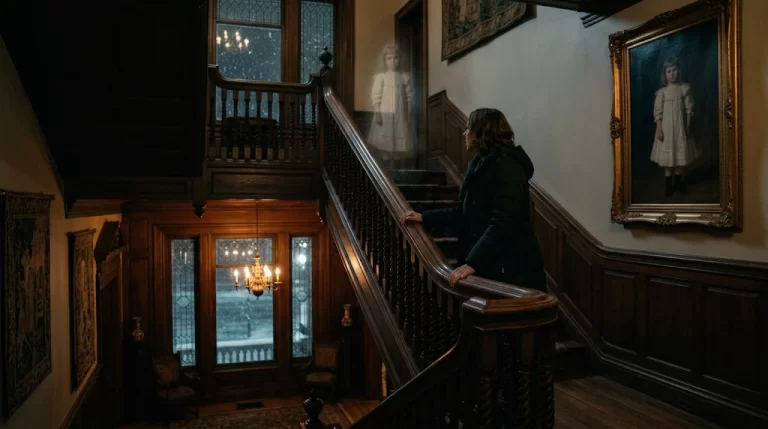
On a crisp autumn afternoon, light filters through the stained-glass windows of the grand foyer, casting warm hues across the polished mahogany staircase…
Legend says that if you stand in the grand ballroom when the sun sets over the Great Salt Lake, you can still hear the faint rustle of silk gowns and the rhythm of a waltz echoing from a century past. Alfred McCune loved to hold court here, welcoming governors, artists, and titans of industry under the hand-carved ceilings.
During its restoration, craftsmen uncovered small treasures hidden behind the walls—letters, forgotten trinkets, and handwritten notes—reminders of the dozens of artisans who labored to carve every leaf into the woodwork.
Today, the McCune Mansion stands not just as a grand historic landmark, but as a living bridge between Utah’s frontier roots and its gilded ambitions.
The Tapestry of McCune Mansion
Act I: The Baron of Capitol Hill
To understand the mansion at 200 North Main Street, one must first understand Alfred W. McCune. Born in 1849 in Fort William, India, to a British soldier father, McCune immigrated to Utah as a child. By age fifteen, he was hauling timber for the Union Pacific Railroad. Through sharp instincts and relentless ambition, McCune expanded from railway contracting into silver, gold, and copper mining across Utah, Montana, and British Columbia, eventually partnering with titans like J.P. Morgan and Marcus Daly in the Cerro de Pasco copper mines of Peru.
By the late 1890s, McCune was one of Utah’s richest men and a key political figure—narrowly missing a seat in the U.S. Senate during a famous 1899 deadlock in the Utah Legislature.
To solidify his family’s place at the peak of Salt Lake society, McCune commissioned architect Carl M. Neuhausen to build an estate that would rival the gilded châteaux of the East Coast.
Act II: Crafted Without Compromise
Construction began in 1898 and took two full years, costing over $730,000—an astronomical sum at the turn of the century (equivalent to tens of millions today).
- The Exterior: Neuhausen designed a striking hybrid of Colonial Revival and East Asian influences, capped with reddish-orange roof tiles custom-baked in the Netherlands and shipped around South America’s Cape Horn to San Francisco, then hauled by rail to Salt Lake City.
- The Interior Opulence:
- Marble & Woods: Walls lined with dark English oak, Central American mahogany, and rare Sanpete white sandstone. The grand foyer featured columns carved from imported Nubian marble.
- The Ballroom: On the third floor, McCune installed a magnificent ballroom complete with an imported German orchestra alcove and a spring-loaded dance floor designed to absorb the rhythm of hundreds of dancers without fatigue.
- Modern Wonders: The house featured built-in wall safes, a subterranean heating plant, elaborate early electrical fixtures, and an internal telephone system connecting all 21 rooms.
Act III: Elizabeth McCune & The Suffrage Movement
While Alfred built the fortune, his wife, Elizabeth Claridge McCune, gave the mansion its soul. Elizabeth was a prominent leader in The Church of Jesus Christ of Latter-day Saints and a national advocate for women’s rights.
In 1899, while the mansion was under construction, Elizabeth represented Utah at the International Council of Women in London. Her speeches impressed international delegates, including Susan B. Anthony, who became a close personal friend and guest at the McCune home.
The mansion became a vibrant cultural salon where local artists, visiting dignitaries, political activists, and church leaders gathered beneath the crystal chandeliers.
Act IV: The Gift & The Music School Era
By 1920, with their children grown and their sights set on California, Alfred and Elizabeth made an unprecedented gesture: they donated the entire estate to the LDS Church to be used for cultural and educational purposes.
For nearly three decades, the home operated as the McCune School of Music and Art. The grand halls, once filled with high-society galas, echoed with the scales of young pianists, violinists, and operatic singers. During the Great Depression and World War II, the mansion served as a beacon of artistic community for Salt Lake City.
Act V: Restoration & Today
In 1999, local businessman Philip McCarthey purchased the property and initiated a restoration effort to undo a century of wear and tear:
- Craftsmen stripped decades of paint to reveal original hand-carved mahogany scrollwork.
- Artisans restored the original silk wall coverings and gold-leaf ceiling stenciling.
- Historical conservators repaired the original Dutch roof tiles after a freak tornado struck Salt Lake City in August 1999.
Today, the McCune Mansion stands meticulously restored—a jewel box of Utah history available for weddings, events, and quiet reflection on the visionaries who built it.
The Midnight Waltz of McCune Mansion
The storm over the Salt Lake Valley had turned the night black as pitch. Rain lashed against the high leaded-glass windows of 200 North Main, and thunder rumbled across Capitol Hill like heavy cannon fire.
Inside, David was alone.
He was hired as the night watchman during the final stages of the 1999 restoration. His job was simple: lock the grand oak doors at dusk, patrol the three floors, and make sure the historical fixtures stayed safe from the weather.
At 11:45 PM, the power flickered once—then died.
In the sudden darkness, the mansion seemed to shrink. The scent of aged mahogany, beeswax, and damp stone grew thick in the air. David switched on his heavy flashlight, its beam cutting through the gloom of the grand foyer.
That’s when he heard it.
Thump. Thump. Thump.
It was coming from the third floor—the grand ballroom.
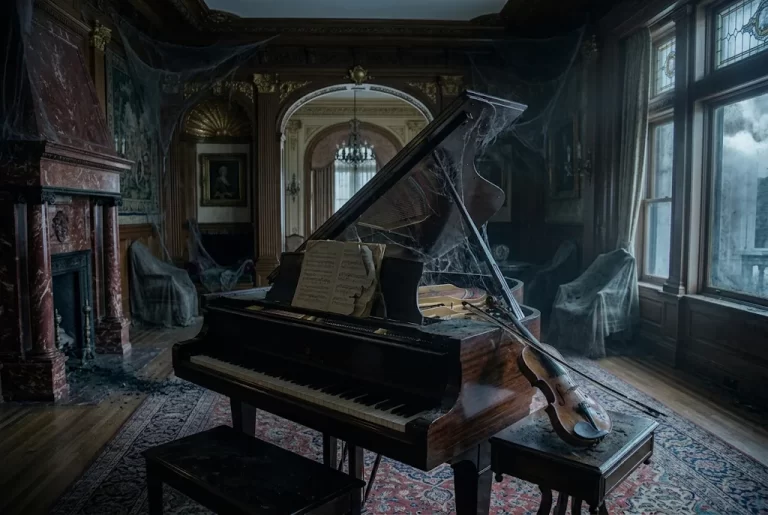
David froze at the base of the staircase. The sound wasn’t footsteps. It was a rhythmic, subtle dipping sound—the distinct give-and-take of the ballroom’s famous spring-loaded floorboards, flexing under weight.
“Hello?” David’s voice swallowed itself in the cavernous hallway. “The building is closed. You need to leave.”
Silence answered him. Then, faint and tinny, came the sound of a violin.
It wasn’t modern music. It was a slow, melancholy waltz from the early 1900s, played with a frantic, trembling bow.
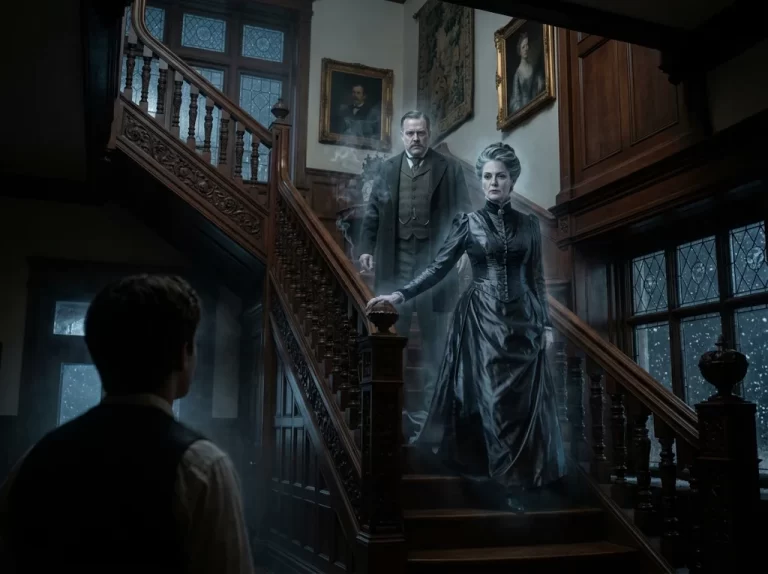
Hand on his radio, David mounted the grand staircase. Step by step, the air grew unnaturally cold—so cold his breath bloomed in white clouds before him. As he reached the second-floor landing, his flashlight beam caught the antique floor-length mirror.
In the reflection, David saw the hallway behind him. But it wasn’t empty.
Standing three feet behind his shoulder was a tall, slender woman in a high-collared black Victorian dress. Her hair was swept up in a tight bun, and her face was completely featureless—a smooth, pale oval where eyes and a mouth should have been.
David spun around.
Nothing was there. Just the dark corridor.
Heart hammering against his ribs, he looked back into the glass. The reflection showed the woman pointing a pale, slender finger upward—toward the third floor.
CRACK.
A deafening peal of thunder shook the house. Above him, the music suddenly exploded in volume. Dozens of invisible feet began shuffling across the ballroom floor above—a mad, swirling dance that shook the ceiling plaster.
Driven by terror or a strange compulsion, David ran up the final flight of stairs to the ballroom doors. He shoved them open.
The vast room was bathed in the pale, icy glow of lightning flashes.
Through the storm-lit shadows, David saw the floor boards rising and falling in waves. Shadowy silhouettes—men in tailcoats and women in flowing gowns—swirled together in pairs, dancing silently across the flexing floorboards. None of them had faces.
At the far end of the ballroom, sitting at a ghost of a piano, sat a man in a dark suit. He slowly turned his head 180 degrees to look directly at David.
“You’re late for the final dance, David,” a voice whispered—not from the room, but from inside David’s own head.
David dropped his flashlight. It shattered on the floor, plunging the ballroom into total darkness.
When the emergency lights finally clicked back on ten minutes later, police found the front doors of the mansion wide open to the rain. David’s flashlight lay smashed on the third floor.
David was found three hours later, sitting on the steps of the State Capitol down the street, drenched in rain, muttering the same five words over and over:
“The floor never stops moving.”
Two weeks after David was found shivering on the Capitol steps, Dr. Sarah Mercer arrived in Salt Lake City. A professor of architectural history specializing in Western Gilded Age estates, Sarah had been hired by the restoration committee to audit the mansion’s structural safety following David’s incident.
While reviewing Neuhausen’s original 1898 architectural schematics in the Utah State Archives, Sarah discovered something impossible: a 300-square-foot subterranean void beneath the cellar, completely omitted from the official municipal filings.
Deep in the archived journals of an apprentice stonemason named Thomas Thorne, she found a cryptic note dated November 1, 1900:
“We finished the lower vault tonight. Mr. McCune sealed the iron door himself. May God forgive us for what we buried beneath the floorboards. The house will never let its keepers leave.”
Driven by curiosity, Sarah decided to inspect the estate alone on a freezing November night.
The winter wind howled off the Wasatch Mountains as Sarah unlocked the side entrance near the carriage house. Equipped with thermal imaging cameras, audio recorders, and a heavy crowbar, she descended into the fruit cellar.
Behind a stack of antique wine crates, her thermal camera registered a localized drop in temperature—a wall that was -15°F colder than the surrounding mortar. Sarah swung the crowbar. The modern drywall crumbled, revealing a rusted iron door hidden behind the brickwork.
With a metallic screech that echoed up through the floorboards, the door gave way.
Beyond lay a narrow, stone spiral staircase winding down into total darkness. As Sarah descended, her flashlight beam illuminated ancient wax candles lining the steps—and fresh, wet footprints leading downward.
At the bottom of the staircase sat a circular chamber paneled in black walnut. In the center sat an antique phonograph with a horn carved like a gaping mouth. Resting on the turn-table was a heavy wax cylinder labeled:
“OCTOBER 31, 1900 — THE LAST DANCE”
Before Sarah could touch the cylinder, the heavy iron door at the top of the stairs slammed shut with a deafening thud.
The needle on the phonograph dropped on its own.
A scratching, distorted melody began to play—the exact same waltz David had heard. Above her head, the entire three-story mansion groaned as if waking from a century-long sleep.
Heavy, pounding footsteps began pouring down the spiral staircase.
Sarah spun around, raising her flashlight. Emerging from the gloom was a procession of figures clad in immaculate 1900 evening wear—gowns of crushed velvet and tailcoats of black wool. But as they entered the light, Sarah gasped in horror:
Their faces were not empty like the ones David saw. They were smooth porcelain masks, each painted with a frozen, weeping expression. And through the eyeholes of the masks, glowing embers burned in the dark.
Leading the procession was the figure of the stonemason, Thomas Thorne, holding a heavy iron key.
“The master made a bargain to keep the house eternal,” Thorne’s raspy, hollow voice echoed from behind his mask. “A soul for every decade of splendour. You are forty years late, Dr. Mercer.”
The phantom guests closed in, their porcelain fingers reaching out to grab her coat. The temperature plummeted until frost crackled across Sarah’s visor and flashlight lens.
Desperate, Sarah didn’t run for the stairs. She grabbed the heavy iron crowbar and smashed the wax cylinder on the phonograph.
CRACK!
The needle screeched. A deafening, otherworldly shriek echoed through the vault as the wax shattered into a thousand pieces.
Instantly, the shadow figures stiffened. The porcelain masks cracked open, dissolving into streams of black dust that were sucked into the center of the broken phonograph. The stone room violently convulsed, dust and mortar raining from the arched ceiling.
Sarah scrambled up the spiral stairs as the stone steps collapsed behind her into a yawning pit. She hurled her shoulder against the iron door at the top, bursting out into the cellar just as the entire subterranean chamber collapsed into rubble below.
Sarah escaped into the freezing night, leaving her equipment behind.
The official investigation concluded that an ancient cistern beneath the mansion had suffered a structural cave-in due to winter freeze-thaw cycles. The void was backfilled with hundreds of tons of concrete, sealing the lower chamber forever.
Today, the McCune Mansion stands quiet and restored, host to grand weddings and celebrations under the warm light of its chandeliers.
But tour guides on the night shift still tell new employees one strict rule:
If you ever hear a phonograph playing in the basement after midnight, do not look in the mirrors. Just walk out the front door, and never come back.