- Stories at this place
- 1
- Filed as
 Haunted Places
Story 507
Hitchhiker at Exit 343
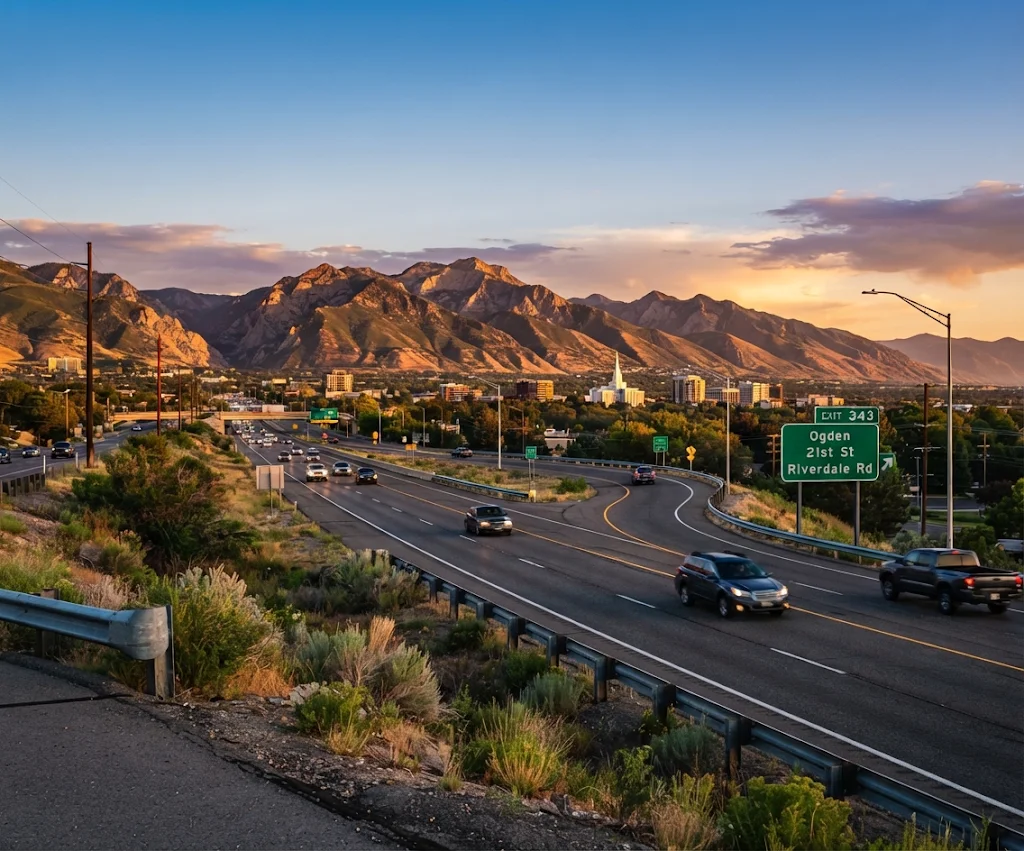
Long before the concrete ribbons of Interstate 15 sliced through Weber County, the stretch of land shadowing the Ogden River and the old rail yards was a crossroads of heavy transit and deeper isolation. Exit 343 (21st Street) sits at a restless intersection—flanked by sprawling truck stops, industrial yards, and the cold, dark hum of transport corridors that link the Wasatch Front to the wider world.
For decades, long-haul truckers and midnight drivers have traded whispers about this specific off-ramp. Local lore ties it to the darker history of Ogden’s transit boom—the days when the Union Station brought desperate drifters, railway hoboes, and transient misfortune into the valley. But the story locals tell most carefully isn’t about the trains. It’s about the girl who waits where the asphalt meets the dark.
The rain was coming down in sheets, blurring the overhead amber sodium lights of the Exit 343 interchange into bruised smears of orange and gray. Mark gripped the steering wheel of his sedan, his knuckles white. He had been driving south from Idaho for four hours, fighting exhaustion and a storm that seemed to thicken the deeper he got into the Ogden corridor.
As he signaled to take the 21st Street exit, his headlights swept across the slick shoulder near the merge.
Standing entirely exposed against the downpour was a figure. A young woman, wearing a faded canvas field jacket zipped tightly to her chin, her dark hair plastered flat against her cheeks. She wasn’t holding a sign, nor was she thumbing a ride in the traditional sense. She simply stood with her hands shoved deep into her pockets, staring straight ahead with an expression of profound, hollow urgency.
Mark didn’t consider himself the type to pick up hitchhikers. Every safety rule drilled into him from childhood warned against it, especially off a major interstate corridor in the dead of night. But as he slowed to a crawl near the top of the ramp, the look in her eyes caught him—not menacing, but stranded in a way that felt entirely absolute, like she had been standing there for days.
He cracked the passenger window. The wind whipped rain onto the upholstery.
“You need a lift?” Mark called out over the roar of passing semi-trucks. “Next gas station’s just up the road.”
She walked over immediately, her steps unnaturally light, and pulled open the door. A sudden wave of intense, freezing air rushed into the car, carrying a sharp, coppery scent—like wet pennies and old iron. She slid into the seat, pulling the door shut with a heavy thud.
“Thanks,” she said. Her voice was remarkably steady, though barely above a whisper. “I just need to get across the river. Past the old stockyards.”
“Rough night to be out,” Mark said, keeping his eyes on the road as he merged back toward the local thoroughfares. He cranked the heater, hoping to clear the sudden layer of condensation fogging up his windshield. “How long were you out there?”
“Long enough,” she murmured, staring fixedly at the dashboard glove compartment.
For a few miles, they drove in silence, save for the rhythmic slap of the windshield wipers. Mark glanced sideways at her. In the dim glow of the dashboard instrumentation, her skin looked startlingly pale, almost translucent. Water didn’t seem to be dripping from her jacket anymore; the fabric looked dry to the touch, yet a faint puddle began to pool on the floor mat beneath her feet.
“You live around Ogden?” Mark asked, trying to break the oppressive quiet.
“I used to,” she replied, her voice soft, detached. “Before the expansion. Before they paved over the lower tracks.”
Mark frowned slightly, navigating a dark stretch of road near the old industrial park. “They’ve changed a lot of this area over the years. Hard to recognize parts of it.”
She didn’t answer. She simply raised a hand and pointed through the foggy glass toward a dark, overgrown access road branching off toward the river bottoms—an old stretch of concrete that ran parallel to the historic rail lines.
“Here,” she said quietly. “Turn here. My house is just down by the old grading.”
Mark tapped his brakes, uneasy. There were no houses down that dark stretch—only rusted chain-link fences, municipal maintenance sheds, and the eerie, skeletal frames of abandoned brick warehouses left over from Ogden’s industrial past.
“Look, miss, there’s nothing down there except utility yards,” Mark said, pulling to a halt at the mouth of the dark road. “Let me take you into town, to a diner or a station where you can dry off.”
She slowly turned her head to look at him. In the shadows of the car, her eyes looked completely black.
“I’m already home,” she whispered.
Before Mark could process the words, the passenger side door clicked open. A rush of bitter, freezing river air flooded the cabin. He whipped his head around to grab her arm, but his hand met nothing—only empty air and a sudden, stinging frost that bit into his fingertips.
The passenger seat was completely empty.
Yet the seatbelt was still buckled. And pooled on the floor mat wasn’t just water, but thick, dark red mud that hadn’t been there a second before.
Heart hammering against his ribs, Mark hit the gas, speeding away from the riverbank without looking back. He didn’t stop driving until he reached a brightly lit convenience store near downtown Ogden, his hands trembling as he parked beneath the safety of the fluorescent lights.
When he finally built up the courage to lean over and check the passenger side, the mud on the floor mat was gone. But pressed firmly into the inside of the glass—on a window that had been rolled tight all the way from the truck stop—was the distinct, frosty imprint of a small handprint, facing outward, toward the dark highway