- Stories at this place
- 1
- Filed as
 Hawaiian Folklore
Story 1240
A Hike at Mānoa Falls
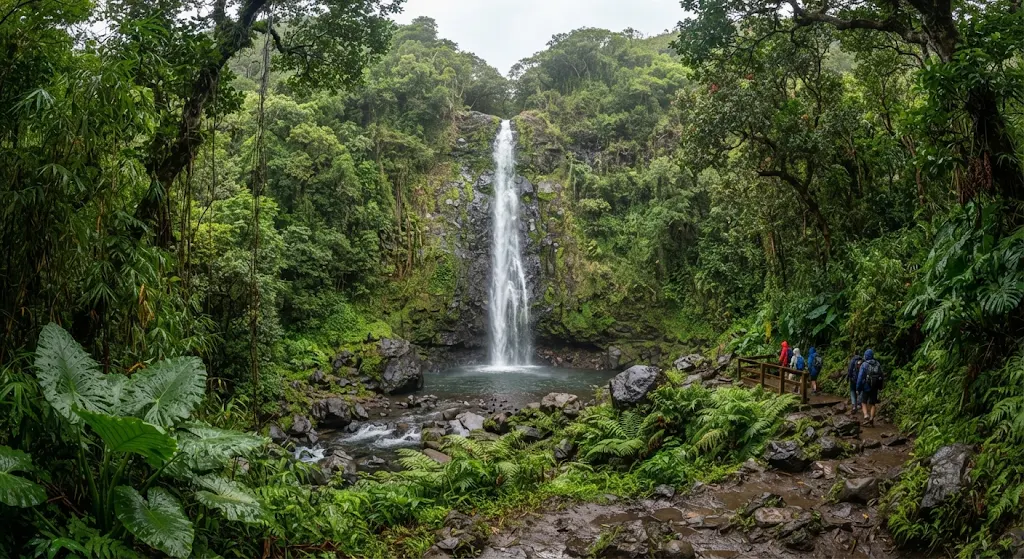
High in the Koʻolau mountains above Mānoa Valley, the mist does not drift so much as it breathes, swallowing the jagged green ridges in cool, grey silence until a man can no longer see the boots beneath his ankles.
Liko had climbed the narrow, root-tangled spine above Mānoa Falls since boyhood, gathering maile vines and medicinal ʻōlena roots for his grandmother’s remedies. He knew every slick basalt ledge, every wind-twisted ʻōhiʻa lehua tree, and every warning his Tūtū had pressed into his palm along with a bundle of ti leaves before he left the porch at dawn: “Never whistle on the ridge after noon, Liko. Never step off the spine when the clouds drop low. And if the air goes still, listen for the wings of our elders—the pueo watches the heights where our feet forget to look.”
By mid-afternoon, the trade winds died, and the heavy mountain cloud—the Ua Tuahine, the famed rain of Mānoa—rolled over the summit like a wet wool blanket. Within minutes, the valley floor vanished. The sheer drop on either side of the razorback trail disappeared into white nothingness, leaving Liko suspended on a strip of mud no wider than his shoulders.
Then came the false trail.
In the disorienting glare of the fog, a faint track of trampled ferns branched left, seeming to follow the familiar curve of the descent. Cold rain plastered Liko’s shirt to his chest as he stepped onto the slick clay, trusting muscle memory over sight.
Before his second boot could settle, a sharp, rasping cry tore through the mist—kē-kē-kē—followed by the soft, muffled whuff of broad feathers brushing inches past his cheek.
Liko threw his arms up, stumbling backward onto the main ridge just as the ground where he had nearly stepped gave way. A slab of rain-soaked mud and loose basalt sheared off silently into the fog, followed three seconds later by the distant, hollow crash of boulders striking the ravine hundreds of feet below.
Heart hammering against his ribs, Liko sank to one knee in the mud. Out of the swirling grey ahead emerged a pueo—the short-eared Hawaiian owl—perched low on a gnarled ʻōhiʻa branch. Its round, golden eyes, ringed in dark feathers like ancient kapa patterns, stared straight into his without blinking. Even in the dim mountain gloom, the pale, streaked plumage of its breast seemed to hold a faint, warm light.
Liko bowed his head, pressing his open palm to his chest in the old gesture of respect. “Aloha, e kūpuna,” he whispered into the damp air. “Forgive my haste. Show me the path home.”
The owl tilted its head once, spread its wide, silent wings, and glided ten yards down the true spine of the ridge, settling onto a mossy boulder before looking back over its shoulder.
Step by careful step, Liko followed. Whenever the fog thickened into an impenetrable wall or a tangle of uluhe ferns threatened to mask a sheer drop-off, the pueo lifted off with a single, soft beat of its wings, hovering in the mist just ahead until Liko found solid footing. Down through the dripping canopy of koa and kukui trees they moved—the owl gliding like a pale lantern through the shadows, the young man following in quiet reverence.
At the edge of the lower forest, where the scent of wet ginger and woodsmoke rose from the valley floor and the warm yellow lights of his grandmother’s house flickered through the dusk, the pueo landed one final time on a stone wall bordering the stream. It let out a low, gentle trill, lifted into the clearing twilight, and banked high toward the Koʻolau cliffs until the last mist folded it from sight.
Liko stood at the threshold of the trail with mud to his knees and the bundle of maile still dry inside his pack, knowing that on Oʻahu’s high ridges, the ancestors never truly leave the mist.