- Stories at this place
- 1
- Filed as
 Apparition
Story 516
Echoes of the Old Pool
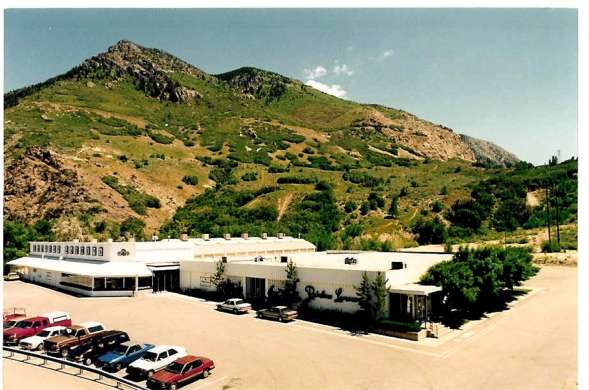
The mouth of Ogden Canyon has always been a place where the earth breathes hot. Long before the pioneers, long before the grand Victorian sanitariums and the mineral bath resorts of the late 1800s, the Ute tribes spoke of the thermal springs not as a gift of healing, but as a vent. They believed the water was the sweat of a subterranean giant trying to claw its way back to the surface, lured by the sound of human laughter echoing off the canyon walls.
Julian knew the history. As a structural archivist mapping the aging foundations of commercial properties slated for renovation, he had spent three weeks in the sprawling labyrinth of Rainbow Gardens. He knew how the grand wooden resort of 1895 had burned straight to the ash. He knew how the brick-built El Monte Springs of the 1920s had collapsed into bankruptcy during the Depression. He knew that beneath the charming boutiques, the terraced solarium gift gardens, and the quiet corridors of the shuttered Planet Rainbow wing, ghosts of old masonry and sealed-off water vaults still slept.
Or so he thought.
It was 11:45 PM when Julian descended into the lower subterranean level—the old footprint of the indoor swimming pool that had been filled in decades prior to create the terraced gift garden. Armed only with a flashlight and a heavy tablet, he was mapping the moisture seepage patterns running off the canyon bedrock.
The air down here always smelled faintly of sulfur and decaying potpourri from the old novelty nooks. But tonight, the air was dead. Heavy. The humidity clung to his skin like a second layer of wet wool.
Drip.
Drip.
Julian shined his light against the exposed brick wall, near where the old bowling lanes used to bleed into the storage annex. Water trickled down the mortar, but it wasn’t clear. It was a thick, rust-colored film that smeared like oil.
“Just iron bacteria,” Julian muttered to himself, his voice sounding hollow, sucked dead by the dense perimeter of artificial flora and dead-stock porcelain dolls left behind in the dark corners of the closed shops.
He tapped his tablet, logging the corrosion. But as he looked at the screen, the blueprint layout of the building seemed to drift. The digital lines warped, stretching outward. On the blueprint, a space appeared—a rectangular chamber right behind the brick wall he was facing. A room that didn’t exist in the architectural schematics of the 1940s Riverside Gardens remodel.
A room labeled in faint, looping cursive: The Bather’s Retention.
Julian frowned, pressing his palm against the damp brick. It felt… warm. Not ambient room temperature, but a feverish, organic heat—roughly 140 degrees, matching the historical records of the uncaptured canyon springs that ran deep beneath the bedrock.
Then, he heard it. A sound muffled by feet of concrete and compacted earth.
Music.
It wasn’t a modern tune. It was a scratchy, distant gramophone recording of a 1920s waltz, warped by time and a terrible, dragging rhythm, as if the turntable was spinning through mud. Accompanied by it came the sound of wet, heavy footsteps splashing in shallow water. Slosh. Pause. Slosh.
Julian’s breath hitched. “Hello?” he called out. His voice lacked any real conviction.
The music stopped. The footsteps stopped.
And then, a voice whispered directly against the inner shell of his ear, clear as a bell, sliding through the bones of his skull:
“The water is so heavy tonight, Julian. Why are you keeping your skin dry?”
Julian spun around, sweeping his flashlight beam across the dark, silent aisles of the abandoned gift stalls. Rows of empty shelves and staring, glassy-eyed porcelain collector dolls stared back at him from the shadows. Their painted smiles looked entirely too wide, stretched tight across ceramic faces.
He backed away, his heel catching on an old, rusted metal rack. He stumbled, hitting the brick wall behind him.
The mortar beneath his spine gave way with a sickening, wet crunch.
The brick wasn’t solid. It was a facade. As he fell backward, he plunged not into a concrete basement, but into a pool of scalding, opaque water that smelled intensely of sulfur and antiquity.
He broke the surface, gasping, coughing up thick, metallic liquid that burned his throat. The flashlight was gone, swallowed by the dark depths. But the room glowed with a sickly, iridescent amber light filtering upward from the vents below.
He wasn’t in a modern store room. He was inside the original 1895 timber-and-stone bathhouse vault—the one official history claimed had burned entirely to ash.
The wooden beams above him were charred black, dripping with continuous, weeping condensation. And lining the edge of the sunken pool were figures. Dozens of them. They stood waist-deep in the steaming water, their bodies stretched impossibly tall and thin, dressed in heavy, sodden Victorian bathing attire that clung to frames that looked entirely hollow.
They weren’t looking at him with eyes. Their faces were smooth, blank slates of wet clay, yet they tracked his every movement.
Julian tried to scream, but the air in his lungs turned to steam. He looked down at his hands. The skin on his fingers was beginning to wrinkle, turning pale, translucent, and gray, sloughing off in long strips as the mineral-heavy water ate hungrily at his flesh.
From the center of the pool, a figure larger than the rest shifted. It raised a long, water-logged arm, pointing a finger directly at his chest.
“Stay,” a chorus of a hundred voices hissed from the bubbling vents, echoing the promotional slogans of the resort’s distant past. “Gifts, food, and eternal fun at the mouth of the canyon.”
Julian tried to swim for the breach in the wall, but his legs wouldn’t obey. They felt heavy, heavy as lead, heavy as stone, sinking down into the subterranean muck where the earth’s old giants pull everything down to breathe the heat.
Above, on the surface, the automatic lights of the modern Rainbow Gardens gift shop flickered on for the morning shift, illuminating rows of cheerful wind chimes and bright Utah souvenirs, completely undisturbed by the quiet, permanent addition resting deep beneath the floorboards.