- Stories at this place
- 2
- Filed as
 Menehune
Story 423
The Masons of Waimea
The red dust of Waimea Canyon does not merely stain boots; it settles in the lungs, a fine, iron-rich silt that tastes faintly of old pennies and damp earth.
To the tourists leaning over the concrete guardrails of the Waimea Canyon Lookout, the 3,000-foot chasm is the “Grand Canyon of the Pacific,” a sweeping canvas of rusted basalt and emerald green. But the locals know the truth of the geography. They know that what looks like the natural carving of the Waimea River is too precise, too geometric in places—terraces that defy the erosion of centuries, and massive basalt blocks fitted together with a tightness that leaves no room for mortar, nor explanation.
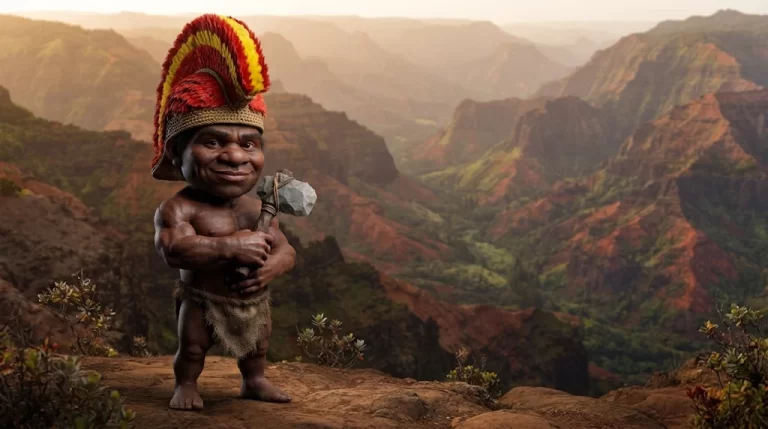
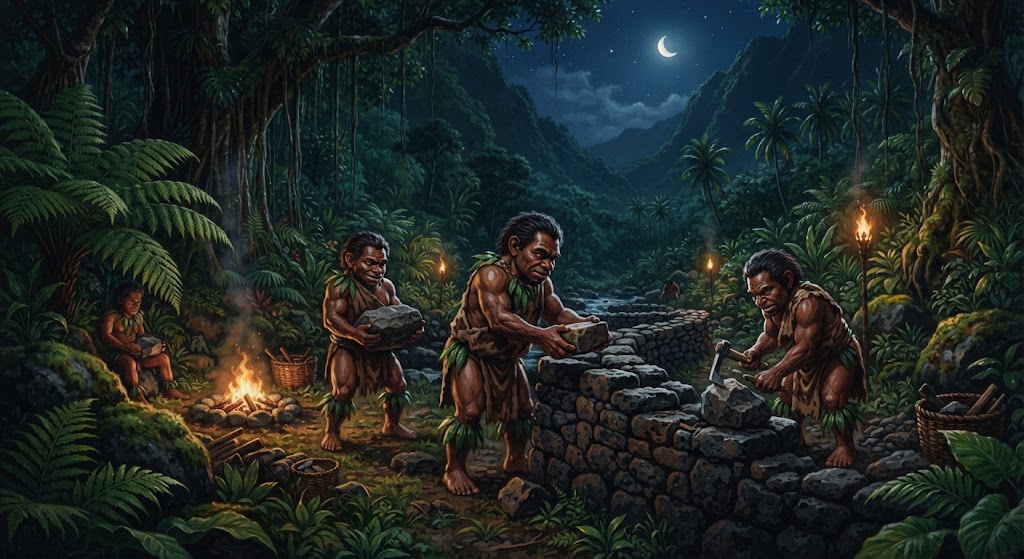
In Hawaiian folklore, the Menehune are master builders of the night—elusive, diminutive people who could carve out watercourses, build stone temples (heiau), and construct massive fishponds in a single evening, bound by a strict celestial law: their work had to be completed before the first rays of the sun struck the mountain peaks. If dawn broke and a single stone was unplaced, they vanished into the fern-choked mists, leaving the project behind.
Most tourists think it’s a charming myth told to children.
Julian Thorne found out it is a warning.
Julian was a surveyor, a man of precise angles and cold iron chains, hired to map a remote, unplatted spur of the canyon rim before a private development venture broke ground. He liked the solitude. By late afternoon, the tourist vans had vanished down the winding highway, leaving Julian alone with the wind whistling through the koa trees and the shadows creeping up the canyon walls.
At precisely 6:15 PM, as the sun dipped behind the western ridge, the temperature plummeted.
A heavy, wet mist rolled over the rim, smelling intensely of crushed mountain fern and something sharper—something like the copper tang of an exposed nerve. Julian pulled his high-vis jacket tighter and checked his tripod.
That was when he heard the tapping.
It wasn’t the rhythmic click-click of an animal’s claws on stone. It was metallic, rhythmic, and impossibly dense. Tink. Tink. Tap-tink.
“Hello?” Julian called out, his voice swallowed instantly by the thick, grey fog.
The tapping stopped.
Julian switched on his high-powered LED headlamp, sweeping the beam across the red-dirt track. Ten yards away, crouched at the edge of a sheer drop-off, was something small.
At first, he thought it was a feral pig or a stray dog. But it walked on two legs, and it was impossibly broad-shouldered for its height—no taller than three feet, with limbs so thick they looked like knots of polished koa wood. Its skin wasn’t brown or fair; it had the dull, light-absorbing sheen of raw, unpolished basalt.
The creature didn’t run. It slowly turned its head.
In the brilliant beam of Julian’s headlamp, he saw its face. There was no nose to speak of, just two flared slits above a wide, flat mouth stretched tight across a jaw that seemed too large for its skull. Its eyes weren’t reflective like an animal’s; they were deep, lightless hollows, watching him with an ancient, calculating intelligence.
In its massive, calloused hands, it held a wedge of black volcanic rock and a heavy stone mallet.
Julian stumbled backward, his boot heel catching on a surveyor’s stake. He fell hard onto his back, the breath rushing from his lungs. When he looked up, the small figure was gone.
“Nerves,” Julian whispered to the empty air, his heart hammering against his ribs. “Too much coffee, too much altitude.”
He scrambled to his feet, grabbed his gear, and turned toward his truck parked fifty yards down the trail.
That’s when he saw the road.
Or rather, the lack of it.
The red-dirt access road he had driven up just hours ago had vanished. In its place stood a sheer, unbroken wall of cyclopean masonry—giant, dark-grey basalt blocks, fitted together so tightly that not even a knife blade could slide between them. They rose twenty feet into the fog, glistening with fresh, heavy condensation.
Julian spun around. The canyon behind him had changed, too. The ragged, overgrown slopes were gone, replaced by stepped agricultural terraces carved deep into the cliffside, descending into an abyss of absolute blackness.
From the darkness below came the sound.
It was no longer a single tap. It was a chorus. Thousands of tiny, rhythmic strikes echoing against the stone walls—a frantic, synchronized symphony of construction. Tink, tink, tap. Tink, tink, tap.
Julian ran along the base of the massive stone wall, panic clawing at his throat, screaming into the mist. “Let me out! Hey! Somebody!”
A shadow detached itself from the top of the wall. Then another. And another.
They lined the stone ledge above him, dozens of them, silhouetted against the pale, dying light of dusk. They didn’t shout. They didn’t threaten. They simply worked. With terrifying speed, they passed heavy stone blocks hand to hand, building upward, enclosing the space, sealing the canyon rim block by block.
Julian realized then why the Menehune worked only by night. They weren’t hiding from humans out of shyness. They were hiding their remaking of the world.
He lunged forward as the final gap in the wall began to close, but a small, heavy hand—cold as river silt and strong as hydraulic steel—clasped around his ankle.
Julian fell face-first into the red dust.
As the last stone slid into place, plunging the enclosure into total, absolute darkness, the frantic tapping stopped. A deep, resonant silence settled over Waimea Canyon, broken only by a low, collective exhale from the shadows.
Out on the highway above, the morning tour buses would soon arrive. The sun would crest the eastern ridge, painting the canyon in brilliant strokes of gold and rust. The tourists would look down at the magnificent, geometric terraces and marvel at what nature could carve out of the earth over millions of years.
And down in the dark, the work had only just begun.