- Stories at this place
- 3
- Filed as
 Roads
Story 238
Clinton Road After Midnight
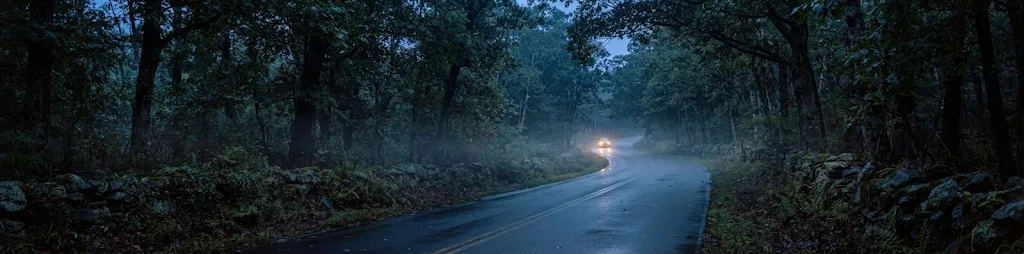
The locals called it Miller’s Span, though no one remembered which Miller had built it or when. It was just a rotting hump of gray concrete and rusted iron rail, choked by blackberry brambles, spanning a narrow, black-watered creek three miles out on the county line. By day, it was nothing—a rusted nuisance where teens occasionally left crushed beer cans. By night, it belonged to the Ghost Boy.
The legend was as old as the county itself: stand on the apex of the bridge after midnight, cast a silver coin into the black current, and wait. If the current went dead still, the ghost child would toss the coin straight back up to strike your shoe. But if you weren’t careful—if you reached too fast or listened too closely to the wet, bubbling splash—a small, icy hand would shoot from the reeds and try to pull you down into the muck.
Julian didn’t believe in legends. He believed in deadlines, thirty-year mortgages, and the crushing, low-grade exhaustion of a man who worked forty-eight hours a week at a regional distribution warehouse.
Yet, at 12:15 AM on a Tuesday, his sedan was parked off the shoulder of the old wagon road, its hazard lights blinking a rhythmic amber against the damp ferns.
He stood on the crown of the bridge. The air smelled of rotting leaves, stagnant iron, and the sharp, autumn chill that bites through a denim jacket. Below him, the brook didn’t babble; it gurgled, a thick, sluggish murmur over submerged stones.
Julian pulled a quarter from his pocket. It felt heavy in his palm, cold as a key.
“Stupid,” he muttered to himself, his breath pluming white in the dark.
He had come out here because his younger sister, Clara, would have turned twelve today. Or she would have, if the ice on the old farm quarry hadn’t given way twenty years ago. He had been fourteen, standing on the bank, too paralyzed by terror to reach out a branch. He had watched her slip under. He had spent half his life wondering what it felt like to drown—to have the water fill your chest like liquid lead, stealing your voice before you could even scream.
With a dry swallow, Julian flicked the quarter.
It left his thumb in a silver arc, catching a stray beam of moonlight before plunging into the black water. Plip.
Then, absolute silence. The crickets stopped their chorus all at once. The wind died in the branches. The gurgling of the creek seemed to mute itself, pulled down into a vacuum of anticipation.
Julian held his breath, his boots frozen to the concrete. One second. Five. Ten.
Clink.
Something small and hard struck the toe of his right boot and bounced onto the asphalt.
Julian looked down. It was a quarter. Not the modern eagle-stamped coin he had thrown, but a slick, darkened old Washington head, worn nearly smooth at the edges, coated in a film of black river silt.
A sudden, violent shiver racked his spine. He took a half-step back, his heart hammering against his ribs like a trapped bird.
From beneath the concrete lip of the bridge, where the iron girders rusted into the mud, came a sound. It wasn’t a splash. It was the wet, sucking drag of bare feet shifting in deep silt.
Then came the breathing—shallow, rattling, and choked with water.
“Hello?” Julian’s voice was a cracked whisper. He shouldn’t have spoken. The legend said you mustn’t answer.
A small, pale face emerged from the shadow of the bridge abutment.
It was a boy, no older than ten, wearing a faded blue cotton shirt that clung like a second skin to his frail ribs. His skin had the greyish, bloated pallor of something kept too long in the dark. But it was his eyes that locked Julian in place—wide, dark, and hollow, brimming with an ancient, unbearable cold.
The boy raised a tiny, waterlogged hand from the water and pointed a thin finger straight at Julian’s chest.
“Cold,” a voice whispered in Julian’s mind, thin as a winter draft. “It’s so cold down there, Julian. You forgot to pull me out.”
Julian staggered backward, his heel catching on the rusted lip of the bridge railing. Panic, sharp and white-hot, seized him. The ghost boy lunged forward with impossible speed, his small hands splashing onto the concrete edge, fingers ending in long, grey nails that clamped onto the hem of Julian’s jacket.
The grip was iron. It pulled with the weight of an undertow, dragging Julian toward the drop.
“No—let go!” Julian gasped, dropping to his knees as the cold surged up through his clothes, freezing the air in his lungs. He looked down into those hollow eyes and didn’t see a monster. He saw Clara’s eyes on the day the ice cracked. He saw his own cowardice, waiting for him in the dark.
For twenty years, he had run from that water. He had built his whole life around outrunning the memory of that helpless second on the quarry bank.
Julian stopped fighting the pull. Instead, tears hot and sudden spilling over his lashes, he leaned forward over the concrete edge, reached down through the bite of the night air, and grabbed the boy’s tiny, freezing wrist with both hands.
The skin was like river ice. The shock of it paralyzed his fingers, but he tightened his grip anyway.
“I’m sorry,” Julian choked out, his voice breaking into the silent woods. “I’m so sorry I let go.”
For a heartbeat, the weight grew heavier—heavy as an entire river pressing down on his chest.
Then, the tension broke.
The icy grip vanished from his jacket. The hand slipped from his fingers not with a shove, but like water sliding through an open palm.
Julian fell backward onto the rough asphalt, gasping for air, clutching his chest as if he’d just broken the surface after a long, deep dive.
The crickets slowly resumed their hum. The creek began to gurgle again over the stones.
Julian lay on his back for a long time, staring up at the indifferent stars through the tangled branches of the oak trees. When he finally sat up, his hands were trembling.
He looked down at his boots. The old, smoothed-out quarter was still sitting there in the dust.
Julian picked it up. It was freezing cold, but as he closed his fist around it, the metal slowly warmed against his palm. He stood up, dusted off his knees, and walked back to his car, leaving the dark water behind him to flow quietly beneath the bridge.