- Stories at this place
- 3
- Filed as
 Night Marchers
Story 230
Marchers on the Pali
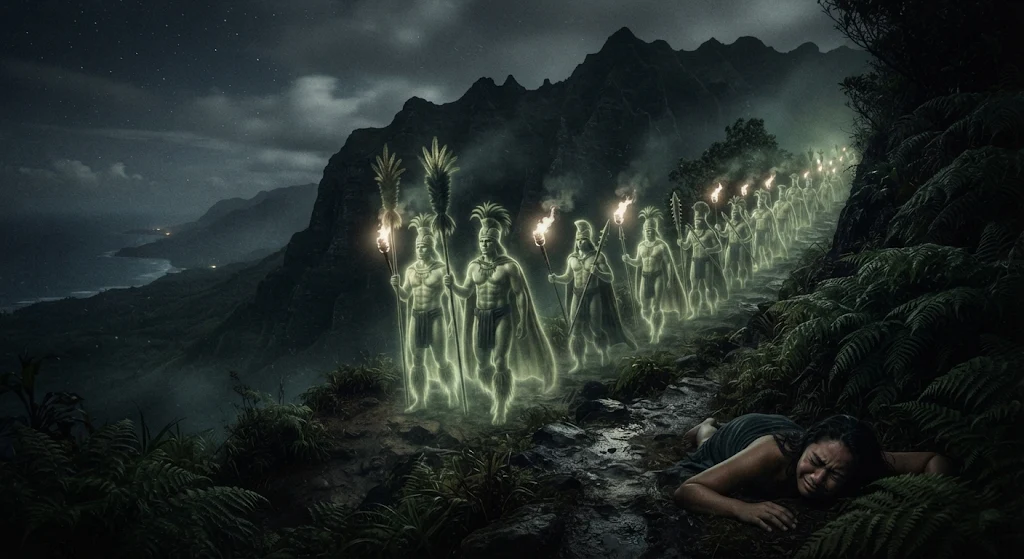
The wind does not simply blow through the Nuʻuanu Pali; it screams. It funnels down the steep, jagged Koolau mountain pass with a force that can knock a person off balance, tearing at the trees and howling through the highway tunnels. For most modern travelers, the Pali Lookout is a breathtaking scenic stop to admire the panoramic wash of green valley and ocean. But for those who know the history—and those who respect the shadows—the wind carries something far heavier.
It carries the echoes of May 1795.
The Crimson Climax of Unification
In the spring of 1795, the fate of the Hawaiian Islands hung in the balance. King Kamehameha I of the island of Hawaiʻi was relentless in his campaign to conquer and unify the archipelago under a single rule. Having already secured Maui and Molokaʻi, his massive armada of peleleu war canoes crossed the channel and landed on the shores of Oʻahu, stretching from Waiʻalae to Waikīkī.
Waiting for him was Kalanikūpule, the king of Oʻahu. Outnumbered and facing Kamehameha’s terrifying advantage of European-supplied muskets and swivel cannons—commanded in part by captured British sailors like John Young—the Oʻahu defenders fought a desperate, retreating battle up the narrow floor of the Nuʻuanu Valley.
The defense crumbled near Laʻimi when Oʻahu’s brilliant general, Kaʻiana, was struck down by cannon fire. Panic rippled through the ranks. Pushed by the advancing forces of Kamehameha, the retreating warriors and chiefs found themselves trapped. Behind them lay no escape—only a sheer, vertical precipice dropping hundreds of feet down the windward cliff face.
In the desperate chaos that followed, hundreds of Oʻahu warriors were driven over the edge of the pali. The battle earned the grim name Kaleleakaʻanae—literally translating to “the leaping mullet,” after the fish leaping from the water to escape predators. When construction workers laid the original Pali road over a century later in the late 1890s, they unearthed more than 800 human skulls at the base of the cliff, silent witnesses to the day a kingdom fell and the modern Hawaiian nation was born.
The Huakaʻi Pō
The blood spilled in Nuʻuanu Valley did not wash away with the heavy mountain rains. In Hawaiian lore, when a person dies a violent, sudden, or spiritually significant death, their spirit may be bound to the earth, marching in eternal cycles of duty and remembrance.
They are the Huakaʻi Pō—the Night Marchers.
On Oʻahu, particularly during the sacred nighttime moon phases associated with the ancient gods, the Pali is said to belong to them.
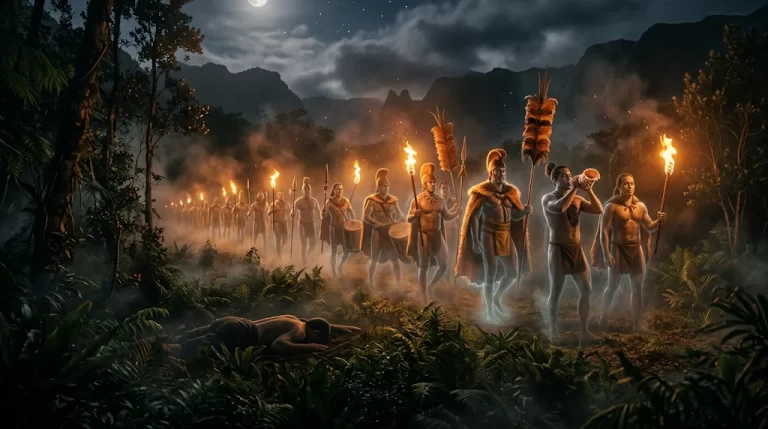
Local legend warns that if you stand near the old paths after midnight, the air changes. The trade winds suddenly die, replaced by an unnatural, dead silence. Then, a low, rhythmic thunder begins to vibrate through the earth—the measured, heavy beat of sharkskin drums. Faint chanting, high-pitched and haunting, rises above the rustle of the ferns.
Then, you see them.
A single line of towering, muscular figures emerges from the mist. They wear feathered helmets and dark malo (loincloths), their skin gleaming with the sweat of an endless battle. Some carry shark-tooth clubs (leiomano) and ancient spears; others bear tall kāhili (feathered standards) denoting high ancestral chiefs. In their hands, they carry blazing torches made of kukui nuts, which cast a strange, ghostly green-gold light that flickers without consuming wood.
They march with absolute, terrifying purpose. They are the vanguard of a sacred chief, retracing the steps of their final, fatal campaign, moving seamlessly between the steep rock faces where the old trails lie.
Crossing the Path
For generations, kupuna (elders) have passed down strict, unyielding laws regarding an encounter with the Huakaʻi Pō. To break these rules is to invite certain doom.
If you hear the drums and see the torches flickering on the Pali highway, you do not run toward your car. You do not stand your ground to look.
According to tradition, if you are caught in their path, you must immediately drop to the ground. You must lie flat on your stomach, face down in the dirt, keeping your eyes tightly shut. You must not make a sound, and above all, you must never look upon them. To gaze directly at a Night Marcher is to show a fatal disrespect, and the spirits will snap your neck where you lie.
Some traditional accounts note one exception: if a marcher steps over you and recognizes you as a blood descendant—a member of their own ʻohana—they will whisper “Naʻu” (“Mine”) and spare your life, letting you pass untouched. For anyone else, survival depends entirely on absolute, humble submission to the ghosts of the past.
As dawn approaches, the rhythmic drumming begins to fade. The spectral torches flicker out against the first pale rays of sunlight stretching over the windward side of Oʻahu, and the warriors retreat into the mist of the pali.
The highway opens to morning traffic. Cars stream through the tunnels, commuters rush to work, and tourists snap photos of the breathtaking view, entirely unaware of the sacred blood-soaked ground beneath their feet. But the valley remembers. And when the moon wanes dark, the drums wake up once more