- Stories at this place
- 1
- Filed as
 Campground
Story 1319
Holy Ghost Gampground
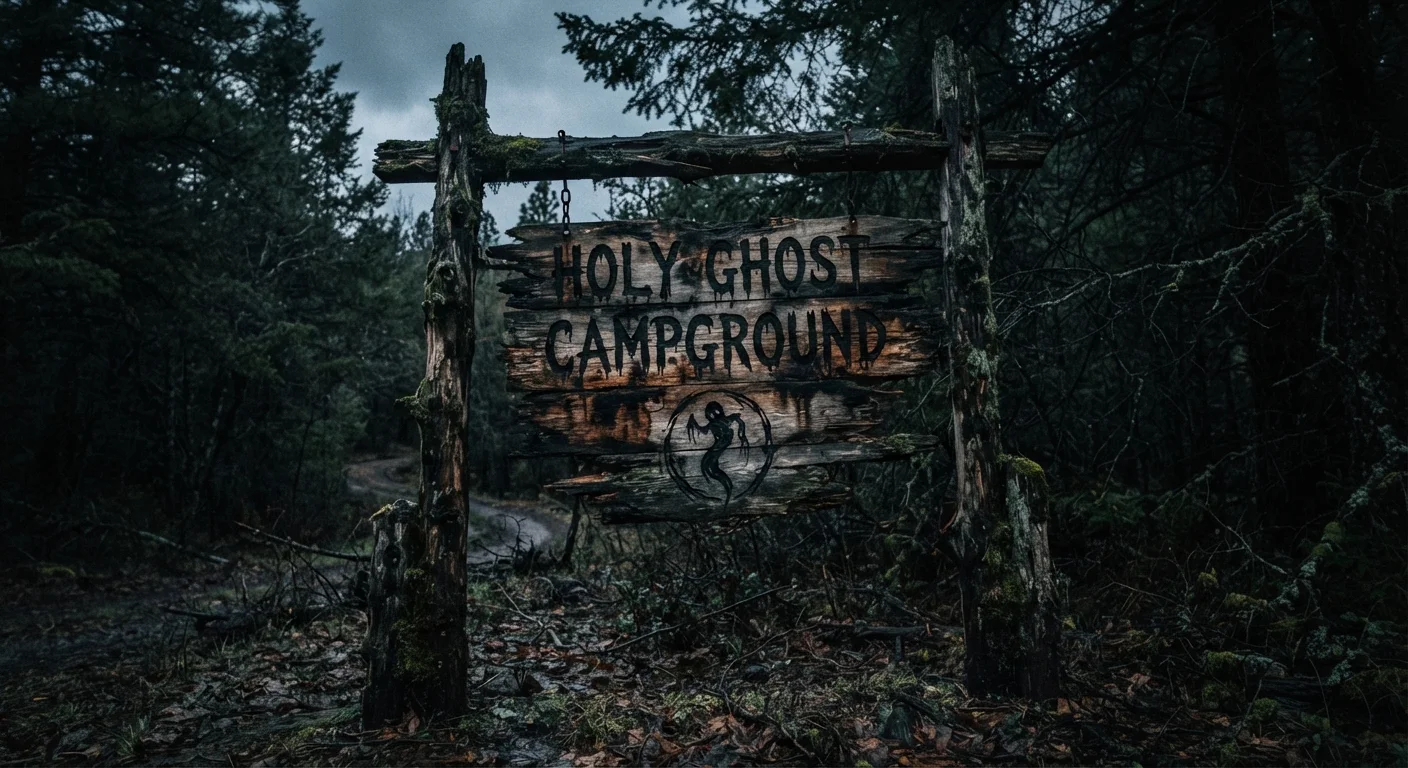
The wind in the Sangre de Cristo Mountains does not howl; it whispers in Spanish, low and rhythmic, like the murmur of a parish congregation reciting the rosary in an unheated adobe church.
Marcus knew the legends of Holy Ghost Campground before he ever turned his truck onto Forest Road 122, just north of Terrero, New Mexico. Everyone in Pecos knew them. They knew that in the late nineteenth century, the narrow canyon was home to an isolated Hispanic settlement—and to a priest whose devotion curdled into madness. As the local folklore goes, the padre began murdering his own parishioners, burying their bodies in the rocky soil beneath the tall ponderosa pines. When the townspeople finally uncovered his crimes, they didn’t wait for the territorial authorities from Santa Fe. They dragged him into the woods and hanged him from a heavy pine bough, leaving his body to swing in the mountain chill.
The Forest Service cleared the old structures decades ago, leaving behind neat numbered campsites, fire rings, and the cold, clear rush of Holy Ghost Creek.
“Just ghost stories to keep the Santa Fe tourists from crowding the best trout holes,” Marcus muttered to himself, zipping his tent against the October frost. It was late in the season—past the peak of the golden aspens—and his was the only vehicle parked along the creek loop.
At 2:14 a.m., the creek stopped making noise.
Marcus woke instantly, his breath clouding in the dark nylon dome of his tent. In the mountains, sudden silence is worse than a sudden sound. Even the wind in the ponderosas had died, leaving a heavy, suffocating vacuum that pressed against his eardrums.
Then came the footsteps.
They weren’t the heavy, shuffling crunch of a black bear foraging near the bear box, nor the light, nervous patter of mule deer. It was a slow, deliberate crunch-drag, crunch-drag on the pine needles, circling the perimeter of his camp.
Marcus reached slowly for his flashlight, his thumb hovering over the rubber switch. Through the thin mesh of the rainfly, a faint, greenish luminescence flickered—like swamp gas, or the pale glow of a lantern seen through frosted glass. In the old stories from Terrero, campers spoke of La Llorona weeping along the creek beds, and of glowing orbs drifting between the trunks where the unmarked graves lay.
The footsteps stopped directly outside his tent flap.
The air temperature inside the tent plummeted. Frost bloomed visibly across the inside of the nylon fabric in jagged, fern-like patterns. Through the thin wall, Marcus saw the silhouette of a tall figure standing motionless. The figure’s head was tilted at an unnatural, broken angle, resting sharply against its left shoulder.
A smell filled the tent—not woodsmoke or pine, but damp earth, old tallow candles, and the sharp, metallic tang of copper.
“Confiesa,” a voice rasped. It sounded as though it were being forced through a crushed throat. “El servicio está por comenzar.”
Marcus didn’t breathe. His fingers locked around the aluminum body of the flashlight, paralyzed by a primal certainty that clicking it on would seal his fate.
Outside, the silhouette raised one long, skeletal arm, pointing down toward the dirt beneath Marcus’s sleeping pad—directly into the rocky ground where the old village once stood. Slowly, the shadow stepped backward, fading into the pitch-black timber without snapping a single twig.
A heartbeat later, the roar of Holy Ghost Creek rushed back into Marcus’s ears, loud and deafening, accompanied by the sudden, violent thrashing of the wind through the pines.
Marcus didn’t wait for dawn. He left his tent, his sleeping bag, and his lantern behind, sprinting barefoot to his truck and tearing down the washboard gravel toward the Pecos River, never once looking in his rearview mirror at the dark canyon behind him.
The History & Folklore Behind the Haunting
While Marcus’s encounter is fiction, the eerie reputation of Holy Ghost Campground in the Santa Fe National Forest is deeply rooted in New Mexico folklore and regional history:
-
The Legend of the Mad Priest: The most persistent local tale claims the canyon was once a small 19th-century Hispanic village whose parish priest went insane and murdered several members of his flock. According to the lore, surviving villagers executed him by hanging him from a tree in the canyon—giving the area its unsettling name, Holy Ghost (Espíritu Santo).
-
Historical Reality vs. Myth: While historians and Forest Service records have found no official documentation of a mass-murdering priest in the canyon, the area was genuinely settled by Hispanic homesteaders and loggers in the late 1800s and early 1900s, and the nearby town of Terrero boomed as a bustling copper, lead, and zinc mining camp in the 1920s and 1930s before rapidly becoming a near-ghost town when the mine closed in 1939.
-
Reported Phenomena: Over the decades, campers and hikers have consistently reported unexplained cold spots, disembodied chanting or weeping near Holy Ghost Creek (often linked to regional legends of La Llorona), mysterious floating lights among the trees, and the overwhelming sensation of being watched after sundown.