- Stories at this place
- 1
- Filed as
 Roads
Story 1253
The Devil’s Highway
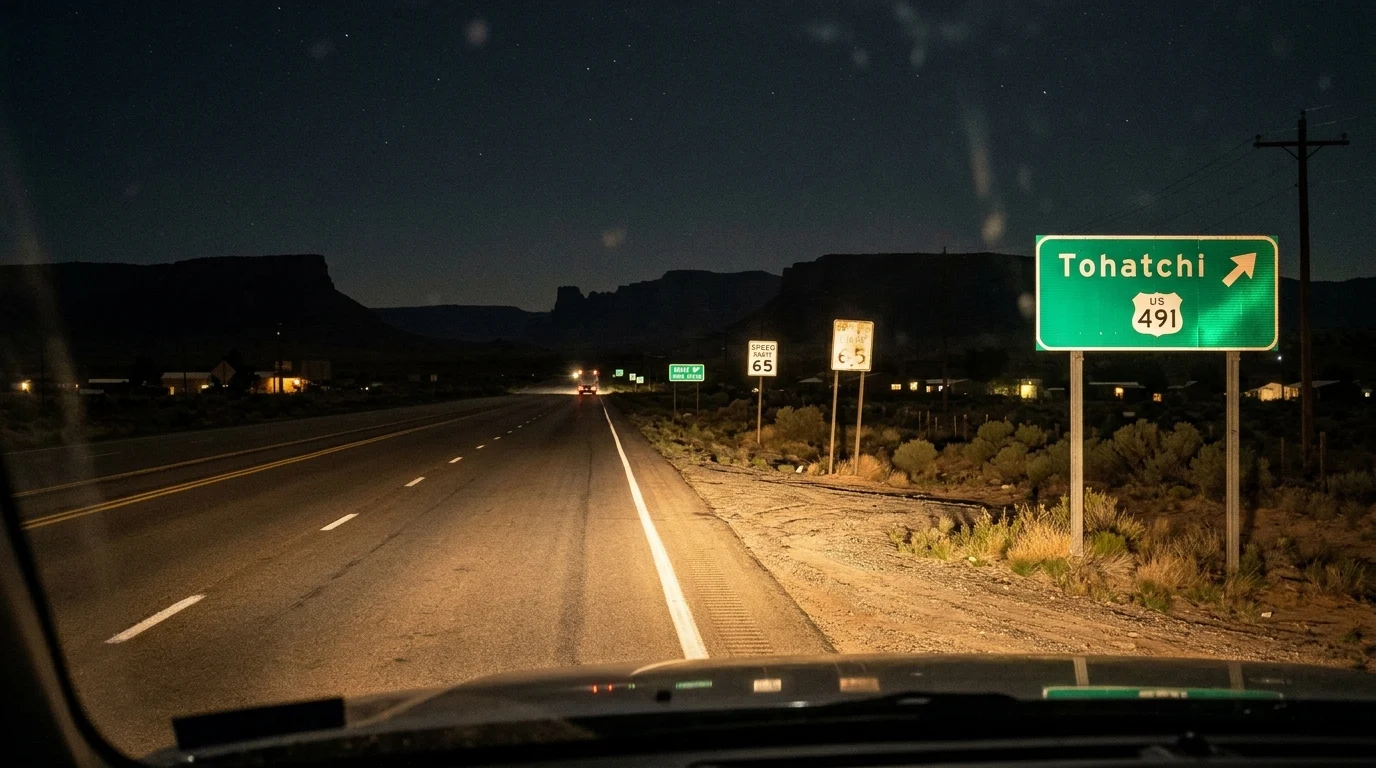
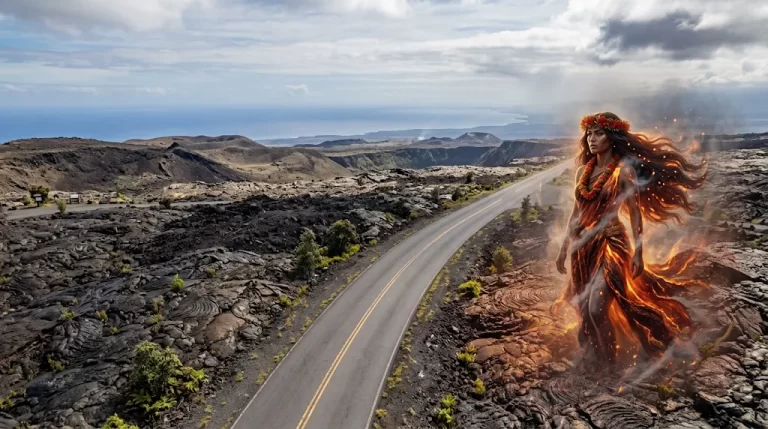
Cutting north out of Gallup, New Mexico, through the vast expanse of the Navajo Nation and into Colorado and Utah, U.S. Route 491 looks today like any other high-desert corridor. For nearly eighty years, however, it bore a designation that made it one of the most infamous roads in America: U.S. Route 666. Assigned in 1926 simply because it was the sixth spur of the iconic U.S. Route 66, the highway’s biblical number quickly earned it the nickname “The Devil’s Highway.” Originally stretching from Arizona up to Monticello, Utah, the route was truncated at Gallup in 1992 when Arizona renumbered its segment to U.S. 191, leaving New Mexico, Colorado, and Utah with the notoriety.
The road’s dark reputation wasn’t built on superstition alone. For decades, the narrow, poorly lit two-lane stretch north of Gallup—passing near the sacred volcanic peak of Shiprock—suffered from a staggering fatality rate, earning a spot in 1997 among the 20 most dangerous highways in the United States. Where engineering failed, folklore rushed in to fill the dark. Late-night truckers and local drivers traded stories of hellhounds with glowing yellow eyes tearing at tires at sixty miles an hour, vanishing hitchhikers standing motionless on the shoulder, and a phantom 18-wheeler—its cab glowing with unnatural fire—barreling down the center line to force cars into the arroyos. Alongside these highway myths sat older, quieter warnings from Navajo tradition about skinwalkers stalking the isolated mesas after sundown.
In 2003, following a campaign led by New Mexico Governor Bill Richardson and Navajo Nation leaders—who wanted both federal safety upgrades and an end to the stigma hurting local tourism—highway officials officially renumbered the road U.S. Route 491. Almost overnight, souvenir hunters stripped the highway bare, using chainsaws to cut down wooden posts and even ramming cars into welded metal poles to steal the last 666 shields. At the July 2003 rededication ceremony, Navajo medicine man George Blue Horse performed a blessing to lift the road’s dark legacy, declaring that the new number would be “a medicine.” Subsequent widening and safety projects dramatically lowered the crash rate—yet drivers who run the corridor between Gallup and Cortez after midnight still say the asphalt remembers its old name.
The Old Number
Dale had been hauling freight between Albuquerque and Salt Lake City long enough to know that the desert doesn’t care what the Department of Transportation puts on a sign.
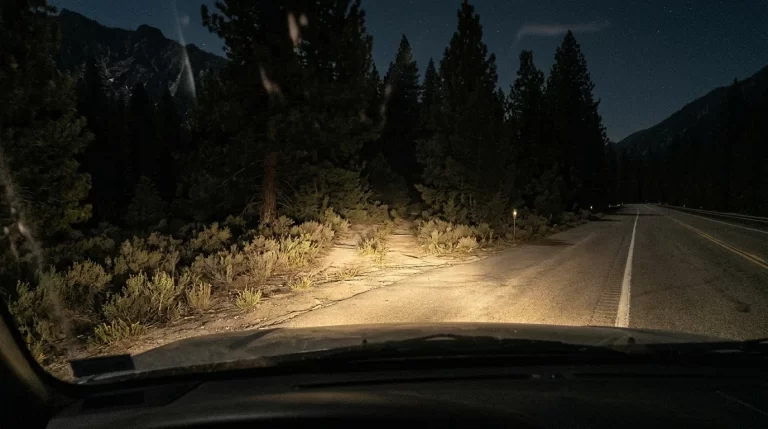
It was a little past eleven on a moonless November night when he turned north off I-40 at Gallup onto U.S. 491. His rig was running light—just a half-load of commercial HVAC parts bound for Monticello—and the cab smelled faintly of stale coffee and warm dust from the defroster. He had made this run a dozen times since they widened the lanes, and normally it was the easiest four hours of his week: flat blacktop, sparse traffic, and the jagged silhouette of Shiprock rising out of the dark ahead like a sunken cathedral.
Twenty miles north of Gallup, the temperature gauge on his dash dropped nine degrees in thirty seconds.
Dale tapped the plastic face of the instrument cluster with his knuckle, thinking the sensor had shorted. At the exact same moment, the FM radio—which had been playing a tinny country station out of Farmington—collapsed into a low, rhythmic hiss, like tires rolling over wet gravel.
He reached over to twist the dial, and that was when he saw the headlights in his driver-side mirror.
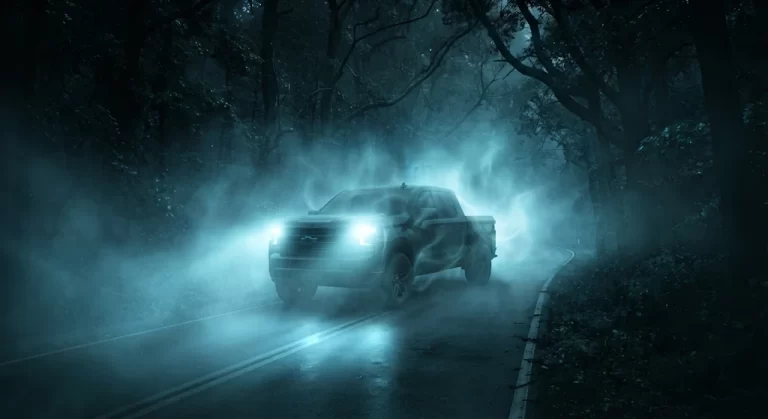
They hadn’t been there a second ago. On a straightaway this flat, you can see a set of high beams five miles back, climbing the rises long before they ever reach your bumper. These were already less than a hundred yards behind his trailer, burning a dull, dirty amber instead of modern LED white.
Great, Dale muttered, easing off the throttle a hair to let whoever it was pass. Some local running late.
The lights didn’t pull into the left lane. They closed the gap in three heartbeats and settled directly behind his rear doors, so close that the hood vanished into his trailer’s blind spot. Even over the steady thrum of his own Cummins diesel, Dale couldn’t hear the other truck’s engine—no turbo whine, no jake brake, nothing. Just a faint, dry crackle through his CB speaker, even though the unit was switched off.
He checked his speedometer: sixty-five. He pushed it to seventy. The amber headlights stayed glued to his tail, casting a strange, flickering orange wash across his side mirrors, as if the other driver had a flare burning on his dashboard.
Then Dale caught movement in the ditch to his right.
At first he thought it was a stray reservation dog chasing the rig, the way they sometimes do near the turnoffs. He shifted his gaze to the passenger-side mirror and felt his stomach drop.
Whatever was pacing his cab on the gravel shoulder wasn’t a dog. It was low, heavy-shouldered, and running effortlessly at seventy miles an hour, its legs moving in a fluid, loping stride that kicked up no dust. When it turned its head toward his window, his ditch-light caught two pale, reflective eyes—set too wide apart, and staring straight up into the cab with a cold, deliberate focus.
Dale’s hands locked onto the wheel. He didn’t brake. Every trucker who runs the Four Corners knows the rule: if something paces you in the dark, you don’t slow down, and you don’t look it in the eye.
He kept his eyes pinned to the painted yellow line ahead. The next highway route sign caught his high beams. As he flashed past it, the reflective white metal seemed to blur—not 491, not for a fraction of a second, but three crisp black sixes staring back out of the dark on a scarred, rusted shield that hadn’t stood on this road in more than twenty years.
Behind him, an air horn blasted.
It wasn’t a normal horn. It sounded warped and hollow, like a brass pipe screaming through a tunnel of fire, rattling the glass in Dale’s side windows. In the left mirror, the massive, dark grille of an old cab-over semi surged into the passing lane—no chrome, no company markings, just blackened metal and a cab interior glowing dull red like banked coals.
Dale wrenched the wheel right, his passenger tires spitting gravel on the rumble strip, bracing for the crunch of steel.
The phantom rig swept past his door without a breath of wind. There was no buffeting of air, no roar of tires on asphalt—just a sudden, suffocating wave of heat and the sharp, unmistakable smell of scorched rubber and burning diesel seeping through his closed vents.
He stared straight ahead, waiting for the red taillights to pull in front of him.
The highway was empty.
Nothing ahead. Nothing in the mirrors. The amber glow was gone. On the shoulder to his right, the sagebrush stood still and lifeless under the stars. Slowly, the country station crackled back to life on the dashboard, mid-chorus, as if nothing had ever interrupted it.
Dale didn’t stop in Shiprock. He didn’t stop in Cortez. He drove straight through to the truck stop in Monticello with the cab lights turned all the way up, his knuckles white against the steering wheel.
When he finally climbed down onto the concrete to stretch his legs and check his tires, the desert air was crisp and freezing. Everything on the rig looked normal—except for the passenger-side door, just below the mirror, where three long, deep gouges had been scraped clean through the paint down to bare metal, still warm to the touch.