- Stories at this place
- 1
- Filed as
 Pele
Story 1156
Madame Pele on Chain of Craters Road
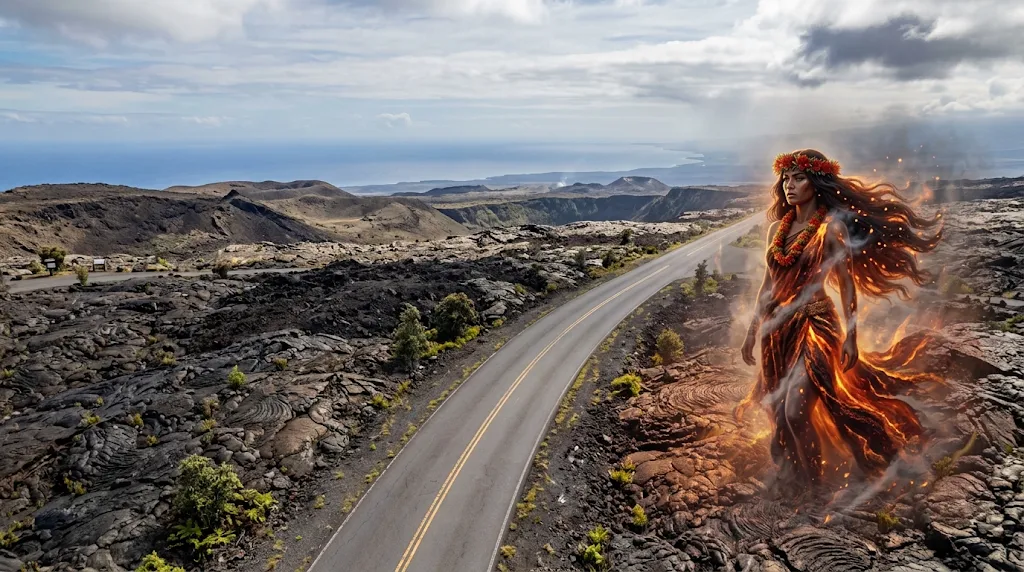
The air along Chain of Craters Road in Hawaiʻi Volcanoes National Park always tastes faintly of sulfur and ancient rain. As the black ribbon of asphalt winds down the slopes of Kīlauea toward where the sea swallowed the road, the temperature shifts abruptly—pockets of tropical warmth colliding with the cold, ghostly breath of the high calderas.
For Elijah, who drove the winding descent every evening just as the sun dipped below the rim, the road was more than a scenic route. It was a bridge between the modern world and something far more ancient.
The Heart of the Legend
Long before the National Park Service laid asphalt over the fiery scars of Puna, the Hawaiian people knew this landscape as the sacred domain of Pehuʻaināpoiʻaikalani—more simply and reverently known as Madame Pele, the deity of fire, lightning, wind, and volcanoes.
According to ancient folklore, Pele did not originate in these islands. She fled her homeland of Kahiki across the ocean, pursued by her angry sister, Nā Maka o Kahai, the goddess of the sea, who sought to drown Pele’s sacred fires. From island to island Pele traveled, digging fire pits with her magic digging stick, Pāoa. Each crater she carved—from Kauaʻi down the chain to the majestic summit of Mauna Loa and finally into the restless womb of Kīlauea—became a home.
The Chain of Craters Road follows the East Rift Zone of Kīlauea, cutting directly through grounds deeply steeped in her presence. Hawaiian tradition holds that Pele often walks this terrain in disguise. She is famously known to appear as an old woman dressed in a tattered white muʻumuʻu, sometimes accompanied by a small white dog, walking alone along the remote stretches of volcanic highways. She tests the hearts of travelers, asking for a ride, a glass of water, or a simple offering of aloha.
The Encounter
Elijah knew the stories well. Born and raised in Hilo, his grandmother had drilled the rules of the mountain into him since he was a child: Never disrespect the ʻāina (land). Never take rocks or sand as souvenirs—the “Curse of Pele” ensures they bring endless misfortune until returned. And above all, if you see an old woman on the roadside after dark, you pull over.
It was dusk when Elijah’s headlights swept across a figure standing near the shoulder of the road, right where the old lava flows from the 1969–1974 Maunaulu eruption crossed the asphalt.
An old woman stood completely still against the vast, dark expanse of hardened basalt. She wore a simple white dress that fluttered faintly in the trade winds, though the air around her was unnaturally still. Next to her sat a small, alert white dog.
Elijah’s foot instinctively lifted off the accelerator. Every instinct told him to stop, roll down the window, and offer assistance. But Elijah had a dinner reservation in Pāhoa, and he was running late. A cynical voice in his head whispered that she was just a confused hiker or a park visitor stranded by a dead battery.
I don’t have time for this, he thought.
He didn’t pull over. Instead, he signaled around her, pressed down on the gas pedal, and sped past, catching a fleeting glimpse of her in his rearview mirror.
In that split second, her silhouette seemed to stretch against the gathering twilight, and the temperature inside his car plummeted.
The Weight of Ignorance
Within seconds of passing her, the dashboard lights flickered violently. The radio hissed, cutting out any music and replacing it with a low, rhythmic thrum—sounding suspiciously like the deep, subterranean heartbeat of the earth.
Elijah glanced at his rearview mirror again, but the road behind him was empty. There was no old woman, no white dog—only the endless, gleaming black desert of fresh lava.
Then came the smell. It wasn’t the familiar faint tang of sulfur, but the rich, metallic scent of freshly turned earth and absolute heat, as if a furnace door had been flung open inches from his face.
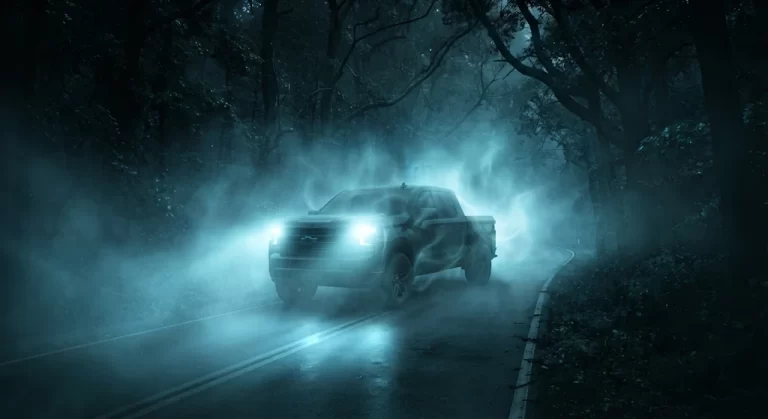
The steering wheel suddenly grew searingly hot beneath his palms. Elijah gasped, pulling his hands back with a hiss of pain, nearly swerving off the road. The tires shrieked against the asphalt as he slammed on the brakes, bringing the car to a shuddering halt in the middle of the desolate highway.
He stared through the windshield. Ahead of him, glowing red cracks began to spiderweb across the dark asphalt. Wisps of steam curled up from the pavement beneath his front tires. The air grew thick, heavy, and suffocatingly hot, smelling of burnt ohia wood and molten rock.
Elijah froze, the terrifying reality of Hawaiian folklore crashing over him.
According to the old accounts, those who see Pele in her human guise and choose to help her, show respect, or offer kindness are blessed with safe passage, good fortune, or mysterious guidance out of danger. But those who ignore her—who dismiss her, show arrogance, or turn a cold shoulder to her tests—invite the wrath of the fire goddess. Their cars break down mysteriously, accidents befall them on the winding descent, or a heavy, inescapable shadow of bad luck follows them back to their homes.
Trembling, Elijah realized his mistake. He threw the car into reverse, backing up hastily to the exact spot where he had passed her. He cut the engine, stepped out onto the cooling asphalt, and bowed his head toward the dark expanse of the crater.
“E Pele,” he whispered into the wind, his voice shaking. “Forgive me. I was in a rush. I let my own haste blind me to your presence. Aloha aku, aloha mai.“
For a long, agonizing minute, the heavy heat pressed down on him, and the glowing cracks in the road seemed to pulse with a warning light.
Then, abruptly, a cool, gentle breeze swept down from the summit of Kīlauea, carrying the sweet scent of mountain maile. The heat dissipated. The red glow beneath the asphalt faded into the dark gray of ordinary stone.
Elijah got back into his car, his hands still slightly trembling. He drove the rest of the way down Chain of Craters Road in absolute silence, deeply aware that the land he traveled upon was alive, watchful, and never truly empty.