- Stories at this place
- 3
- Filed as
 Night Marchers
Story 1152
Huakaʻi Pō
In Hawaiian folklore and cultural history, few phenomena evoke as much primal dread as the Huakaʻi Pō, or the Night Marchers. Unlike modern ghost stories designed for entertainment, the Night Marchers are rooted deeply in traditional Hawaiian kapu (sacred laws), ancient warfare, and an enduring cultural reverence for the spirits of ancestors (ʻaumākua).
The History and Backstory
Who Are the Night Marchers?
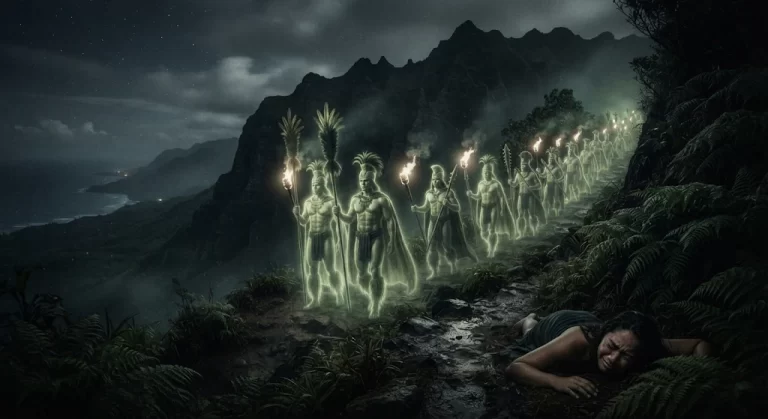
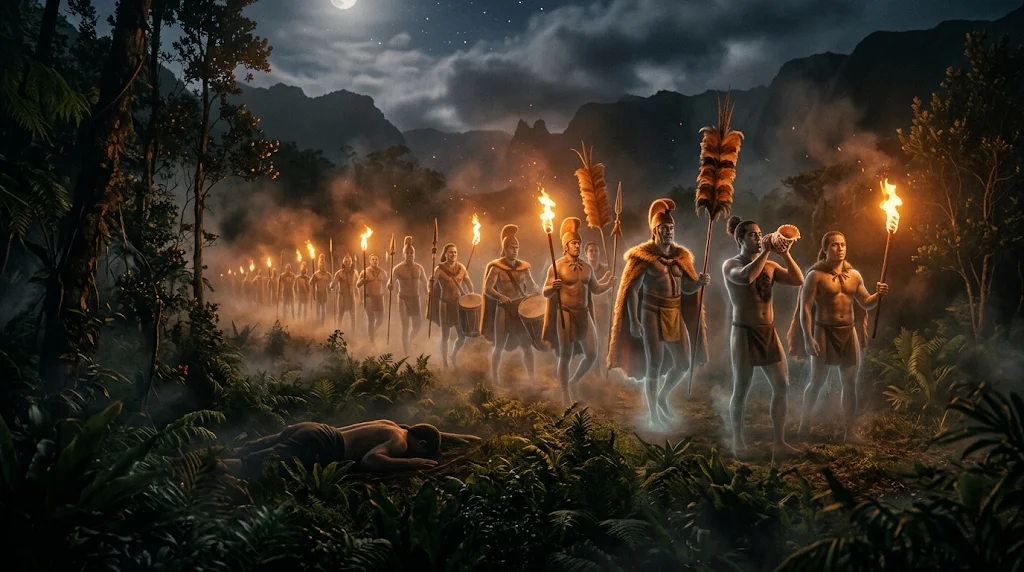
The Night Marchers are the spectral processions of ancient Hawaiian warriors—chiefs (aliʻi), priests (kahuna), and foot soldiers—returning from the netherworld to march across the islands. They typically travel along ancient trails, mountain passes, and sacred sites where battles were once fought or where aliʻi were buried.
According to tradition, the marchers are led by high-ranking chiefs whose spirits possess immense spiritual power (mana). Lower-ranking warriors and attendants follow in absolute lockstep.
The Sacred Law of Kapu
In ancient Hawaii, the social hierarchy was strictly governed by kapu. Commoners were forbidden from looking upon high-ranking chiefs, let alone casting a shadow on them or hearing their voices. The punishment for violating a chief’s kapu was absolute death.
This rule extends even into the afterlife. The ancient law dictates that if a living person crosses the path of the Night Marchers, looks directly at them, or hears their approach and fails to hide, they will be violently killed by the spirits to protect the sacred mana of the chiefs.
A Factual, Documented Account of the March
While skeptics attribute encounters to atmospheric conditions, collective hysteria, or shadows cast by moonlight through jungle canopies, generations of island residents—both Native Hawaiian and modern settlers—have reported terrifying, inexplicable encounters that defy rational explanation.
The Encounter in the Nuʻuanu Valley
One of the most famous historical regions associated with the Night Marchers is the Nuʻuanu Valley on Oʻahu, the site of the brutal 1795 Battle of Nuʻuanu, where King Kamehameha I conquered the island, driving hundreds of defending warriors off the steep Pali cliff.
In the late 20th century, a group of local construction workers and residents near the valley edge experienced an event that local historians still recount as a chilling testament to the legend.
- The Warning Signs: Shortly after midnight, the tropical trade winds completely died, plunging the valley into an unnatural, suffocating silence. Even the island’s tree frogs (coqui or endemic insects) fell entirely mute—a phenomenon locals recognize as hāʻuleʻule, a sudden drop in ambient sound.
- The Sound of War: Then came a low, rhythmic thunder vibrating through the damp earth. It wasn’t seismic; it sounded like hundreds of bare feet striking rock in unison, accompanied by the deep, hollow concussions of ancient shark-skin drums (pahu) and the low blowing of conch shells (pū).
- The Visuals: Witnesses peering through the dense jungle fog described seeing flickering torches casting an eerie, cold blue light rather than warm flame. Moving through the mist were tall, shadowy figures draped in traditional feather capes (ʻahu ʻula) and helmets (mahiole), carrying ancient weapons like shark-tooth clubs and spears.
Survival Under Kapu
In traditional lore, the only way to survive an encounter with the Night Marchers—should you be caught in their path—is to strip completely naked, lie face down on the ground, and feign death. By showing utter submission and stripping away personal identity, you signal that you are not worthy of their wrath, and the procession may pass over you without harm.
Those who claim to have survived recount smelling the distinct scent of ancient burial caves—stale earth, damp moss, and old sandalwood—lingering in the air long after the rhythmic drumming faded into the silent mountain mist.