- Stories at this place
- 9
- Filed as
 Hotel
Story 1147
Room 107 – Fear Unlimited
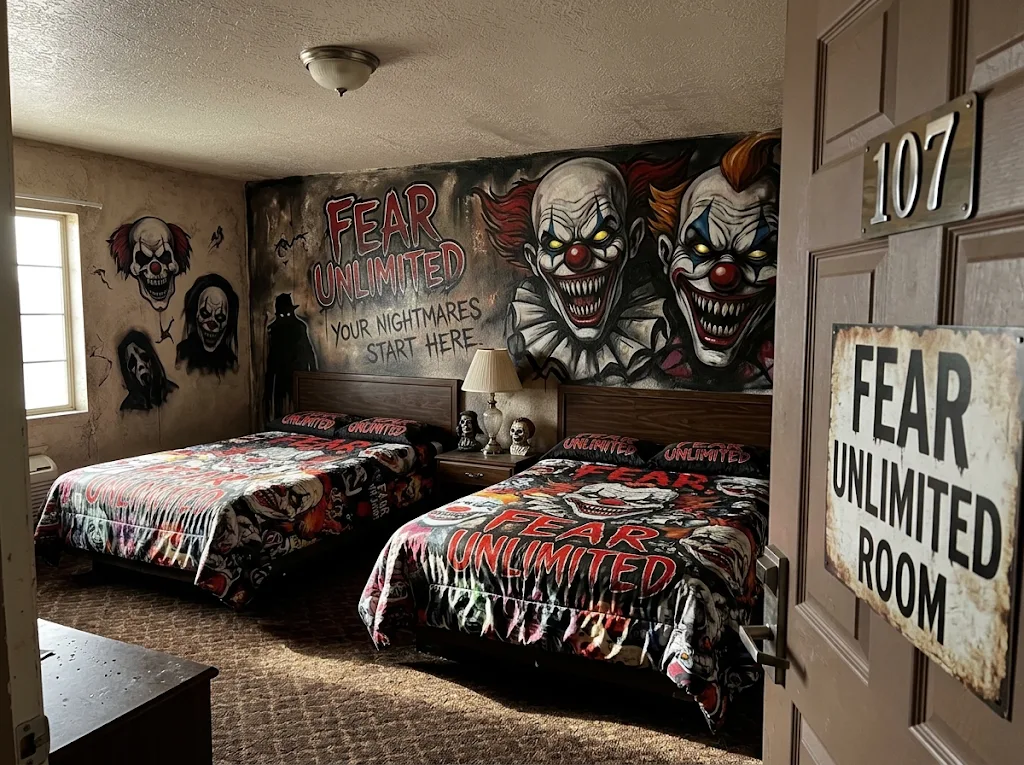
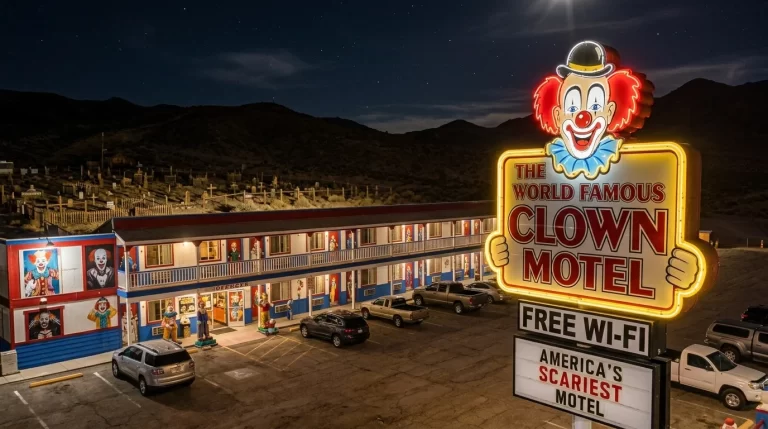
The Clown Motel in Tonopah, Nevada, sits perched on Main Street like a monument to eccentric nostalgia, staring directly across from the historic Old Miner’s Cemetery. For travelers navigating the lonely stretches of Highway 95, it is a quirky roadside beacon. But beneath the circus-themed novelty and the thousands of porcelain clowns watching from glass cases, the motel carries a darker, heavier reputation—none more infamous than Room 107.
The History and Four-Year Closure of Room 107
Built in the mid-1980s by brothers Leona and Wayne Percha—who dedicated the venture to their father, a master builder who loved clowns—the motel was destined to be wrapped in local folklore from the start. Its proximity to a graveyard where hundreds of 19th-century miners and plague victims are buried already cast a long shadow.
Over the years, Room 107 became the epicenter of the property’s paranormal lore, gaining a grim notoriety that eventually forced management to take drastic action. Following a disturbing series of not-so-pleasant occurrences surrounding sudden tragedies and unexplained deaths within its walls during the motel’s earlier years, the atmosphere in the room turned sour and oppressive. Guests reported being physically scratched, choked, or overwhelmed by an unbearable sense of dread.
Citing safety and an escalating string of dark, inexplicable incidents, management finally locked Room 107 down, pulling it from circulation entirely. For four long years, the door remained bolted shut—dusted only by passing time and avoided by staff, save for the occasional brave paranormal investigator. But as interest in the motel surged and bookings grew, management decided it was time to test the waters, freshly painting the walls, swapping out the old mattress, and officially reopening Room 107 to the public.
The Night Shift in Room 107
Leo Harris didn’t believe in ghosts. As a long-haul trucker who spent his life chasing horizons across the Great Basin, Leo believed in tired bones, bad coffee, and the quiet relief of a firm mattress. Driving south through Nevada on a moonless October night, a sudden transmission slip forced him to pull his rig off Highway 95 and look for a place to crash in Tonopah.
The motel was packed for a regional festival, and the desk clerk was apologetic, explaining they were completely booked. But when Leo mentioned he was dead on his feet and willing to take anything, the clerk hesitated, eyeing him carefully. She mentioned they had just cautiously reopened Room 107 after keeping it locked up tight for four full years following a string of grim, unexplained tragedies and deaths associated with the space.
“We just put it back in rotation,” the clerk said, dangling the heavy brass key with a nervous laugh. “Fresh paint, new sheets. Just… don’t mind the history.”
Leo just chuckled, grabbed his duffel bag, and stepped out into the crisp desert air, the flickering neon smile of the motel’s giant clown sign casting long, distorted shadows across the pavement.
Room 107 smelled faintly of fresh latex paint mixed with old cedar and dry desert dust. A single painting of a melancholic jester hung above the headboard, its painted eyes seeming to track Leo as he dropped his keys on the nightstand. Unfazed, Leo kicked off his boots, tossed his jacket on a chair, and went straight for the bathroom to splash cold water on his face.
As he dried his hands, the bathroom door—which had been propped wide open—slowly began to swing shut on its own, clicking softly into the latch.
Leo paused, staring at the brass knob. Drafty old building, he thought. He reached out, twisted the knob, and pulled the door open.
That was when the temperature in the room plummeted. The pleasant ambient warmth vanished instantly, replaced by a biting, cellar-like chill that made his breath fog in the dim light.
Before Leo could step back into the main room, a sharp, metallic tap-tap-tap echoed from the bathroom mirror. It sounded as if someone were rapping their knuckles against the glass from the other side.
Leo’s heart gave a hard thud against his ribs. He leaned closer to the mirror, his reflection staring back under the harsh yellow vanity lights. “All right,” he muttered, his voice sounding hollow. “Very funny.”
The tapping stopped. In its place came a low, grating sigh—the sound of exhausted lungs drawing a long, shuddering breath of air that hadn’t circulated in the four years the room sat locked away. Simultaneously, the faucet in the sink hissed, sputtered, and turned itself on full blast, sending freezing water splashing over the porcelain basin.
Panic, cold and sharp, flared in Leo’s chest. He jammed his hand down on the cross-handle, forcing the spigot shut. But the moment the water stopped, the overhead lights flickered violently and died, plunging the bathroom into absolute, suffocating darkness.
Feeling his way along the slick tile wall, Leo stumbled out into the bedroom, desperate to reach the door and grab his keys. But the room had changed. The darkness outside the window was no longer the quiet desert night; it pressed against the glass like a physical weight, illuminated only by the erratic, pulsing neon glow from the sign outside.
And then he heard it—the slow, heavy scuff of work boots dragging across the floor near the foot of the bed. Scuff. Drag. Pause.
Leo froze, his back pressed hard against the wall beside the door. His fingers scrambled frantically over the light switch plate, but nothing happened. In the shifting red and blue neon strobe, a tall, gaunt silhouette detached itself from the shadows near the window. It wore the vague, broad-shouldered shape of a 19th-century laborer in a heavy canvas coat, standing motionless, staring directly at him.
The air grew thick with the heavy, sickening scent of old rust and damp earth—the lingering atmosphere of the dark tragedies that had kept the room empty for forty-eight months.
“What do you want?” Leo whispered, his voice trembling despite his best efforts to stay grounded.
The shadow didn’t speak, but a sudden, violent wave of overwhelming grief and exhaustion washed over Leo, so powerful it brought tears to his eyes. It wasn’t malice he felt from the figure, but a crushing, endless sorrow—the anchor of a soul trapped far from home, bound to the earth by sudden tragedy and a door that had finally been opened again.
Without thinking, Leo swallowed his terror, straightened his posture in the dark, and spoke softly into the room. “I know you’re tired, man. I’m tired too. But your shift down here ended a long time ago. It’s time to rest.”
For a long, agonizing moment, the figure remained frozen. The neon sign outside flashed one last time, casting a brilliant red glow across the room.
In that final flash, the space at the foot of the bed was empty.
The heavy chill in the air instantly dissipated, replaced by the normal warmth of the motel room. The overhead light clicked back on with a sharp buzz, illuminating the quiet, undisturbed space. The painting of the jester hung crookedly on the wall, but otherwise, everything was as it had been.
Leo didn’t sleep that night. He sat in the armchair by the window with his boots back on, staring out at the silent, moonlit crosses of the Old Miner’s Cemetery across the street, watching the first pale streaks of dawn break over the desert horizon.
By six o’clock, he checked out at the front desk, tossing the brass key onto the counter without a word. The clerk looked up, noted the pale exhaustion on his face, and asked with a knowing grin, “Did you survive Room 107’s big comeback?”
Leo offered a tight, weary smile, picked up his bag, and walked out into the morning sun. “Yeah,” he muttered, glancing back one last time at the windows of the Clown Motel. “Might want to keep it locked for another four years, though.”