- Stories at this place
- 4
- Filed as
 Mainland Folklore
Story 1036
The Echoes Beneath the Reservoir
The water at Pineview was never completely still. Even on July afternoons when the surface of the reservoir stretched out like a plate of hammered pewter, there was a faint, rhythmic pulse beneath the buoys—a low, resonant thrum that the old-timers in Huntsville and Eden shrugged off as the old river currents shifting against the concrete footings of the dam.
Will knew better. Will was forty-two, with iron-gray hair at his temples and skin the color of well-seasoned cedar from forty summers on the Weber River. He rented pontoon boats to tourists from Salt Lake who came up through Ogden Canyon to drink lukewarm beer and scream off the back of inner tubes, but when dusk settled and the orange hulls were chained back to the dock, Will stayed out on the water.
He was looking for the schoolhouse bell.
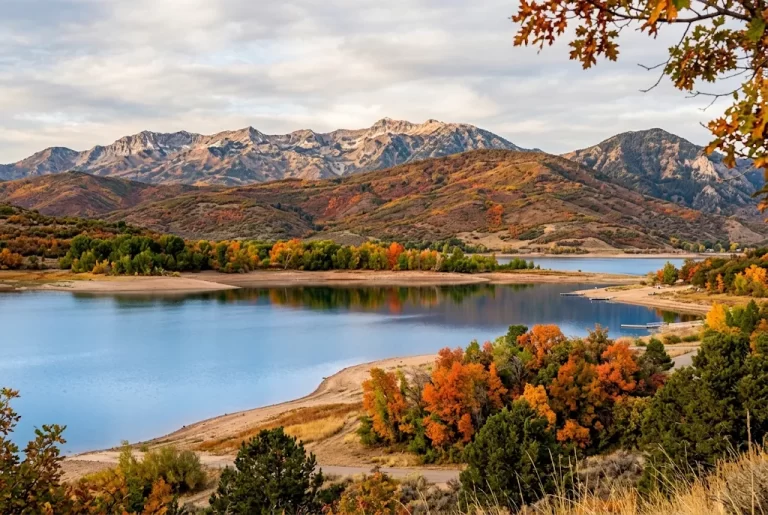
In 1937, the federal government had flooded the Ogden Valley to create water security for the sprawling rail and beet-farming town below. They called it progress. They called it the Pineview Project. But down in the silt and the drowned clover, beneath eighty feet of mountain snowmelt and summer algae, lay the original town of Huntsville—its clapboard general store, its blacksmith shop, its orchard stone foundations, and the brick-and-mortar Saint James Catholic Church.
The townsfolk had been paid pennies on the dollar and moved up the benchlands to build New Huntsville. But according to Will’s grandfather—who had been twelve when the water started rising behind the timber coffer dam—not everyone had caught the wagon.
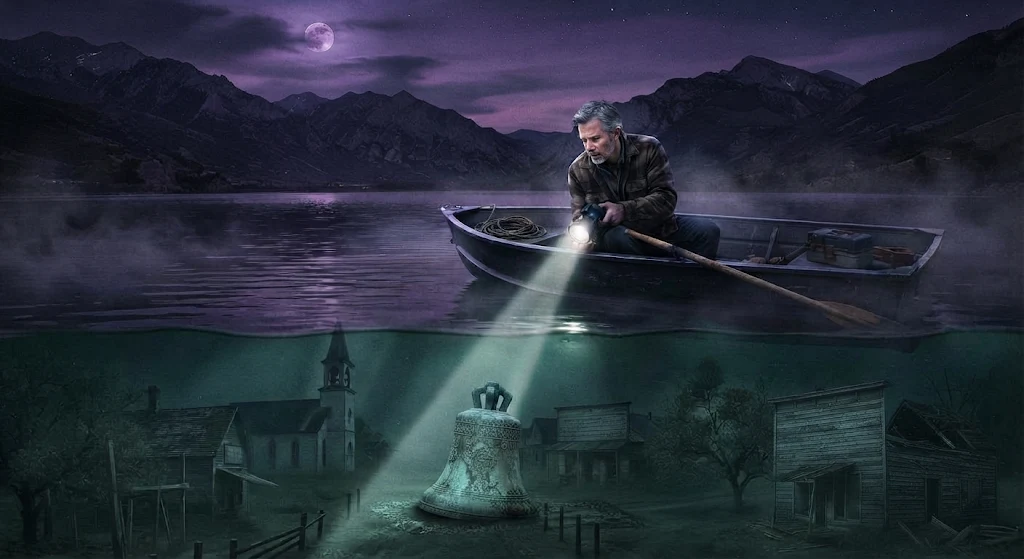
The night was unusually heavy. A bruised purple moon hung over the ridge of the Wasatch Range, casting long, bruised shadows across the water. Will sat in the stern of his aluminum skiff, his oars pulled in, listening to the small slop of water against the gunwales.
Beneath him, the reservoir was a dark, liquid cathedral.
He leaned over the side, holding a heavy halogen spotlight against the surface. The beam cut downward, turning the murky green water into an eerie, luminous shaft that faded into absolute blackness around fifty feet down. He couldn’t see the bottom—the silt stirred up by late-season drawdowns always kept the depths veiled—but he could hear it.
It started with a chime.
Clang.
It was high, clear, and unmistakable, echoing upward through the thermocline like a pebble dropped in a dry cistern.
Will held his breath.
Clang.
A second note, deeper this time, vibrating through the aluminum hull of the skiff and straight up into the soles of his boots. It was the bell in the tower of Saint James. Not rusted, not muffled by sixty years of silt, but ringing clear as a crisp October Sunday morning when the cottonwoods were turning gold.
Will reached into the tackle box at his feet and pulled out a heavy steel pry bar. He didn’t know why he brought it, except that every night for the past three weeks, the pull had been stronger. The drought had drawn the water down nearly six feet below normal pool, exposing the upper reaches of the old homestead fence lines—greasy, black posts that looked like rotted teeth biting the surface.
He pulled the oars and rowed toward the center of the bay, right above where the old town square used to sit according to the faded blueprints in the county clerk’s office.
As he drifted, the water began to change. The surface temperature, usually warm enough by August, turned instantly glacial. A plume of mist rose around the skiff, smelling not of rotting weeds or stagnant mud, but of damp cedar, lime mortar, and woodsmoke.
“You’re late,” a voice said.
Will didn’t jump. When you spend enough time listening to a reservoir, you learn that things don’t sneak up on you; they simply remember you.
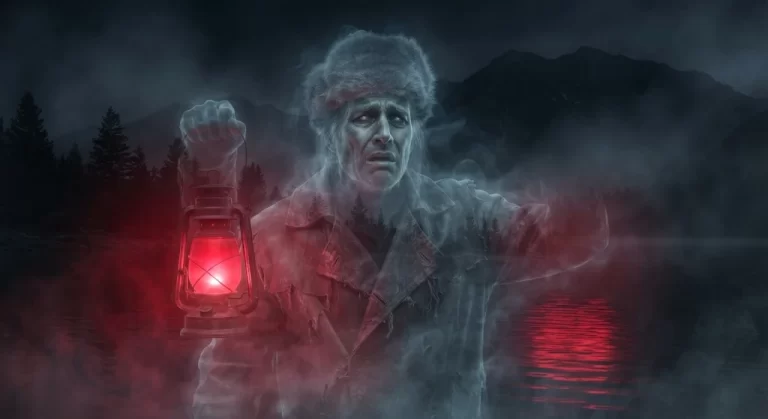
A few yards off the starboard bow, the water parted. It didn’t splash or ripple; it simply folded back like heavy velvet. Standing on the water’s surface—his boots resting an inch above the invisible floor of the drowned valley—was a man in faded denim overalls and a wool cap. His skin had the translucent, pearlescent quality of birch bark peeled after a hard winter, but his eyes were bright, sharp, and unmistakably human.
“Elijah?” Will whispered. He recognized the face from the sepia-toned photograph hanging above his grandmother’s sideboard.
“Took you long enough to row out this far,” the phantom said. His voice sounded like dry leaves scraping across a frozen sidewalk. “The bridge is choked with tamarisk. We’ve been trying to clear the road for three generations.”
“You’re not real,” Will said, though his hands gripped the gunwale so hard his knuckles turned white. “You’re just… an echo. My grandad said the basin holds sound like an old phonograph record.”
Elijah smiled, a slow, patient spreading of thin lips. He gestured down toward the dark water. “An echo doesn’t wait up, Will. An echo doesn’t remember where the blacksmith buried his silver pocket watch. You think we drowned? Water don’t kill a town. It just preserves it. Like salt in a crock.”
Will leaned over the side, his halogen light cutting down. This time, the water didn’t look murky. The silt seemed to settle, pulled away by some invisible undertow.
And there it was.
The town of old Huntsville lay stretched out below like a model train set preserved in amber. The dirt roads were still pale lines of packed alkali dust. The white paint on the general store’s sign—J.H. Taylor & Sons—was still legible under a layer of green moss. Through the clear, cold depths, Will could see figures moving between the submerged fruit trees. Women in long calico dresses walked slowly past fence lines of rusted wire, carrying empty willow baskets. Children in knee-high wool stockings chased a hoop along a lane that ended abruptly against a sheer wall of blue-black mud.
They weren’t screaming. They weren’t thrashing. They were simply living in the pause between breaths, waiting for the water to recede so they could finish their chores.
“Why didn’t you leave?” Will asked, his throat tight.
“Where was there to go?” Elijah tilted his head toward the canyon walls, where the neon lights of modern ski chalets and paved highway guardrails blinked in the distance. “Up there? Where they paved over the meadows with asphalt and turned the river into a bathtub for motorboats? Up there, you’re always rushing toward tomorrow. Down here… we’re right where we left off. The apples are always just about to turn red on the North Bench orchard.”
Elijah stepped closer, his boots making no sound as they touched the metal gunwale of the skiff. The air around him was intensely cold, carrying the smell of wet earth and winter frost. He reached out a hand, pale and slightly translucent, and touched the back of Will’s hand.
Will gasped. It felt like holding an icicle, but underneath the chill was a strange, heavy warmth—the weight of seventy years of mountain snow, deep roots, and unyielding earth.
“The dam is getting old, Will,” Elijah murmured, looking down toward the massive concrete barrier holding back millions of tons of dark water at the mouth of the canyon. “The cracks in the spillway are widening. Someday soon, the state’s going to have to drain the basin to fix the footings. They think they’ll find empty mud and old cans.”
Elijah’s eyes locked onto Will’s with fierce, quiet clarity.
“When they drop the level, don’t let them scrape the foundations. Don’t let the bulldozers in with their iron teeth. If you do… the sound will stop.”
Will looked from the phantom’s face down into the vast, silent grid of the drowned town. A church bell chimed once more—deep, resonant, and beautiful—and somewhere down in the gray avenues, a dog barked once at a moon that had set sixty years ago.
“I won’t,” Will whispered.
When the first gray streak of dawn crested over Lewis Peak, turning the upper ridges of Pineview to pale gold, Will blinked.
He was alone in the skiff. The water around him was ordinary Ogden reservoir water—green, slightly murky with suspended algae, and smelling faintly of outboard motor exhaust and sunscreen. The surface was flat as glass.
He pulled the starter cord on the outboard motor. The engine sputtered once, caught with a sharp roar, and pushed the skiff back toward the public dock.
As he tied off the bowline and hauled the anchor stone up onto the gravel beach, he looked back out across the wide, blue expanse. From the shore, it looked like just another recreation spot—a playground for jet skis and weekend campers.
But as Will walked up the path toward his truck, he felt the heavy iron key in his pocket—the key to the old county records office where the original land grants were kept. And deep beneath the bright, sunlit surface, he could still feel the faint, steady vibration of a town that refused to drown.