- Stories at this place
- 2
- Filed as
 Apparition
Story 990
The Legend of Lothar the Merchant
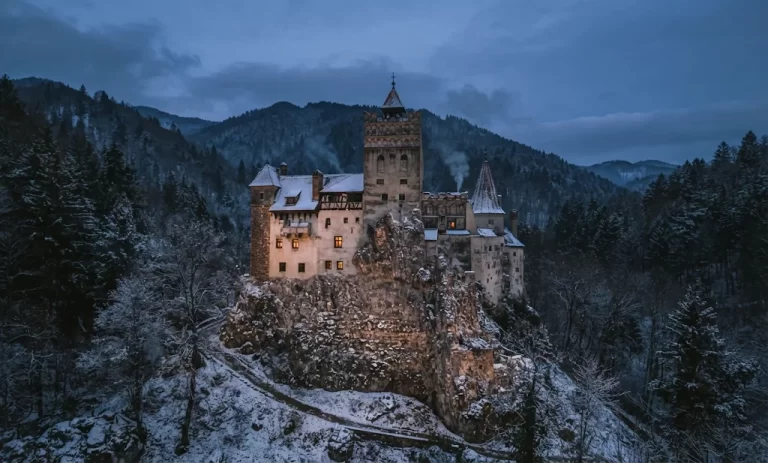
The mist that curls around the jagged limestone cliffs of Bran Pass does not merely obscure the landscape; it archives it. Long before gothic tourism and Victorian fiction turned the fortress into a global icon, Bran served as a brutal, highly regulated customs post. Built in the late 14th century by the Saxon merchants of Kronstadt (Brașov) with the authorization of King Louis I of Hungary, the castle sat squarely on the border between Transylvania and Wallachia.
Every bolt of silk, every barrel of wine, and every coin changing hands was subjected to heavy tariffs. It was a place where commerce met martial law, guarded by professional mercenaries and fiercely competitive traders who viewed the mountain pass as their private economic lifeline.
Out of this crucible of commerce, border anxiety, and deep-seated Carpathian folklore rises the legend of Lothar the Merchant—a ghost born not from royal drama, but from the ruthless ledger books of medieval trade.
History, Background, and Folklore
To understand Lothar’s ghost, one must understand the unique tension of the Bran Gorge. The Saxons who managed the toll station were famously meticulous, keeping exhaustive records of imports, exports, and transit taxes. However, the mountain pass was also vulnerable to sudden Ottoman raids, shifting political alliances, and desperate smugglers trying to bypass the heavy duties.
In local Romanian and Saxon folklore, figures who died violently or under a cloud of uncounted wealth were thought to linger as restless spirits. Furthermore, traditional beliefs regarding the strigoi (the restless undead or troubled souls of Carpathian folklore) heavily influenced how villagers perceived merchants who hoarded gold or cheated on customs. A merchant who died with an unbalanced ledger—or whose coin boxes vanished during a border skirmish—was doomed to walk the stone corridors, eternally searching for his lost inventory.
The Legend of Lothar the Merchant
The autumn of 1462 brought biting cold and high tension to the Törzburg Pass. Rumors had reached the fortress that Vlad the Impaler was clashing with his enemies further south, throwing the trade routes into chaos.
Lothar of Nuremberg, a wealthy and notoriously avaricious Saxon merchant, had pushed his caravan hard through the fog to reach the safety of Bran’s customs house before the winter gates were barred. His wagons were laden with precious goods: Flemish wool, fine Rhenish glassware, and a heavy iron-bound chest filled with gold florins intended to buy entire vintages of Wallachian wine.
Lothar was a man who trusted numbers more than God. When the castle’s chief bailiff calculated a tariff that cut deeply into Lothar’s projected profits, the merchant flew into a rage. Rather than paying the lawful tax, Lothar bribed a low-ranking mercenary guard to help him stash a portion of his gold in one of the castle’s narrow secret communication conduits—a concealed vertical shaft built into the stone core used by guards to move silently between levels.
Greed, however, has a short shelf life in a fortress built for war. Before dawn, word came that a band of raiders was swarming up the lower gorge. The castle bells rang, the heavy timber portcullises were dropped, and the internal staircases were suddenly sealed off to secure the keep.
Lothar rushed back into the secret stone labyrinth to retrieve his hidden chest of gold, desperate before the garrison locked the zones down. But the medieval masonry of Bran is a trap for the uninitiated. A sudden shift in the iron-bolted internal doors—or perhaps a heavy slab dropped by guards sealing the lower tiers against intruders—jammed the stone passage.
Lothar was trapped inside the vertical wall.
For days, soldiers manning the lower levels reported a strange, muffled scraping sound echoing through the stone—not the rhythmic thud of boots, but the frantic scratching of fingernails against mortar. By the time the internal garrison cleared the passage weeks later, they found no trace of Lothar, nor his gold chest. The coin was gone, swallowed by the mountain, and the merchant had vanished into the damp limestone.
The Ghost in the Mist
Ever since, on nights when the fog rolls thick up the Bran Gorge and the wind howls through the narrow arrow-slits, the ghost of Lothar is said to awaken.
Visitors and night-watchmen through the centuries have reported distinct anomalies:
- The Metallic Chink: A sharp, metallic sound resembling coins being dropped onto cold stone, echoing from behind solid castle walls where no rooms exist.
- The Ledger Scrape: A soft, dry rustling noise—like parchment pages being furiously turned in an empty, draft-free gallery.
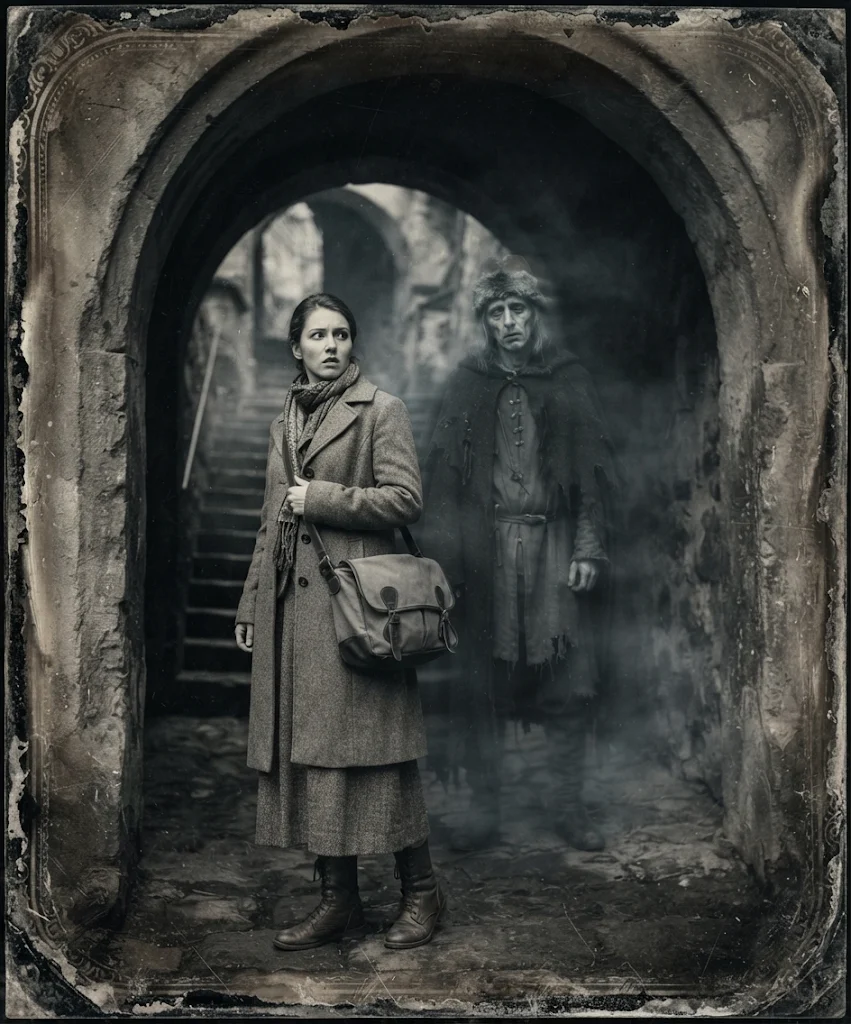
- The Figure in the Wall: A shadowy silhouette dressed in a heavy, fur-lined merchant’s doublet of the 15th century, pacing restlessly near the internal stairwells before dissolving into the mist like breath on winter glass.
Lothar remains the embodiment of the merchant’s eternal curse: surrounded by stone walls that once protected his wealth, forever auditing a ledger that can never be balanced.