- Stories at this place
- 1
- Filed as
 Hotel
Story 795
Moana Surfrider, A Westin Resort & Spa
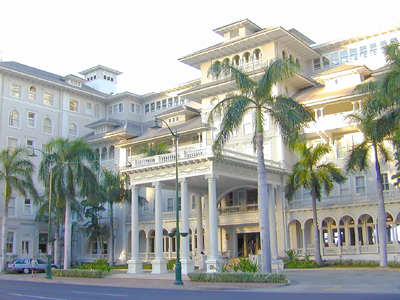
The grand and stately Moana Surfrider, A Westin Resort & Spa, Waikiki Beach Click to open side panel for more information stands as the crown jewel of Kalākaua Avenue, proudly holding the title of Waikīkī’s oldest operating hotel. Often referred to as the “First Lady of Waikīkī,” this gleaming white architectural marvel blends turn-of-the-century Victorian elegance with island luxury. But beneath its graceful colonial-revival pillars, open-air courtyards, and the sheltering branches of its legendary historic banyan tree lies a rich tapestry of history—and some of the most persistent ghost stories in the Hawaiian Islands.
History and Background: The First Lady of Waikīkī
Long before the hotel was built, the land was known as Kaukamalumalu, a cool, shaded resting place favored by Hawaiian royalty, including Prince Kuhio and Princess Ruth Keʻelikōlani.
In the late 19th century, visionaries sought to transform Waikīkī from a marshy wetland into a world-class resort destination. Enter businessman Walter C. Peacock, who envisioned a grand hotel on the beachfront. Designed by architect Oliver G. Traphagen, the hotel officially opened on March 11, 1901. At a cost of $250,000—a staggering sum at the time—the Moana offered guests unprecedented luxuries, including the territory’s first electric elevator, private bathrooms in every room, and telephone service. Its iconic centerpiece, a magnificent Indian banyan tree planted in the courtyard in 1904, grew into a natural sanctuary that has shaded generations of travelers.
Over the decades, the resort expanded significantly with the addition of the Surfrider and Tower wings, yet the original 1901 historic wing—known as the Banyan Building—retains its classic charm, sweeping staircases, and old-world romance.
Is It Haunted? The Legend of the “First Lady in White”
With more than a century of history welcoming travelers from across the globe, the Moana Surfrider has accumulated its fair share of ghost lore. The most famous and enduring paranormal resident is known as the “First Lady in White.”
The legend traces its roots back to 1918, during a time when the hotel hosted wealthy long-term guests seeking tropical rejuvenation. Jane Stanford, co-founder of Stanford University and a frequent visitor to the islands, was staying in a suite on the second floor of the hotel. On the evening of February 28, 1918, she passed away under mysterious circumstances within her room. While official accounts pointed to strychnine poisoning, the abrupt and tragic nature of her passing left an indelible emotional imprint on the historic hallways.
In the years following her death, guests and staff in the Banyan Wing began reporting sightings of an elegant woman dressed in a flowing white Edwardian gown. Witnesses describe her wandering quietly down the second-floor corridors, gazing out toward the ocean from the grand balconies, or softly rustling the silk of her dress before dissolving into thin air. Unlike aggressive poltergeists, the “First Lady in White” is generally perceived as a gentle, serene presence—perhaps a restless spirit still captivated by the timeless beauty of the Pacific.
Modern Encounters and Spectral Footprints
Paranormal investigators and hotel staff note that uncanny occurrences are not limited to the historic upper floors. Guests staying in rooms near the interior courtyard have reported hearing phantom footsteps pacing the wooden verandas late at night, or the faint, echoing strains of 1920s jazz music drifting through the air when the courtyard is completely empty.
Some visitors have awakened to the gentle sensation of someone sitting on the edge of their bed, only to find the room entirely vacant. Security guards doing late-night rounds have occasionally reported shadowy figures standing beneath the sprawling canopy of the historic banyan tree, staring out at the moonlit waves before disappearing into the mist.
Whether viewed through the lens of folklore, grief, or the lingering energy of a bygone era, these ghostly accounts add an extra layer of mystique to the Moana Surfrider. Today, as guests sip afternoon tea beneath the banyan tree or watch the sunset paint the Pacific sky, they share space not just with modern luxury, but with the ghostly echoes of an unforgettable past.