- Stories at this place
- 1
- Filed as
 Mainland Folklore
Story 1169
The Whispering Woods
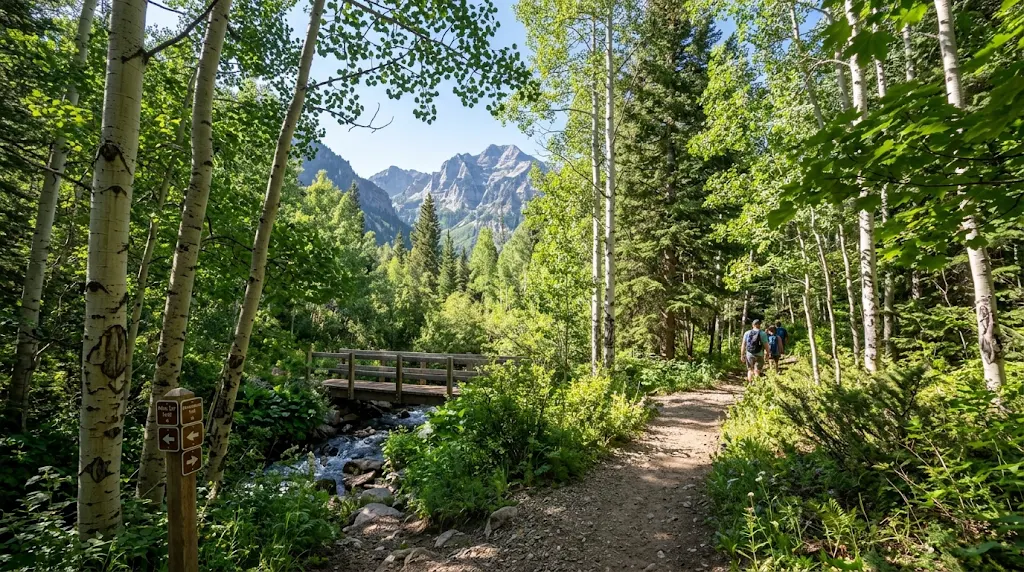
If you spend enough time deep in the Wasatch Mountains above Ogden, Utah, you learn to trust a very specific kind of quiet. Miles past North Fork Park, pushing up the high drainage toward Ben Lomond Peak where cell service dies completely, the canyon settles into a steady rhythm. You get used to the wind threading through dense stands of pine and aspen, the sharp snap of a twig under a foraging mule deer, and the occasional heavy exhale of a bedded elk.
Out there, you start to believe you know the rules. You tell yourself that with the right gear, a topo map, and a healthy respect for the backcountry, you’re safe.
I used to believe that, too—until an October backpacking trip three years ago, deep in the rugged timber northeast of Ogden. People love to swap campfire stories about what hides in these Utah mountains: cryptids, local legends, things that go bump in the dark. What I found out there was infinitely worse. The most terrifying thing in the deep woods isn’t supernatural. It’s flesh and blood, and it knows how to hunt.
It was the second day of a five-day trek. My buddy Mark and I had pitched camp in a natural clearing six miles up a steep, forgotten drainage well off the main trail system. On paper, it was a dream site: a cold runoff stream twenty yards from our tents, a thick canopy of old-growth conifers breaking the wind, and absolute solitude. We hadn’t seen another boot print in forty-eight hours.
We spent the afternoon unwinding—taking in the view of the opposite ridges, eating freeze-dried dinners, and packing our daypacks for the morning push to the ridgeline. By nine o’clock, the campfire had collapsed into a pulsing bed of coals, throwing amber light against the surrounding pine trunks. The temperature dipped into the high thirties under a vast sheet of stars framed by the canyon walls. There was no unease, just the satisfying, bone-deep exhaustion of a hard climb. We zipped into our tents, kicked our boots into the vestibules, and fell asleep to the breeze rustling the dry oak brush.
I woke up somewhere between two and two-thirty in the morning.
Nothing jolted me awake. There was no scream, no crashing branch—just a sudden, suffocating shift in the air. The canyon had gone dead silent. Even the crickets had stopped.
Then I heard it.
Thud.
A heavy, measured impact against the dirt. Not the quick, skittering steps of a coyote or the light trot of a deer. There was massive weight behind it.
Thud.
Slow and deliberate, circling the perimeter of our camp. I lay frozen in my sleeping bag, straining to listen as my pulse hammered against my ribs.
Thud.
It stopped right outside Mark’s tent, barely ten feet from mine. I braced for the huffing of a black bear sniffing our packs, or the rip of claws on nylon. Instead, a sound drifted through the dark that turned my blood to ice: a slow, wet, unmistakably human sigh, followed by the soft drag of heavy hide or coarse fabric scraping across pine needles.
“Mark,” I whispered into the dark between our tents.
Nothing. He was out cold.
I forced myself to rationalize it. It’s an elk, I told myself, staring up at the black curve of my rainfly. Bull elk wander into high-elevation camps all the time looking for salt or water. Or maybe it was a bold black bear. I waited five agonizing minutes, every muscle locked, ready to bolt. The footsteps never resumed. Slowly, the mountain came back to life—a distant owl, a faint draft sliding down the ravine. Convinced I had let my imagination run away with me, I exhaled and eventually slipped back into a thin, restless sleep.
Morning light broke sharp and golden over the eastern ridge, burning off the ground frost. Stepping out with a mug of instant coffee, the ordinary routine felt grounding. Mark unzipped his tent a minute later, rubbing his eyes and yawning.
“Sleep alright?” he asked.
“Not really,” I said, gesturing toward the fire pit. “I think we had a visitor last night. Sounded like an elk or a bear circling the tents.”
Mark chuckled and walked over to check our food hang. “Didn’t hear a thing. You must’ve been dreaming—”
He cut off mid-sentence, his posture going rigid.
“What?” I asked, crossing the clearing to join him.
At the edge of the trees, where damp soil met the moss, sat a footprint. It was easily sixteen or seventeen inches long and impossibly wide across the forefoot, with deep, distinct impressions where bare toes—or something wrapped in thick, crude bindings—had gripped the mud. There were no claw marks. Just a clean, bipedal print driven deep into the earth by terrifying weight.
Mark looked up at me, the color draining from his face. “That’s not a bear.”
We spent the next twenty minutes tracking the clearing. It wasn’t a lone print. A clear trail emerged from the steep timbered slope, stopped directly beside Mark’s tent wall where I’d heard the sigh, and angled back into a dense tangle of deadfall. My stomach soured as every rational excuse fell apart. No hiker walks barefoot through freezing mud in October. No bear leaves a stride that long on two legs.
“Should we pack out?” Mark asked, his voice tight, all his usual bravado gone.
I glanced at the map, then up toward the ridge leading back to North Fork. We were six miles in. Breaking camp meant blowing the whole trip and feeling like fools back in town. “It’s probably some off-grid hermit,” I said, trying to convince myself as much as him. “A local living up in the Wasatch. People like that do weird stuff to scare campers away from their spots.”
We decided to stay, though the peace of the camp was shattered. Every snapping twig made us flinch.
Neither of us slept that second night. We left a propane lantern burning low on a stump outside, a feeble defense against the pitch-black canyon. Around midnight, the wind died, the temperature plunged, and that same heavy, unnatural silence rolled back in.
Then came the warning.
Fifty yards up the timbered slope, hidden in the blackness of the Douglas firs, a voice rang out. It didn’t sound like a normal shout—it was warped and muffled, like a man forcing air through a wool blanket or a metal pipe, straining into a raw, guttural pitch.
“Get… out.”
The words echoed flatly down the drainage, stripped of any normal human cadence.
Mark lunged for his pack and drew his heavy-caliber sidearm. The metallic clack of him chambering a round sounded deafening in the quiet.
“Who’s there?!” Mark shouted into the trees, his voice cracking. “I’m armed! Get the hell out of here!”
No answer. Only the slow, deliberate crunch of something heavy shifting its weight higher up the ridge.
We stayed awake inside our tents, gripping flashlights and sweeping the beams across the nylon walls. Every shadow beyond the dying lantern looked like a pair of shoulders waiting just out of reach.
At 3:15 AM, the nightmare closed in.
There were no footsteps this time—just the dry whisper of fabric brushing against fabric right outside my tent. Something leaned its full, crushing weight against the wall directly behind my head. I went completely still, terrified to even draw a breath.
A massive shadow blotted out the faint moonlight filtering through the canopy. A hand pressed against the mesh window: a broad, oversized palm with thick, calloused fingers caked in dried black mud and matted, coarse fibers. Slowly, the fingers curled inward, dragging down the screen. Then came the breathing—wet, ragged, and heavy, just inches from my face.
In that instant, the last of the mystery vanished. This wasn’t a cryptid. This wasn’t folklore. It was a massive, unhinged man draped in animal pelts or a crude ghillie suit, stalking us in the dark like a predator testing its prey before the kill.
Adrenaline tore through the paralysis. Without thinking, I lunged sideways and drove the heavy aluminum base of my trekking pole straight into the mesh, slamming it into whatever was pressed against the outside.
A startled, animalistic roar—half human grunt, half raw fury—exploded in the dark.
Outside, Mark’s tent zipper tore open. A blinding white flash lit up the clearing as he fired a warning shot straight into the sky, the crack echoing off the canyon walls like artillery.
“Move! Move!” Mark screamed.
I burst out of my tent, stumbling over my boots, my flashlight beam slashing wildly through the smoke and trees. For a split second, caught in the fading light, I saw him: a towering, hulking silhouette draped in dark, rotting pelts and burlap, sprinting upright into the brush with terrifying agility, smashing straight through deadfall as if it weren’t there.
We didn’t break camp. We left our tents and sleeping bags behind, grabbed our packs, sidearms, and keys, and ran six miles down that mountain trail like our lives depended on it—because they did.
We reached the trailhead at 5:30 AM, lungs burning, hands shaking so badly we could barely get the truck unlocked. We drove straight into Ogden, went to the Weber County Sheriff’s Office, and led deputies back up the drainage later that morning.
What they found confirmed the worst of it.
A hundred yards up the ridge, camouflaged into a rock outcropping, sat a makeshift lean-to. Inside were items stolen from hikers and campers over the previous two seasons—knives, jackets, empty ration tins—alongside crude, handmade traps.
The lead deputy pulled me aside before we headed down, his expression grim. “You two are lucky you fired that shot,” he said. “We’ve been getting reports for a couple of years about an individual living off-grid up here. Severe mental detachment. He doesn’t want anyone on his mountain. He uses heavy boots, stilts, or bear-skin wraps to mess with people—makes them think it’s something else so they stay away.”
I haven’t been back to the backcountry above Ogden since that October. People still ask me if I believe in Bigfoot whenever Utah’s mountain legends come up. I just offer a hollow smile. Because when someone describes heavy footsteps, massive prints, and strange voices in the deep woods, I don’t picture a monster. I think of the dark Wasatch timber, and the things that choose to live where no one can hear you scream. And I wonder, sitting safely at home, if the scariest thing out there isn’t something undiscovered—but someone human, waiting in the dark for you to drop your guard.