- Stories at this place
- 2
- Filed as
 Apparition
Story 1029
The Voice at Waterfall Canyon
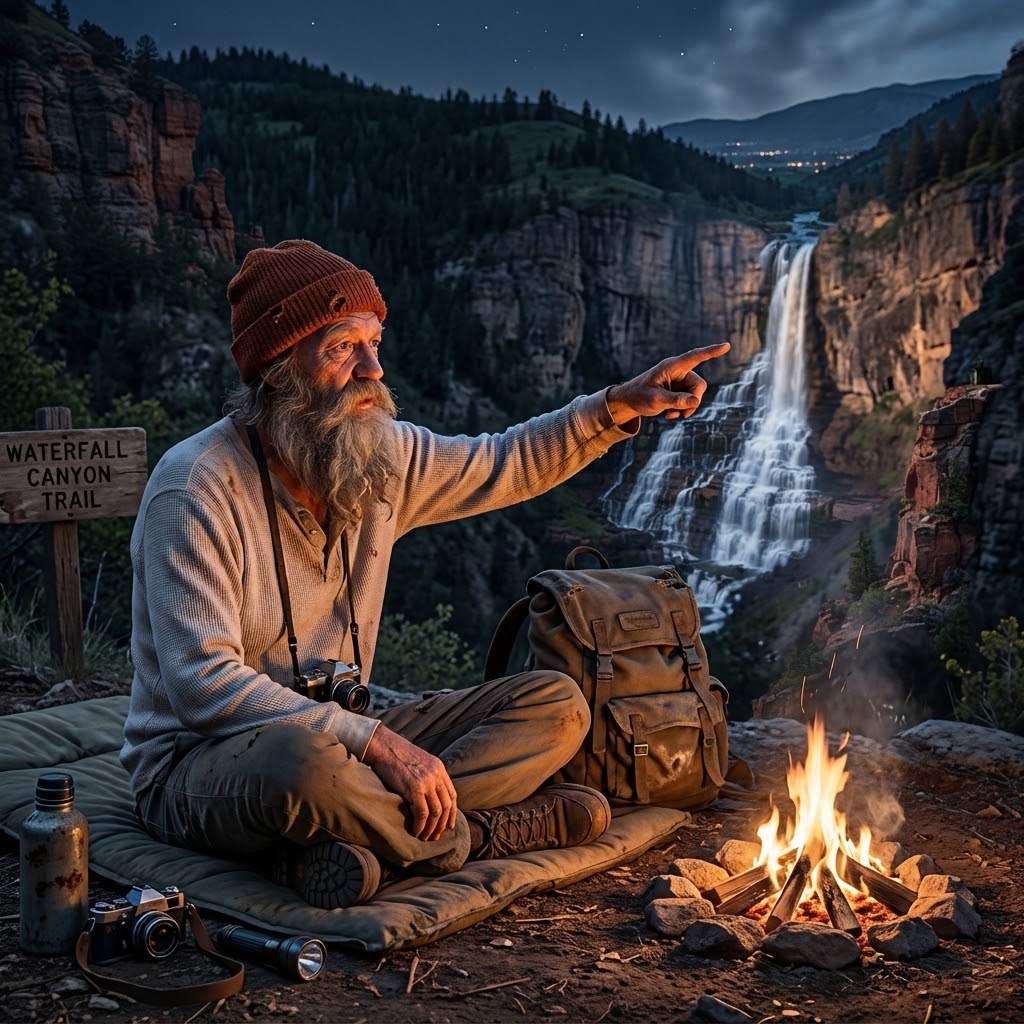
The fire crackled, spitting orange sparks up into the cool mountain air of the Wasatch Front. Around the circle, the shadows of the pine trees stretched long and claw-like in the flickering light. Old man Charles leaned forward, resting his forearms on his knees, his weathered face catching the amber glow. He pulled a worn tin cup from his hand, took a slow sip of coffee, and lowered his voice so the teenagers across the fire had to lean in to hear him.
“You kids love hiking up to Waterfall Canyon during the day,” Charles began, his voice a low, gravelly hum. “You see the spray catching the sunlight, you take your selfies, and you think it’s just a pretty spot in the hills above Ogden. But none of you ever stay past dark. And there’s a damn good reason for that.”
He tossed a small dry twig into the flames, watching it blacken and catch.
“Decades ago, long before the trails were mapped out with neat little yellow blazes, the canyon was a wilder, lonelier place. Back in the autumn of 1928, a young woman named Clara walked up into these very foothills. She was waiting for a man who had promised to meet her by the base of the falls—a prospector who swore he’d struck it rich up in the peaks and was coming back to take her away.
“Clara waited. She sat on the slick limestone boulders as the sun dipped behind the ridge and the temperature plummeted. But her fiancé never showed. What she didn’t know was that his mule had thrown him over a jagged drop-side miles further up the canyon hours earlier. He was already dead in a ravine.
“Clara sat there in the dark, listening to the roar of the water, watching the shadows close in. People say the grief and the freezing mountain air broke something inside her. Or maybe it was the canyon itself—the Wasatch has a way of swallowing people who stay too long after the sun goes down. By morning, Clara was gone. They found her shawl snagged on a briar bush near the churning pool at the bottom of the falls, but they never found a trace of her.”
A sudden gust of wind rustled the pine needles overhead, making the teenagers glance nervously into the dark woods surrounding the campsite.
“Ever since that night,” Charles continued, his eyes reflecting the fire, “the locals call it the Ogden Whispering Waterfall. If you hike up there when the moon is thin, long after the park gates are locked, you won’t just hear the sound of the creek.
“First, the roar of the waterfall seems to drop away, fading into a strange, heavy silence. Then, you’ll hear it—a soft, breathy voice calling out over the rush of the water, whispering names. ‘Is that you?’ it asks. Or sometimes, ‘You’re late.’
“They say if you answer back—if you’re foolish enough to speak to the dark or say your own name—the rushing water will change tone, sounding less like a creek and more like frantic, weeping footsteps splashing across the rocks, closing in on you from behind.”
Charles paused, letting the silence stretch out, punctuated only by the crackle of the campfire and the distant, rushing murmur of the creek down in the canyon.
“So,” Charles whispered with a faint, grim smile, leaning back into his camp chair as the kids nervously eyed the dark trailhead just beyond the camp’s perimeter. “Who’s up for a midnight hike?”
For a second, nobody moved. The teenagers sat frozen around the fire, the amber light dancing over wide eyes and tense shoulders.
Then, fourteen-year-old Toby broke the spell by letting out a nervous, high-pitched laugh. “Come on, Charles. You’re full of it. It’s just wind bouncing off the canyon walls.”
Charles didn’t smile. He just stared into the embers, the red glow catching the deep lines around his eyes. “Is it?” he asked softly. “My brother went up that trail in the summer of ’74. He laughed just like that. Said he was going to prove old man Miller—that was my uncle—was just spinning fairy tales to keep kids out of the watershed. He took a flashlight and a cassette recorder and marched right up the dark path alone.”
Charles took another slow sip from his tin cup, the metal clinking faintly against his teeth.
“We waited at the bottom for three hours,” Charles continued, his voice dropping an octave. “Around midnight, the wind died completely. Not a leaf stirred. And then, floating down from the mouth of the canyon, clear as day over the dry creek bed, we heard a voice on the wind. It wasn’t my brother’s voice. It was a woman’s, high and thin, asking, ‘Are you the one?’ And right after it… my brother yelled back, ‘No, leave me alone!’“
The teenagers stopped breathing. Even Toby’s smirk vanished.
“When he stumbled back into camp twenty minutes later,” Charles whispered, leaning forward so the firelight caught just the sharp edge of his jaw, “he wasn’t carrying his flashlight. His jacket was soaked from head to toe in freezing water—even though there hadn’t been a drop of rain for a month. And to the day he died fifty years later, he never spoke another word about what he saw standing behind the veil of that waterfall.”
Charles let out a long, slow breath, leaning back into his chair as the fire hissed and popped, sending a fresh flurry of sparks up toward the black canopy of the sky.
Suddenly, a sharp crack echoed from the edge of the clearing—the distinct sound of a heavy boot snapping a dry pine branch just beyond the ring of firelight.
Every head around the campfire snapped toward the dark mouth of the trail.
For a long, agonizing moment, amongst the silence a soft, breathless sound drifted into the camp on a sudden gust of icy air.
‘They though it said You’re late.’
Nobody laughed this time.