- Stories at this place
- 2
- Filed as
 Apparition
Story 1011
The Walking Man of Ogden Canyon
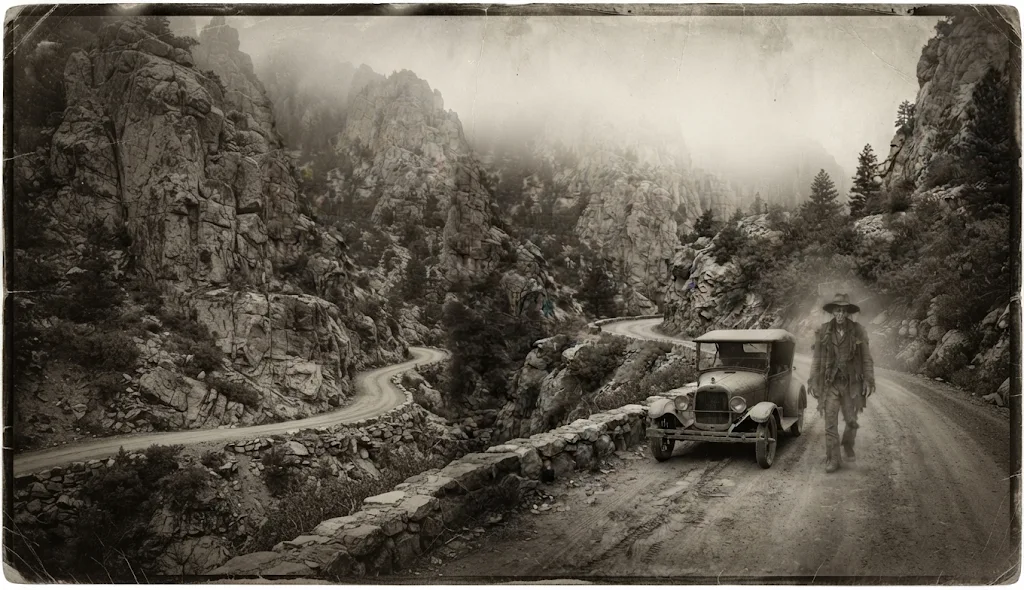
The jagged, towering walls of Ogden Canyon have carved a deep, dramatic path through the Wasatch Mountains of Utah for millennia. Long before it became a scenic corridor connecting Ogden to the sprawling splendor of the Ogden Valley, the canyon was a rugged conduit for fur trappers, railroad workers, loggers, and travelers navigating its treacherous, winding roads.
With such a heavy history woven into steep cliffs, roaring river currents, and isolating winter snows, it is little wonder the canyon gave birth to one of Northern Utah’s most persistent local folklore legends: The Walking Man of Ogden Canyon.
The History Behind the Canyon
To understand the folklore, one must look at the physical reality of the canyon itself. In the late 19th and early 20th centuries, Ogden Canyon was a lifeline of industry and transit. Wagons laden with timber, stone, and supplies—and later, automobiles navigating narrow, unpaved shelf roads—faced sheer drop-offs and sudden, blinding mountain weather.
Winter storms could trap travelers for days, and rockslides were a constant, deadly hazard. Many who walked the canyon’s edge did so out of grueling necessity, braving biting winds and pitch-black nights where the only illumination came from the faint glow of the moon slicing through the narrow gorge. In those days, a lone traveler stranded miles from the mouth of the canyon or the warmth of a mountain lodge faced perilous odds.
The Legend of the Walking Man
Local folklore speaks of a solitary figure—The Walking Man—who appears only to drivers and late-night hikers along the darkest stretches of the canyon road.
According to regional accounts, the Walking Man is a tall, shadowy silhouette clad in old-fashioned, heavy winter garb or a weathered coat, reminiscent of the laborers and wayfarers of a century past. He is always seen walking steadily uphill, moving deeper into the canyon against the flow of traffic, his head bowed against an invisible wind.
Drivers navigating the bends report a sudden, unnatural drop in their car’s interior temperature just before their headlights sweep across a man walking uncomfortably close to the shoulder. What unnerves witnesses most is his absolute persistence: no matter how late the hour, how severe the mountain freeze, or how desolate the stretch of highway miles away from any town, the Walking Man keeps his rhythmic stride.
Drivers who slow down or pull over to offer assistance find themselves met with a chilling phenomenon. As the vehicle comes to a halt, the figure vanishes entirely into the pitch-black void of the canyon wall or over the rocky drop-off toward the rushing river below, leaving behind only the echo of heavy footsteps fading into silence.
How the Folklore Came to Be
Folklorists and local historians suggest that the legend of the Walking Man is a composite manifestation of the canyon’s turbulent past. He represents the collective ghost of all the nameless laborers, freezing prospectors, and stranded travelers who lost their lives to the harsh elements of the Wasatch Range.
Over generations, stories of men who perished in winter blizzards while trying to walk out of the canyon morphed into a localized urban legend. To the people of Weber County, the Walking Man serves as a spectral guardian—or a haunting reminder—of the thin line between civilization and the unforgiving wilderness that looms just beyond the city lights.
Today, locals still caution teenagers and night drivers traversing the curves of Ogden Canyon: if you see a lone traveler walking the shoulder in the dead of night, keep your eyes on the road and do not look back in your rearview mirror to see if he is still following.